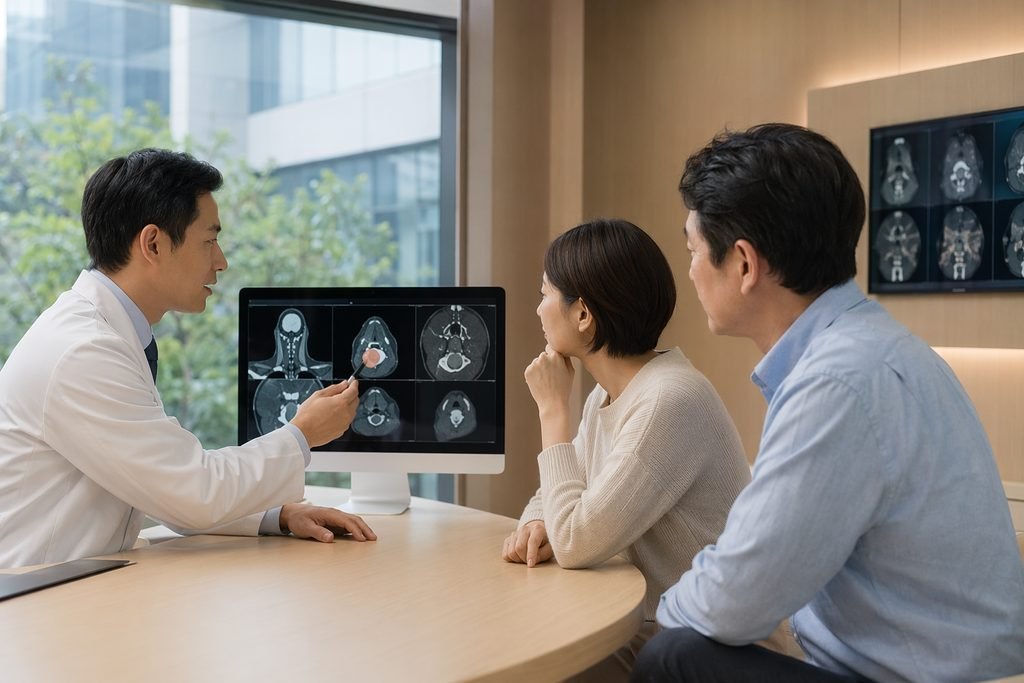
What proton therapy is actually able to address
Proton therapy is a form of external radiotherapy. Instead of X-rays, it uses protons to deliver dose to a target. That physical difference matters because protons can be shaped to deposit most of their energy at a chosen depth and then stop, rather than continuing through the body. The clinical question is not whether protons are 'better' in general, but whether this dose distribution helps in your particular situation.
The treatment can address tumours and some non-cancerous conditions where a doctor judges that sparing nearby healthy tissue is important. Examples discussed in clinical practice include certain tumours near the brain, spine, eye, base of skull, or in children, and some prostate, lung, liver and head-and-neck cancers. The exact list changes with evidence and with each centre's experience, so treat any list as a starting point for a conversation, not as a promise.
What proton therapy cannot do is equally important. It cannot treat cancer that has spread widely through the body, because radiotherapy acts locally. It cannot replace surgery or chemotherapy when those are the appropriate treatments. It cannot guarantee a cure, and it cannot remove the ordinary risks of radiotherapy, such as effects on skin, fatigue, or nearby organs, though the pattern of those risks may differ from X-ray treatment.
It also cannot be arranged simply because a patient prefers it. Every proton centre has to decide whether the indication, the stage, the prior treatment history and the technical feasibility fit what it can safely deliver. That decision belongs to the treating clinicians, not to a coordination service.
Why individual assessment decides suitability
Two patients with the same diagnosis can receive different recommendations. A tumour's size, location, closeness to critical structures, previous radiotherapy, and the patient's overall health all change the calculation. A lesion that sits against the spinal cord may be a strong candidate; a similar tumour elsewhere may be treated just as well with modern X-ray techniques.
This is why the phrase 'not every patient benefits' is not a disclaimer but the central clinical fact. Proton therapy is one tool among several. Sometimes it offers a meaningful advantage in sparing healthy tissue. Sometimes the advantage is small or uncertain. Sometimes another approach is safer or more effective. A centre that accepts you should be able to explain which of these applies and why.
For an overseas patient, the practical consequence is that you cannot decide from a brochure. You need a review of your actual imaging, pathology and treatment history by clinicians who deliver proton therapy. That review produces an opinion about the treatment goal and the technique, and it may also say that protons are not the right choice for you.
The questions that reveal whether a centre can help
When you contact a proton centre in China, ask questions that force a specific answer rather than a general welcome. The first is: what is the intended treatment goal in my case? Curative intent, control of a local recurrence, or symptom relief are different aims, and they lead to different plans and different expectations.
The second is: what would proton therapy spare compared with the alternative you would otherwise recommend? A useful answer names the organ or structure at risk and explains the trade-off. If the answer is vague, ask for the comparison in writing.
The third is: does your centre accept my diagnosis and stage for proton treatment? Acceptance is a clinical decision. A centre may treat a condition in general but decline your specific case because of prior radiation, pacemaker, metal implants, inability to lie still, or other factors. Ask directly whether your case has been reviewed and accepted, and by whom.
The fourth is: what planning and preparation does your centre require before treatment starts? Proton planning typically involves imaging in the treatment position, sometimes a custom mask or immobilisation device, and a planning scan. The number and timing of these visits vary by centre and case. Ask how many visits are expected, whether they can be grouped, and what happens if the plan needs adjustment.
The fifth is: how many treatment sessions are planned, and over what period? Fractionation differs by diagnosis and protocol. Do not assume a fixed number. Ask for your planned schedule in writing so you can plan accommodation and any companion's stay.
The sixth is: what follow-up do you recommend, and can it be shared with my doctors at home? Follow-up after radiotherapy often involves imaging and clinical review at intervals. The receiving team at home should be involved early so that responsibility for later scans and symptoms is clear.
What proton therapy cannot resolve, even when it is appropriate
Even when proton therapy is the right local treatment, it does not address disease outside the treated volume. If there is a risk of microscopic spread, your oncology team may recommend systemic treatment such as chemotherapy, targeted therapy or immunotherapy alongside or after radiotherapy. Protons do not replace those.
It also does not remove the need for multidisciplinary decisions. A radiation oncologist, medical oncologist, surgeon and sometimes a paediatric or neuro-oncologist may all need to contribute. A single opinion, however expert, may not cover staging, systemic options and reconstruction or rehabilitation needs.
Finally, proton therapy does not guarantee a better outcome than other radiotherapy. The evidence for benefit is strongest in specific situations, and it continues to evolve. A centre should be willing to tell you when the evidence for an advantage is uncertain, and what that uncertainty means for your decision.
Records and preparation that make a review possible
A useful review needs more than a diagnosis. The centre will want to see imaging in a usable format, usually DICOM files on disc or through a secure transfer, not photographs of a screen. It will want the pathology report, operative notes if you have had surgery, and a summary of previous radiotherapy with dose information if available.
A short clinical summary in English or Chinese helps: current symptoms, treatments to date, medicines, allergies, and the specific question you want answered. You do not need to send a complete archive at first contact. Start with the key reports and ask what else the centre needs.
Before travelling, confirm in writing what has been agreed: that your case has been reviewed, that the centre accepts you for proton treatment, the planned number of sessions, the expected duration of stay, and the follow-up plan. Distinguish a provisional appointment from a confirmed clinical decision. If a centre cannot confirm acceptance before you travel, ask what remains open and whether a remote review can resolve it.
Practical arrangements matter too. Ask whether the centre has international patient services, whether interpretation is available, and how payment and insurance documentation are handled. These are administrative questions, but they affect whether treatment can proceed smoothly.
A realistic next step
If you are considering proton therapy in China, the first step is not booking a flight. It is asking a centre to review your records and answer the specific questions above. You can begin with a short summary through the enquiry form, email or WhatsApp, and share fuller records once the team tells you what is needed. An initial enquiry is free and does not commit you to treatment or to buying a proxy consultation.
The hospital decides suitability. Your job is to give it the information it needs and to ask for clear answers about the treatment goal, what proton therapy can and cannot address in your case, and what would be required before and after treatment. If the answer is that protons are not right for you, that is a useful result, because it directs you to the treatment that is.
Sources & scope of this guide
References and official service information relevant to this guide.
This is general planning information and has not been individually reviewed by a doctor. Medical decisions and personal treatment advice come from your treating clinicians.