How was the obstruction actually assessed?
Pyeloplasty repairs a narrowing where the kidney meets the ureter, but the operation is not the only decision. The first consent question is whether the blockage has been demonstrated clearly enough to justify an operation at all. Imaging that shows a dilated kidney does not, by itself, prove that surgery is needed. The treating team needs to connect the anatomy to kidney function and to your symptoms.
Ask which tests were used and what each one showed. Typical assessment may involve ultrasound, a functional renal scan, or other imaging chosen by the urologist. You do not need to memorise the names. You need to know what the team believes is happening, how confident they are, and whether any result is borderline or could be explained another way.
A useful follow-up is: what would change your recommendation? If the answer is that nothing would change it, ask why. If the answer is that a repeat scan or a different test could alter the plan, ask when that would be done and what the team is looking for. This is not about doubting the clinician. It is about understanding the basis of a decision that involves an operation, anaesthesia and recovery time.
You should also ask how your kidney function is being monitored. A single blood test does not tell the whole story, and the two kidneys may not be working equally. Ask whether the team has compared the affected side with the other side, and whether that comparison affects the timing or the type of repair.
What does the proposed repair involve for your anatomy?
The operative approach is decided individually. That sentence matters at consent because it means the plan should be specific to you, not a generic description of pyeloplasty. Ask the surgeon to describe the intended approach, the reason it was chosen, and what alternatives were considered.
If the plan is minimally invasive, ask what that means in this hospital and for your case. If the plan is open surgery, ask why. If a robotic or laparoscopic approach is proposed, ask who will perform the operation and what happens if the intended approach cannot be completed. A change of approach during surgery is not necessarily a complication, but you should know in advance that it is possible and how the decision would be made.
Ask about the part of the kidney and ureter that will be repaired, and whether any tissue will be removed or reshaped. You do not need a surgical diagram. You do need to understand whether the plan is a straightforward repair or whether there is additional complexity, such as a long narrowing, a crossing vessel, or a kidney that has already lost significant function.
This is also the point to ask what the team expects to achieve. Pyeloplasty aims to relieve the narrowing and improve drainage. It does not guarantee that every symptom disappears or that kidney function returns to a previous level. Ask what improvement the team hopes for, what would count as a good result, and what would prompt further investigation.
Stents, drains and tubes: what will be in place and who removes them?
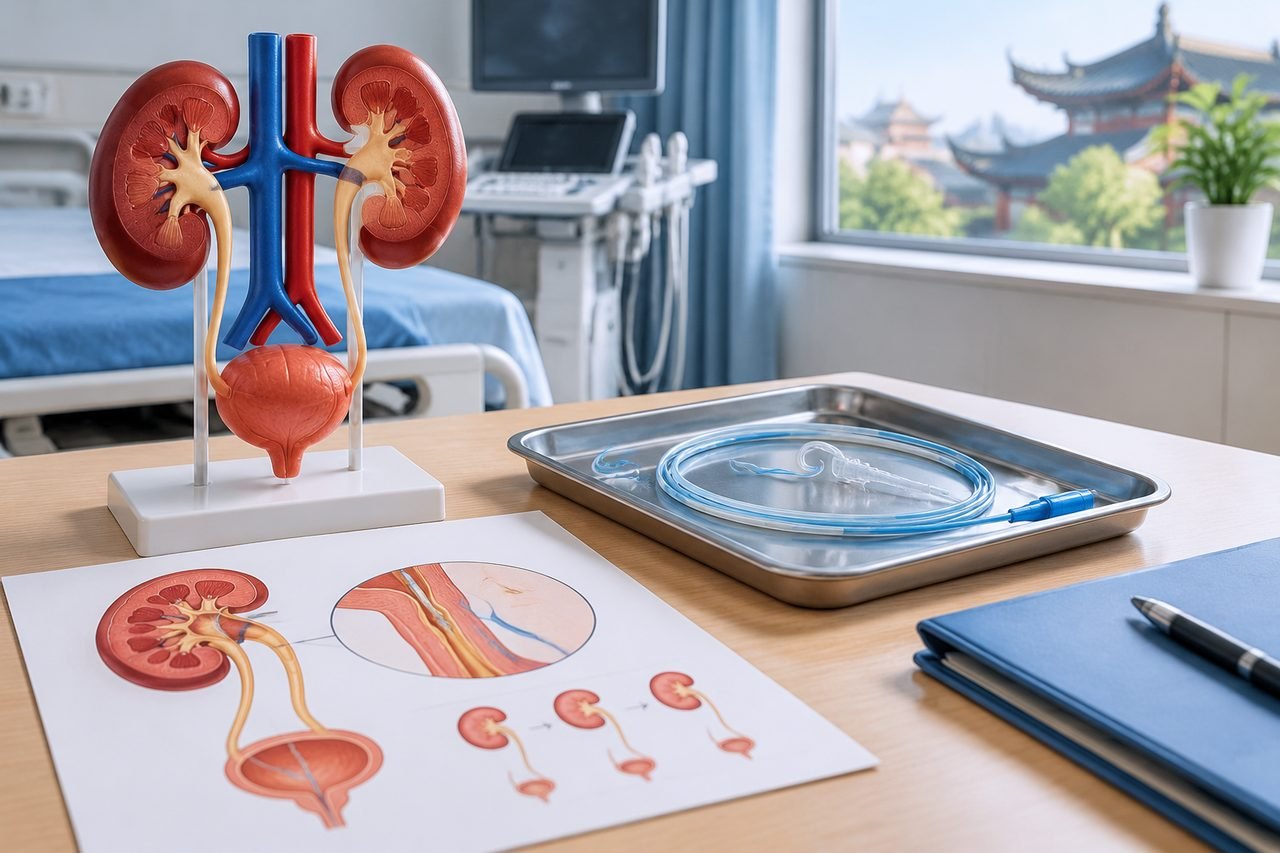
Many patients focus on the operation itself and only later ask about the tube left behind. A ureteric stent is a common part of pyeloplasty, but the schedule for removal is not universal. It depends on the repair, the surgeon's practice and how healing progresses. Ask directly: will I have a stent, for how long, and how will it be removed?
If a stent is planned, ask whether removal happens in China or after you return home. This is one of the most practical consent questions for an overseas patient. A stent that is meant to be removed weeks later creates a planning problem if you have already left the country. Ask who would remove it, where, and what documentation you would need to arrange that locally.
Ask about other tubes or drains as well. Some patients have a catheter or a surgical drain for a period after surgery. Ask what will be in place when you wake up, what it is for, and what the plan is for removal. You should also ask what symptoms would require urgent contact, such as fever, severe pain, reduced urine output or a drain that changes unexpectedly.
Finally, ask what follow-up imaging is planned and when. The timing of a post-operative scan is a clinical decision, not a fixed rule. Ask what the scan is intended to show, who will review it, and how the result will be communicated to you if you are no longer in China.
What are the risks and alternatives in your case?
Consent is not complete until you have had a chance to discuss risks and alternatives. Ask the surgeon to explain the main risks of this operation for someone with your anatomy and your general health. These may include bleeding, infection, urine leak, narrowing that returns, or a need for further procedures. The exact risk depends on the individual case, so ask what the team considers most relevant for you.
You are entitled to ask about evidence-based estimates and uncertainty. A responsible clinician can discuss what is known about outcomes and what remains uncertain. No estimate guarantees your individual result, and a percentage from a study may not apply directly to your situation. The useful question is: based on your experience and my records, what should I understand about the likely course and the main uncertainties?
Ask what happens if the repair does not work as hoped. Would a further procedure be needed, and what would that involve? Ask whether there are alternatives to surgery now, such as continued observation or a different intervention, and why the team recommends pyeloplasty rather than those options. If observation is reasonable, ask what would trigger a decision to operate later.
If you have other medical conditions, ask how they affect the plan. Heart, lung, kidney or bleeding problems can change anaesthetic risk and recovery. The treating team should know your full medication list, including anything you take without a prescription. Do not stop or change any medicine on your own; ask the prescribing clinician or the hospital team how it should be managed around surgery.
What will the hospital's written plan and estimate include?
Cost is not the main clinical question, but it is a legitimate consent question. Ask the named hospital for a written estimate that sets out what is included, what is excluded, and what remains undecided until after assessment. The scope of a quote can vary with the ward type, the length of stay, the approach used and any additional tests or treatment needed.
Do not assume that a figure covers everything. Ask specifically about the surgeon's fee, anaesthesia, the operating theatre, the hospital stay, medicines, consumables such as a stent, imaging and follow-up consultations. Ask whether the estimate is based on the planned operation alone or whether it includes contingency for a longer stay or a change of approach.
Coordination fees are separate from hospital charges. If you use a coordination service, ask what its fee covers and what it does not. Hospital consultations, tests, treatment, medicines and rooms are paid to the hospital or the relevant provider. Ask the provider how its own written estimate works rather than relying on a general description of billing in China.
For an overseas patient, also ask how payment is made, what currency is accepted, and what documentation you receive for insurance or reimbursement. These are administrative questions, but they affect your decision and your preparation. If the answer is unclear, ask for it in writing before you commit.
What should you confirm before you agree?
Before you sign consent, make sure you can answer the practical questions in your own words. Who will perform the operation? What approach is planned, and what would prompt a change? Will you have a stent, and where will it be removed? What follow-up imaging is planned, and who will review it? What symptoms should make you seek urgent care?
If you are travelling to China for care, ask how the hospital handles language and interpretation during consent, ward rounds and discharge. Ask what records you should bring, including imaging discs and recent blood tests, and whether the hospital wants them translated. These arrangements affect safety and understanding, not just convenience.
You do not need to resolve every detail before making an initial enquiry. A short summary of your diagnosis, main question and available records is enough to start. The hospital decides whether pyeloplasty is suitable, and no outcome can be guaranteed. If you would like help organising records, interpretation or a specialist appointment request, ChinaSpecialistCare can explain the confirmed coordination options for this exact problem. An initial enquiry is free, and a proxy consultation is optional rather than a prerequisite.
The next step is to write down the three or four answers that still feel unclear and ask the treating team directly. If you are considering care in China, you can begin with a brief enquiry and share records after first contact.
Sources & scope of this guide
References and official service information relevant to this guide.
This is general planning information and has not been individually reviewed by a doctor. Medical decisions and personal treatment advice come from your treating clinicians.