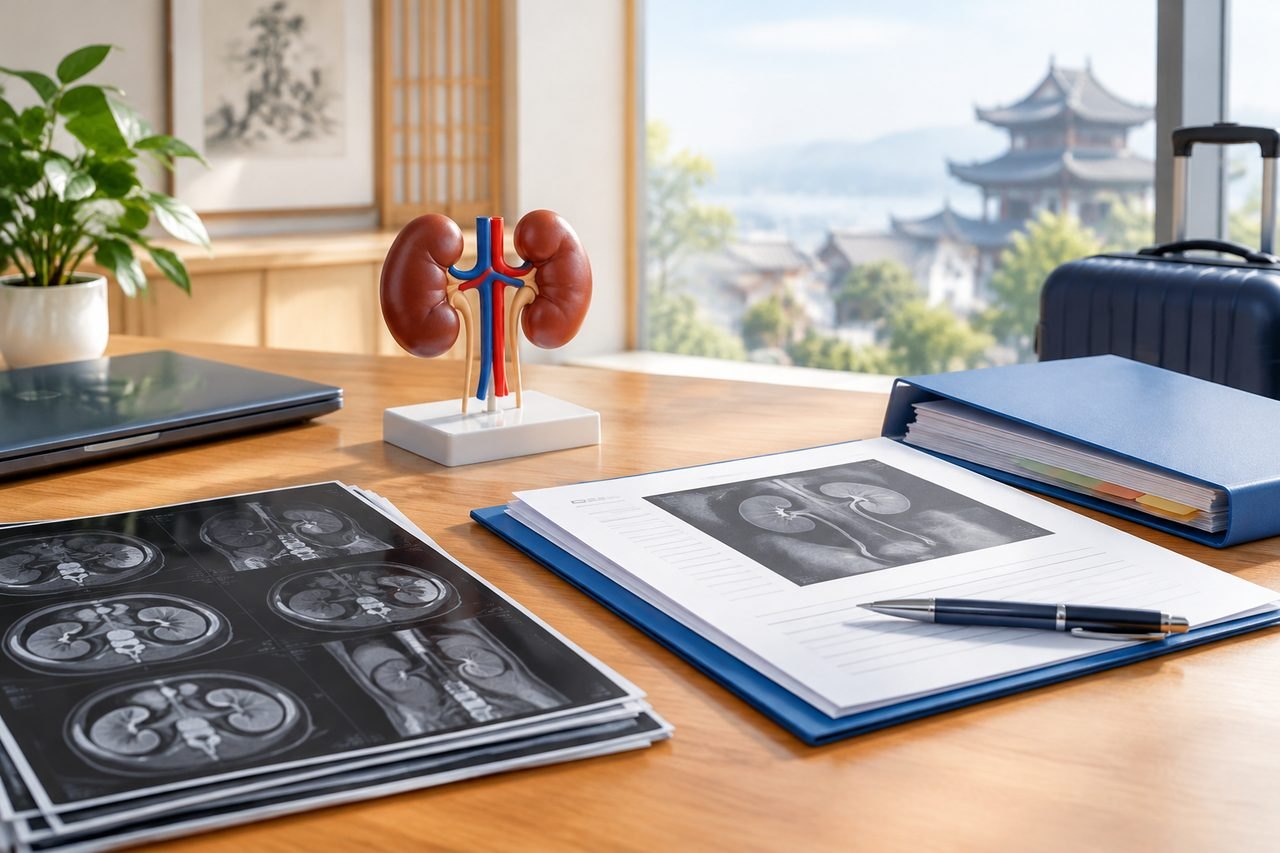
What a real record exchange looks like for pyeloplasty
A pyeloplasty repairs narrowing at the junction of the kidney and ureter, and the operative approach is decided individually. That single sentence explains why a records exchange matters more here than in many procedures: the decision depends on images, function tests and the anatomy of one specific patient, not on a diagnosis label. If your home team only receives a message saying 'pyeloplasty planned', it cannot comment on whether the approach matches what it has seen.
The practical exchange has four parts. First, the imaging that shows the obstruction — typically the study your home team used to identify the narrowing, plus any later scans. Second, the kidney-function information your home clinicians used, including how they measured split function if they did. Third, the Chinese hospital's written assessment: what it sees, what repair it proposes and what it still needs. Fourth, your home urologist's specific questions, sent as questions rather than as a general request for an opinion.
Keep the exchange in writing where possible. A short covering letter from your home clinician, listing the diagnosis, the relevant dates and the questions, is more useful to a Chinese surgical team than a folder of unlabelled images. Ask both sides whether they want the original imaging files or a radiology report first; do not assume one replaces the other.
The obstruction question your home team should answer in writing
The first thing a Chinese urologist needs to understand is how the obstruction was assessed. Was it seen on ultrasound, CT, magnetic resonance imaging or a nuclear medicine study? Was kidney drainage measured, and if so, how? Did the assessment show a clear blockage, borderline findings or a change over time? These are not administrative details. They determine whether surgery is being considered for a definite obstruction, for a partial one, or for a kidney that is being watched.
Ask your home team to state, in writing, what the obstruction test showed and what it did not show. A report that says 'hydronephrosis' describes swelling; it does not by itself prove that surgery is required. Your home urologist can explain whether the findings support an operation, observation or further testing. That explanation is exactly what the Chinese team needs in order to compare its own reading with yours.
If your home team used a particular threshold or criterion to recommend surgery, ask it to name that criterion. If it did not use one, ask what tipped the decision. This is not a challenge to your doctor; it is the information a second surgical team needs to avoid repeating tests unnecessarily or disagreeing without knowing why.
Kidney function: what to send and what to ask
Kidney function is the second half of the pyeloplasty decision, and it is the part most easily lost in translation. Send the results your home team already has — blood tests, urine tests and any split-function study — with the dates attached to each. If split function was measured, say which kidney contributed what and when. If it was not measured, say that too, because the absence of a test is itself information the Chinese team needs before it decides whether to repeat anything.
Then ask your home team two questions in writing. First, how does it interpret the current function in relation to the obstruction? Second, what would it want to see before and after a repair? The answers give the Chinese team a baseline for comparison and tell it what your home clinicians consider important. A number without an interpretation is much less useful than a number with one.
If your home team has monitored function over months or years, ask for the trend rather than a single value. A stable picture and a declining one lead to different conversations, and the Chinese urologist cannot see the difference from one report. Ask your home clinician to state plainly whether the trend changes how urgently the obstruction should be addressed.
Do not ask either team to promise that function will improve. Pyeloplasty is intended to relieve a narrowing, but individual recovery of kidney function varies and depends on factors the treating clinicians must assess. The useful exchange is about the current picture and the plan for monitoring, not about a guaranteed result. If your home team has already discussed what improvement it would consider meaningful, pass that on; it helps both sides agree on what follow-up is for.
Surgical scope: the questions to put to the Chinese team
Once the records are shared, the next exchange is about the proposed operation. Ask the Chinese team, in writing, how it plans to approach the repair and why that approach suits your anatomy. The approach is decided individually, so a general answer such as 'minimally invasive' is less useful than a description of what is planned for you.
Ask what the operation is expected to involve: what will be repaired, what will be left alone, and what the alternatives are if the findings during surgery differ from the imaging. Ask whether a stent is planned, and if so, how and where it would be removed. Stent routines differ between patients and between teams; there is no universal schedule, so this must be confirmed for your case rather than assumed.
Ask how the Chinese team would arrange later imaging reviews and who would be responsible for them after you return home. This is the point where the two teams must agree on a handover: who orders the follow-up scan, who reads it, and how the result reaches your home urologist. A clear answer here prevents the common situation where a patient returns home with a discharge summary but no agreed follow-up plan.
Making the handover explicit before you travel
A handover is not a document; it is an agreement about who does what. Before travelling, confirm three things in writing. First, which clinician at home will receive the Chinese hospital's operative and discharge information. Second, which clinician in China will respond to questions from your home team after discharge. Third, how the two will communicate — through you, through a coordinator, or directly.
Ask your home team what it needs after the operation to continue your care. Some urologists want the operative note and the first follow-up imaging; others want a specific function test repeated at a set interval. Get that list before you leave, because it is much harder to obtain once you are back and the treating team has changed.
If language is a barrier, decide in advance how clinical documents will be translated and who checks the translation. A translated summary is useful, but the original imaging and reports should travel with you or be sent directly. Ask the Chinese hospital what format it accepts for imaging files and what it will provide in return.
Practical next step and what not to assume
Start with a short summary rather than a complete archive. An initial enquiry is free and does not require buying a proxy consultation. ChinaSpecialistCare can help request a specialist appointment, coordinate interpretation and pass records and questions between you and a Chinese hospital, but the hospital decides suitability and the treating clinicians decide the plan. You can begin through the pyeloplasty reference page or the enquiry form.
Do not assume that sharing records establishes acceptance, that a proposed operation is confirmed, or that travel is appropriate. Those are decisions for the treating hospital and your home clinicians. If your symptoms worsen or you develop fever, severe pain or reduced urine output, seek local urgent care rather than waiting for an overseas reply.
Finally, keep the two teams talking about the same questions. The obstruction assessment, the kidney-function picture, the proposed repair and the follow-up plan are the four items that matter most. If any of them is missing from the exchange, ask for it before proceeding.
Sources & scope of this guide
References and official service information relevant to this guide.
This is general planning information and has not been individually reviewed by a doctor. Medical decisions and personal treatment advice come from your treating clinicians.