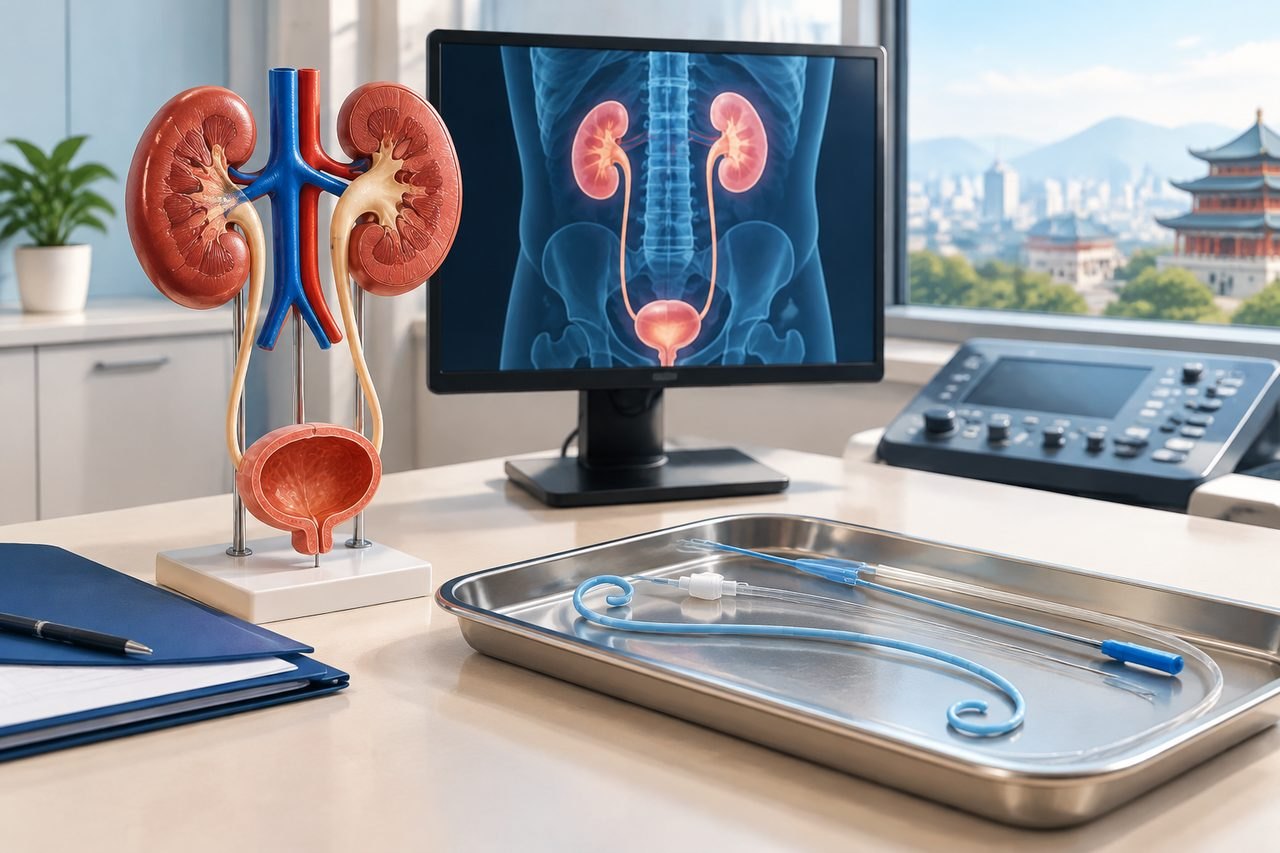
What pyeloplasty actually corrects, and what it does not
Pyeloplasty is an operation to repair a narrowing at the junction of the kidney and the ureter. That junction is called the ureteropelvic junction, and when it is narrowed, urine drains less freely from the kidney. The operation removes or bypasses the narrowed segment and reconnects the ureter to the kidney so urine can pass more normally.
This matters because the decision to operate is not based on a single scan or a single blood test. A dilated kidney on imaging does not automatically mean surgery is needed. Some people have stable swelling for years without losing kidney function. Others have progressive changes that a urologist wants to address. The operation is intended to relieve the blockage; it is not a treatment for every cause of kidney impairment.
The approach — open, laparoscopic or robotic — is decided individually. That decision depends on the anatomy, previous surgery, the surgeon's assessment and the hospital's equipment. It is not a patient preference that can be selected from a menu before the clinical team has reviewed the records.
Ask the team to explain what they believe is causing the narrowing and whether they expect the repair to protect existing kidney function, improve drainage, or both. A responsible clinician can discuss evidence-based expectations and uncertainty; no estimate guarantees an individual result.
How the obstruction is assessed before surgery is proposed
The first practical question is not 'which operation' but 'how do you know this is an obstruction that needs repair?' Urologists use a combination of imaging and functional tests. Ultrasound or CT may show a dilated collecting system. A diuretic renography study, sometimes called a MAG3 scan, can show how quickly each kidney drains and whether a diuretic changes that drainage. Blood tests such as creatinine and eGFR give a general picture of kidney function but do not show which kidney is affected or whether drainage is blocked.
If you are seeking care in China, ask the hospital which of these tests it needs and whether it will repeat any of them. Imaging and functional studies from another country may be accepted, or the team may want its own baseline before deciding on surgery. This is a clinical judgement, not an administrative preference.
A useful question is: 'What specific finding on my tests makes you recommend pyeloplasty rather than continued observation?' Another is: 'If my kidney function is already reduced, does that change the plan or the urgency?' These questions help you understand whether the recommendation rests on obstruction, on declining function, on symptoms, or on a combination.
Bring the actual images and reports, not just a summary. A written report describes what someone saw; the treating surgeon may want to review the original scan. Ask the hospital what format it accepts for imaging files and whether a radiology review is part of the assessment.
Kidney function: what can be preserved, what may not recover
Patients often ask whether pyeloplasty will restore kidney function. The honest answer is that it depends on how much function remains and how long the obstruction has been present. The operation is designed to relieve the blockage and protect the kidney from further damage. If some function has already been lost, surgery may not bring it back. If the kidney is still working but drainage is poor, relieving the obstruction can help preserve what is there.
This is why the pre-operative assessment matters so much. A split-function study shows how much each kidney contributes. If the affected kidney has very little function, the team may discuss whether repair is worthwhile or whether another approach is more appropriate. That is a specialist decision based on the individual case, not a general rule.
Ask the team to explain, in plain terms, what your current kidney function is, what they expect to happen after surgery, and what they will monitor. Ask whether there is any risk of the kidney function worsening if surgery is delayed, and what symptoms or changes should prompt earlier review. Do not stop or change any medication on your own; that belongs to your treating clinician.
If you have reduced kidney function, also ask how the hospital manages anaesthesia and medication dosing in that situation. This is a standard part of surgical planning, but it is worth confirming that the team has reviewed your kidney function before the day of surgery.
Stents, drains and what happens after the repair
Many pyeloplasty operations involve placing a temporary stent inside the ureter to keep it open while it heals. The stent is usually removed later, but the timing and method vary. Some stents are removed through a cystoscope as a short procedure; others may be attached to a string and removed in clinic. The plan depends on the surgeon's technique and the individual repair.
Do not assume a universal stent schedule. Ask the team: 'Will I have a stent, how long will it stay in, and how will it be removed?' Also ask who removes it and whether that can be arranged locally if you are not staying in China for the whole period. If the hospital expects you to return for removal, that affects your travel planning.
You should also ask about the follow-up imaging plan. After pyeloplasty, teams often repeat a functional study or ultrasound to confirm that drainage has improved. The timing varies. Ask when the first review is expected, what test will be used, and whether it can be done in your home country with results sent back.
A related question is what happens if symptoms return or if imaging shows the repair is not working as hoped. This is uncommon but possible, and it is reasonable to ask how the team would assess it. The answer helps you understand the follow-up commitment, not just the operation itself.
Records and questions to prepare before contacting a hospital in China
A useful enquiry starts with a short summary, not a complete medical archive. You can describe the diagnosis, the main symptom or concern, and the specific question you want answered. After first contact, the hospital or coordinator can tell you which records to send.
For a pyeloplasty enquiry, the relevant records typically include recent imaging reports and the images themselves, blood test results showing kidney function, any functional renography study, and a summary of previous surgery or interventions. If you have had a stent or nephrostomy, include those details. If you have reports from more than one hospital, a short timeline helps the reviewer understand the sequence.
Prepare a written list of questions. Ask how the team assesses the obstruction, what the proposed repair involves, how kidney function will be monitored, and how stent removal and later imaging reviews would be arranged. Ask what the hospital's written estimate includes and what remains undecided until after clinical review. Ask whether the hospital can provide interpretation during consultations and whether reports are issued in English.
Do not send passport numbers, card details or a full medical archive in an initial message. A brief summary is enough to start. The hospital decides whether it can accept the case and what further information it needs.
What to confirm before you commit to travel
Overseas surgical planning involves several separate questions. The first is clinical: does the hospital, after reviewing your records, consider pyeloplasty appropriate, and what does its assessment show about your kidney function and obstruction? The second is practical: what is the proposed plan, how long would you need to stay, and what follow-up is expected? The third is financial: what does the hospital's written estimate cover, and what coordination or travel costs sit outside it?
Ask for the clinical plan and the written estimate in the same conversation where possible. If the hospital cannot give a firm plan until it sees you in person, ask what can be confirmed remotely and what must wait. A records-based opinion can clarify the likely options, but it does not establish final eligibility, hospital acceptance or a guaranteed outcome.
If you are comparing hospitals, ask each one the same questions so the answers are comparable. Do not rely on a general reputation or a single recommendation. The right hospital for your case depends on the specific anatomy, your kidney function, previous surgery and the team's experience with similar cases.
Finally, keep your local clinician informed. If your kidney function is stable and you are not having severe symptoms, an overseas enquiry can proceed in parallel with local care. If you develop fever, severe pain, reduced urine output or other worsening symptoms, seek local medical assessment promptly rather than waiting for an overseas reply.
A brief next step: you can send a short summary of your diagnosis, main question and available records through the enquiry form, email or WhatsApp. An initial enquiry is free and does not require buying a proxy consultation. The team can then tell you what information is missing and whether a specialist review is the relevant next step.
Sources & scope of this guide
References and official service information relevant to this guide.
This is general planning information and has not been individually reviewed by a doctor. Medical decisions and personal treatment advice come from your treating clinicians.