Why obstruction tests come before a pyeloplasty decision
A pyeloplasty repairs narrowing at the junction where the kidney meets the ureter, the tube that carries urine downward. That narrowing can slow drainage and cause the kidney's collecting system to swell. But swelling alone does not automatically mean surgery is needed. The clinical question is whether there is a real obstruction that is affecting the kidney, and whether an operation would improve drainage or protect kidney function.
Obstruction tests are the evidence that separates those possibilities. They help the team judge whether the problem is a mechanical blockage, a functional delay in drainage, or something that can be observed. That distinction changes the treatment recommendation. It also changes what the surgeon plans to do during the operation.
For an overseas patient, this is the practical point: the tests are not paperwork before a pre-decided operation. They are part of deciding whether pyeloplasty is the right operation at all, and what its scope should be.
What obstruction tests actually measure
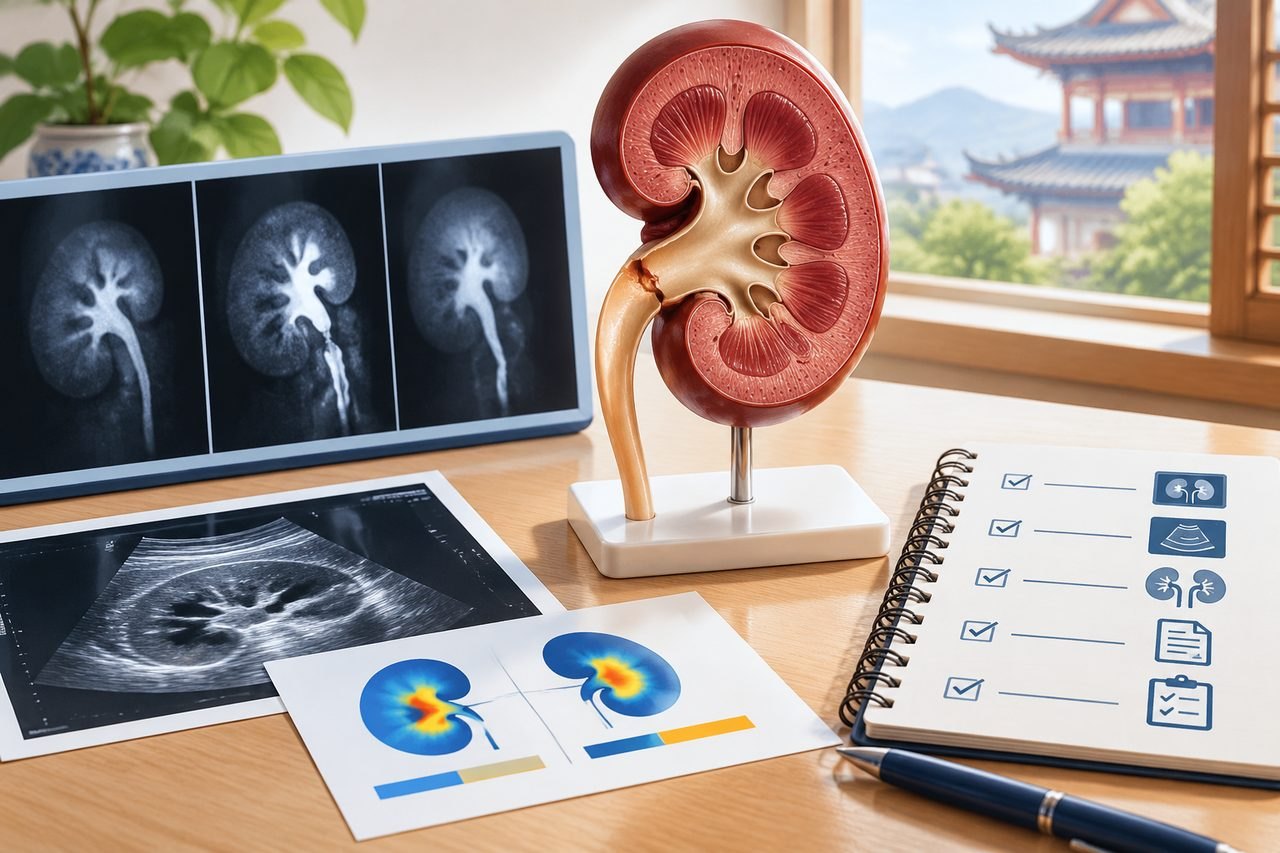
Obstruction testing usually combines imaging and kidney function information. Imaging shows the shape of the kidney's collecting system, the level of the narrowing, and whether the ureter is dilated above it. Function testing shows how well each kidney is working and whether drainage improves after a diuretic is given. Together, these results help the team see whether urine is held up and whether the kidney is under strain.
The exact test names and protocols vary by hospital and by patient. Some teams rely on ultrasound and a nuclear medicine drainage study; others add CT or MRI detail. The important thing for you is not to memorise a test list. It is to understand what each report contributes: anatomy, drainage, and function.
When you send records to a hospital in China, include the images themselves when possible, not only the written report. A radiologist's summary can be useful, but the surgical team may need to review the actual study to judge the level and severity of the narrowing. If you only have reports, say so clearly so the team can tell you what else it needs.
How obstruction results shape the surgical plan
The operative approach for pyeloplasty is decided individually. The surgeon considers the location and length of the narrowing, the anatomy of the kidney and ureter, previous surgery or infection, and the patient's overall health. Obstruction tests feed directly into that decision because they show where the problem is and how the kidney is responding.
A clear obstruction with declining function may point toward repair. Mild swelling with preserved function and no clear obstruction may point toward monitoring. A complex anatomy may require a different reconstruction than a straightforward narrowing. None of these decisions can be made from a single report or from a phone description alone.
This is also why the phrase 'pyeloplasty' can cover more than one operation. The goal is to restore drainage, but the technical steps depend on what the tests show. Ask the surgical team to explain, in plain terms, what your imaging shows and what the proposed repair would involve. If the answer is vague, ask what additional information would make the plan clearer.
Kidney function, split function and what the numbers mean
Kidney function testing in this context is often about split function: how much work each kidney is doing. If one kidney is contributing less, the team wants to know whether that is due to reversible obstruction or to permanent loss of function. That distinction affects both the urgency and the expected benefit of surgery.
No test result by itself tells you whether you will need an operation. A low split function does not always mean the kidney is unsalvageable, and a normal split function does not always mean surgery is unnecessary. The treating clinician interprets the numbers alongside the images, your symptoms, your history and your other health conditions.
You can ask useful questions without interpreting the numbers yourself. Ask whether the obstruction is affecting function, whether the effect appears reversible, and what the team expects to learn from follow-up testing. Ask what would change the recommendation. These questions are appropriate for any patient considering kidney surgery.
Records to prepare for a pyeloplasty enquiry in China
A useful enquiry starts with a short summary and the key reports. You do not need to send a complete medical archive at first contact. The hospital will tell you what it needs for a proper assessment. What matters is that the records are specific enough for the team to understand the obstruction and the kidney's condition.
Prepare the imaging reports and, if available, the actual image files. Include kidney function blood tests, urine tests, and any nuclear medicine drainage study. List your current medications and relevant past surgery. If you have had a stent or a previous repair, include those details because they change the surgical assessment.
Keep a simple timeline: when the problem was first noticed, what tests were done, what each showed, and what treatment has been tried. This helps the team see the trajectory rather than a single snapshot. If a report is missing, say so rather than guessing. The team can then tell you whether it needs that item or can proceed without it.
- Imaging reports and, where possible, the original image files
- Kidney function blood tests and urine tests
- Any nuclear medicine drainage study or diuretic renography report
- Details of previous stents, surgery or urinary infections
- A short timeline of symptoms, tests and treatments
Questions to ask the team about obstruction, repair and follow-up
The most useful conversation is not about whether you can book an operation. It is about how the team assesses the obstruction, what the proposed repair involves, and how follow-up would be arranged. Ask how the team will confirm the obstruction using your existing records and whether any further testing is needed before a decision.
Ask what the operation is intended to achieve in your case: relief of symptoms, protection of kidney function, or both. Ask what the alternatives are, including monitoring, and what would make the team recommend one path over another. Ask about the plan for any stent or drainage tube, including how and where removal or review would be arranged. The timing and schedule are clinical decisions, so ask the team to explain its own plan rather than relying on general expectations.
Ask how later imaging reviews would be organised and who would be responsible for interpreting them. If you are travelling from abroad, ask how follow-up could be coordinated with your local clinicians and what records you should take home. These are practical questions that affect whether a trip is feasible, not just clinical ones.
Finally, ask what the team needs from you to give a written estimate or plan. Hospital fees, tests, treatment and rooms are paid to the hospital or provider, and coordination fees are separate. The scope of any quote depends on the actual assessment, so ask the named provider what its written estimate includes, excludes or leaves undecided. An initial enquiry is free and does not require buying a proxy consultation. The hospital decides whether pyeloplasty is suitable for you.
Sources & scope of this guide
References and official service information relevant to this guide.
This is general planning information and has not been individually reviewed by a doctor. Medical decisions and personal treatment advice come from your treating clinicians.