
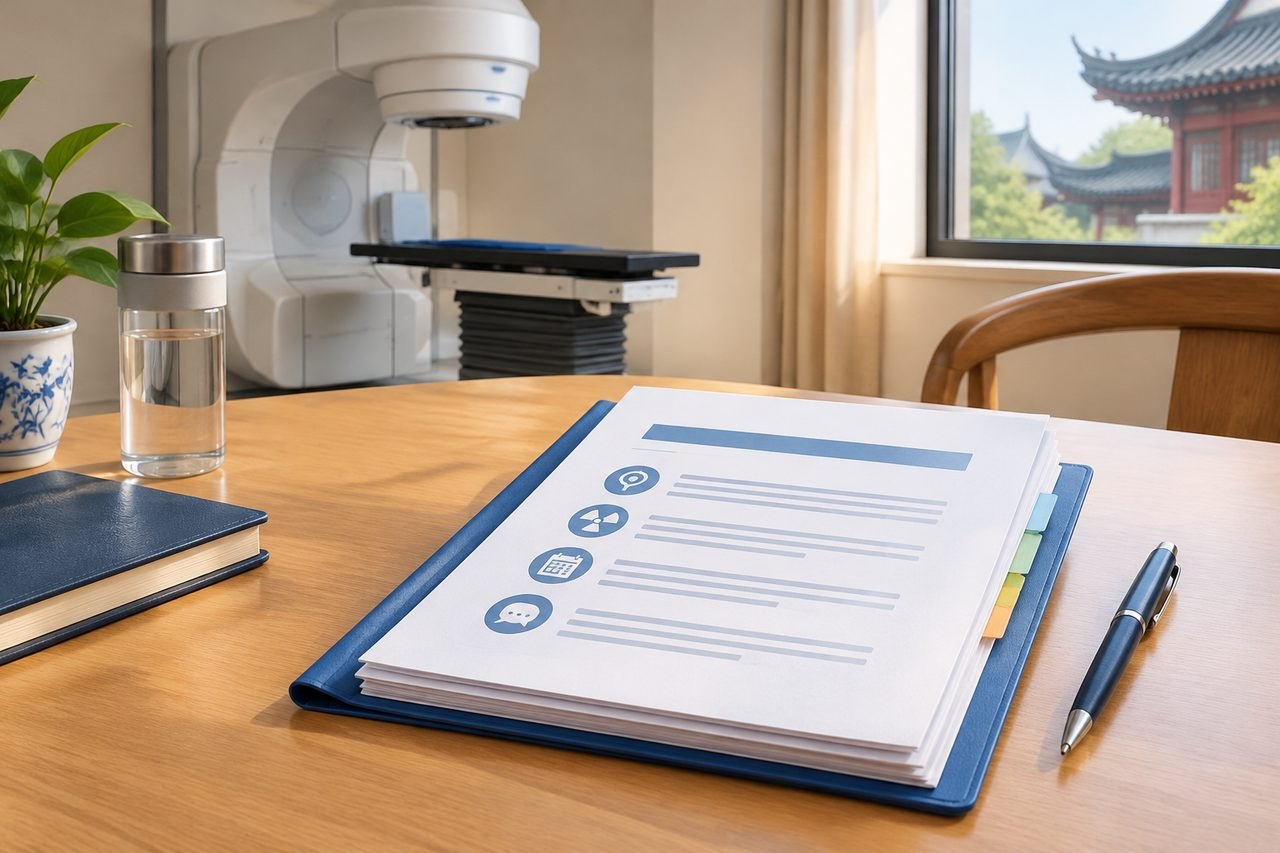
What a useful radiotherapy summary should contain
A discharge summary written for a patient is not the same as a treatment record written for another clinician. The first explains what happened in plain language. The second gives the receiving team enough technical detail to judge what has already been done and what should happen next. If you only receive the first, ask whether a clinician-to-clinician summary can also be prepared.
The National Cancer Institute describes radiotherapy as treatment that uses radiation to treat cancer, with the technique and schedule depending on the individual treatment plan. That is exactly why a generic statement such as 'completed radiotherapy' is not enough for your home clinician. They need to know what was planned, what was delivered, and what remains uncertain.
- The treated site and side, and whether treatment was definitive, adjuvant, palliative or given for another stated purpose.
- The radiotherapy technique and the schedule actually delivered, including start and end dates.
- The total dose and fractionation as recorded by the treating department.
- Any concurrent or recent systemic treatment, surgery or other therapy that formed part of the plan.
- Acute side effects observed during treatment and how they were managed.
- Unresolved results: imaging, pathology, blood tests or other investigations still pending or not yet explained to you.
- Planned follow-up in China, if any, and the clinician or department that should receive questions.
- A contact route for your home clinician to request clarification.
Ask before discharge, not after you get home
The practical difficulty is timing. Once you leave the hospital and return home, reaching the radiotherapy team becomes slower and more expensive. Ask about the summary while you are still in contact with the department, ideally before your final review appointment.
A useful question is: 'Can I receive a written summary that my doctor at home can use, and when will it be ready?' Ask who prepares it, whether it will be in English, and whether it can be collected in person or sent by a secure route. Do not assume a particular turnaround time; ask the department what it can commit to for your case.
If the summary is not ready before you fly, ask what interim document you can carry and how the full version will reach you. A discharge letter, an appointment card and a copy of your imaging reports are better than nothing, but they do not replace a treatment summary.
Records your home clinician will likely want to see
Your home clinician is not obliged to accept a plan simply because it was made in China. They will decide what they can safely continue, what they need to verify, and whether any part of the plan needs to be repeated or adjusted. Your job is to give them the material to make that judgement, not to persuade them in advance.
Ask the treating hospital which of the following it can provide, and in what language: the radiotherapy summary, the planning documents, imaging before and after treatment, pathology reports, operation notes if surgery was involved, medication lists, and the contact details of the responsible clinician. If some items are not available, ask the hospital to state that in writing rather than leaving a gap.
Keep a simple index at the front of the file: what each document is, its date, and which hospital produced it. This sounds minor, but it prevents the receiving team from spending their first appointment reconstructing the order of events.
Unresolved results and open questions
Radiotherapy sits inside a longer pathway, and the pathway does not stop when the machine stops. A scan may be scheduled after treatment ends, a pathology result may still be pending, or a decision about further treatment may depend on a review that has not yet happened. These open items are the part of the record most easily lost between two hospitals and two languages, because they are not events that already occurred. They are questions still waiting for an answer, and a summary that lists only completed treatment leaves your home clinician unable to see them.
Write down, in your own words, every question you still have. Then ask the treating clinician to answer each one in the summary or in a short addendum. If an answer is not yet known, ask them to record that it is pending and what will trigger the next step.
Do not ask the Chinese team to predict what your home clinician will decide. Ask them to document what they did and what they observed. The receiving clinician will form their own view.
- Which results were still pending when you left, and who will send them.
- Whether any further imaging or review was recommended, and by when.
- Whether any medication was started, changed or stopped, and why.
- What symptoms or changes should prompt you to seek urgent local care rather than wait.
Communication between the two clinical teams
The cleanest handover is a direct exchange between clinicians, but that depends on the willingness and availability of both sides. You can make it more likely by asking the Chinese team whether they are able to respond to a specific question from your home doctor, and by giving your home doctor a named contact rather than a general hospital switchboard.
If direct contact is not possible, a well-organised written summary is the next best option. Ask your home clinician what format and level of detail they find most useful, then request that from China. Some clinicians prefer a short structured letter; others want the full planning record. You do not need to guess.
Be realistic about what a records-based exchange can establish. A remote review can clarify what was done and identify questions, but it does not by itself confirm that your home team will continue a particular plan, and it does not replace an in-person assessment where one is needed.
Practical next step for requesting the summary
ChinaSpecialistCare provides information and non-clinical coordination. We can help you identify what to ask the treating hospital for, explain how to share records after first contact, and, where relevant, help arrange a specialist appointment or a records-based opinion. We do not write your radiotherapy summary, and we cannot guarantee that a home clinician will accept it.
If you are still in China and need help requesting documents or arranging a follow-up appointment, an initial enquiry is free. You can send a brief summary of your situation and the main question you need answered. Do not send a complete medical archive or payment details at first contact.
The relevant reference page for the treatment itself is Precision Radiotherapy. Use it for background on the service, not as evidence of what your own summary will contain.
Sources & scope of this guide
References and official service information relevant to this guide.
This is general planning information and has not been individually reviewed by a doctor. Medical decisions and personal treatment advice come from your treating clinicians.