What the Chinese team actually needs from your home hospital
Revision hip surgery is not a repeat of the first operation. The surgeon has to know what is already inside you, why it is failing, and how much bone is left. That information sits in different places, and a discharge summary alone rarely carries it. The practical starting point is a short list of documents your home hospital can release, sent as clear PDFs or DICOM files rather than phone photos of a screen.
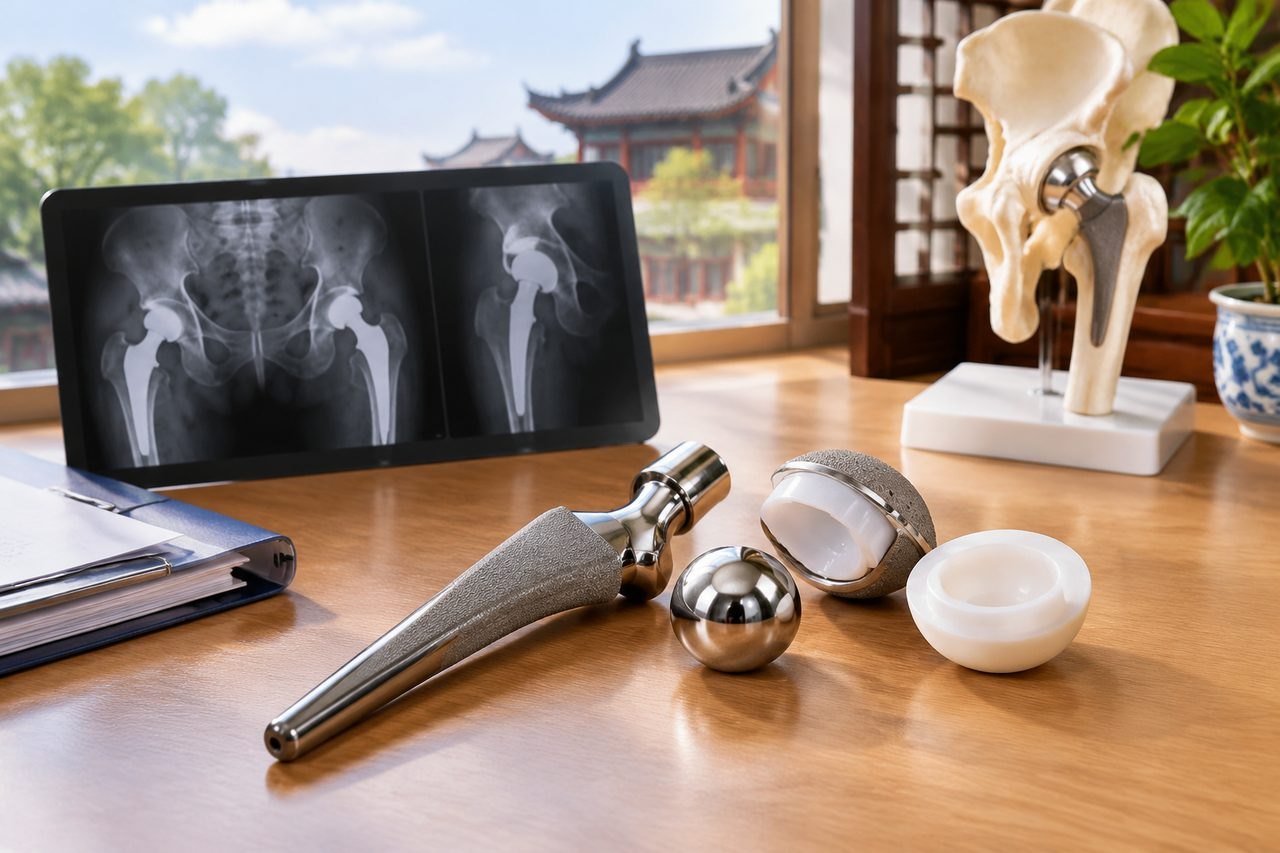
The most decision-relevant item is the implant identity. Ask your home hospital for the manufacturer, model and lot or serial numbers of the acetabular cup, femoral stem, bearing surface and any screws, augments or cages. If you hold an implant card, send both sides. If the card is lost, the operative note and the hospital's implant registry entry are the next places to look. Without this, a revision surgeon cannot know which extraction instruments or compatible components may be relevant.
Second, the operative records from the original replacement and from any earlier revision. These should include the approach used, the sizes implanted, bone graft or augmentation used, and any intraoperative complications. Third, the reason revision is being considered: infection, loosening, wear, instability, fracture or pain without a clear cause. Each changes the assessment. The AAOS patient information on revision total hip replacement notes that revision may replace some or all components, and that infection or bone loss can change reconstruction planning. That is why the Chinese team needs the evidence behind the diagnosis, not only the diagnosis itself.
Fourth, current imaging. Ask your home team which files are most useful to send: recent radiographs, any CT or MRI, and the radiology reports. Do not arrange new imaging for an overseas enquiry on your own initiative; ask the receiving clinician what is needed and whether existing studies are adequate.
Finally, a short clinical summary written by your home surgeon or physician: symptom history, examination findings, relevant blood results, current medications, allergies and any prior infection treatment. This is the document a Chinese specialist is most likely to read first.
The questions your home team should answer in writing
Records without interpretation leave gaps. Before or alongside the file transfer, ask your home clinician to put specific answers in writing. These are the questions that can change a revision plan, and they are easier to answer at home, where the original team has the full history.
What is the working diagnosis, and what evidence supports it? If infection is suspected, what tests have been done, what were the results, and has the joint been aspirated? If loosening is suspected, which component and on what imaging? If the cause is uncertain, say so plainly rather than guessing.
Which components are thought to need revision, and is a staged procedure being considered? A staged revision means one operation to remove components and manage infection, followed later by reimplantation. If your home team has raised this possibility, the Chinese team needs to know why, what the proposed interval would involve, and what would determine the second stage. This is a clinical decision for the treating surgeons, not something to settle by email, but the reasoning should travel with you.
What is your current weight-bearing status and mobility? Are you using crutches, a walker or a wheelchair? What has changed recently? This affects both surgical planning and how you would manage travel and the period before any operation.
What rehabilitation has already been tried, and what does your home physiotherapist consider realistic? The receiving team will make its own assessment, but knowing what has and has not helped avoids repeating unsuccessful approaches. Ask your home physiotherapist to summarise current exercises, restrictions and progress in one page.
Are there any medical issues that would affect surgery: cardiac history, anticoagulant use, diabetes control, kidney function, previous reactions to anesthesia? Your home physician can provide this concisely.
How to send records so the Chinese team can use them
A file that cannot be opened is not a record. Before sending anything, confirm with the receiving hospital or coordinator which formats and which transfer method they accept. Many hospitals accept PDF for text documents and DICOM for imaging; some prefer a secure upload link rather than email attachments. Ask rather than assume.
Label each file clearly: document type, date, hospital and your name. A folder named only by date is hard to match to the right episode. If reports are in a language other than English or Chinese, ask whether a translation is needed and who should provide it. Do not pay for certified translation until the receiving team confirms it is required.
Keep a simple index. One page listing every file, its date and its source lets the Chinese clinician see quickly whether something is missing. If a document cannot be released, say so and explain why, rather than leaving a silent gap.
Send the minimum useful set first. A complete archive is not needed for an initial enquiry, and large transfers can fail. Start with the implant details, the most recent operative note, the current imaging reports and the clinical summary. Add further files when the receiving team asks.
Do not send passport numbers, payment card details or unrelated personal records through an article enquiry form. Share sensitive documents only through the channel the hospital or coordinator confirms.
What the Chinese team should send back, and what it cannot promise
A records exchange is two-directional. After review, ask the Chinese team to return a written summary of its assessment: which records it received, what it considers the main problem, what further information it needs, and what it would want to confirm in person. This is a records-based opinion, not a final decision. Suitability for revision surgery, the choice of procedure and hospital acceptance are decided by the treating clinicians after they have examined you and reviewed the full picture.
Ask specifically whether the team proposes a single-stage or staged revision, and what would determine that choice. Ask what imaging or tests it would repeat in China and why. Ask who would be responsible for the operation and for follow-up, and what the plan would be if the assessment in person differs from the records-based view.
It is reasonable to ask about evidence-based risks and expected outcomes for your situation. A responsible clinician can discuss what is known about revision hip surgery, including uncertainty, without guaranteeing a result. What no one can provide before examination is a personal prediction.
If the reply is preliminary, treat it as a request for more information rather than a decision. A preliminary view often means the file is incomplete or the question needs an in-person examination. That changes your next action: supply the missing item or ask what examination is needed, rather than booking travel on the strength of an interim note.
Agreeing who does what: handover and rehabilitation
Before travel, clarify the division of responsibility. Who at home will remain your point of contact? Who will receive the Chinese operative note and discharge summary? Who will manage anticoagulation, wound checks and medication after you return? These are practical questions, and answering them in advance prevents gaps.
Rehabilitation is where handover matters most. Weight-bearing instructions after revision hip surgery are individual and depend on what was reconstructed. Ask the Chinese team to provide written postoperative instructions covering weight-bearing, movement restrictions, wound care and warning signs, in a form your home physiotherapist can follow. Ask your home physiotherapist whether they can work from those instructions and what they would need to continue care. The receiving clinician and your home physiotherapist both exercise independent judgement; the goal is a clear written plan, not one team overriding the other.
Ask how follow-up would be arranged once you are home: which imaging or blood tests, at what intervals, and who reviews the results. Confirm how the Chinese team prefers to be contacted with questions after discharge, and what information they want sent back.
If a staged revision is proposed, the handover is more complex. Ask what the interval between stages would involve, where you would spend it, and which team would monitor you. Do not assume this can be managed remotely; confirm the plan with both teams.
Finally, agree what happens if plans change. If the in-person assessment leads to a different operation, or if surgery is not advised, who tells your home team and how? A named contact on each side makes this workable.
A practical next step for your enquiry
You do not need to buy a proxy consultation to begin. A free initial enquiry can review a short summary, identify which records are missing and suggest the relevant next step. ChinaSpecialistCare can help with records handling, interpretation and requesting a specialist appointment at a suitable hospital; the hospital decides suitability, and no outcome or acceptance is guaranteed.
Start with a brief summary: your main question, the date of your original hip replacement, any earlier revision, the current diagnosis or suspicion, and the records you can obtain. Then ask your home hospital for the implant identity, the operative notes and the current imaging reports. Send those first, and ask the Chinese team what else it needs. Keep your home clinician informed throughout, and do not delay urgent local care while an overseas enquiry is in progress.
For the procedure itself, see the revision hip replacement reference page, which explains the operation and what it involves.
Sources & scope of this guide
References and official service information relevant to this guide.
This is general planning information and has not been individually reviewed by a doctor. Medical decisions and personal treatment advice come from your treating clinicians.