Why the previous implant is the starting point for revision planning
Revision hip surgery is not a repeat of the first operation. According to the American Academy of Orthopaedic Surgeons, revision total hip replacement may replace some or all of the implant components, and the presence of infection or bone loss can change how reconstruction is planned. That single sentence explains why your previous implant records matter so much: the revision team is not choosing a fresh implant in isolation. They are deciding what to remove, what to keep, what to rebuild, and how to stabilise the joint.
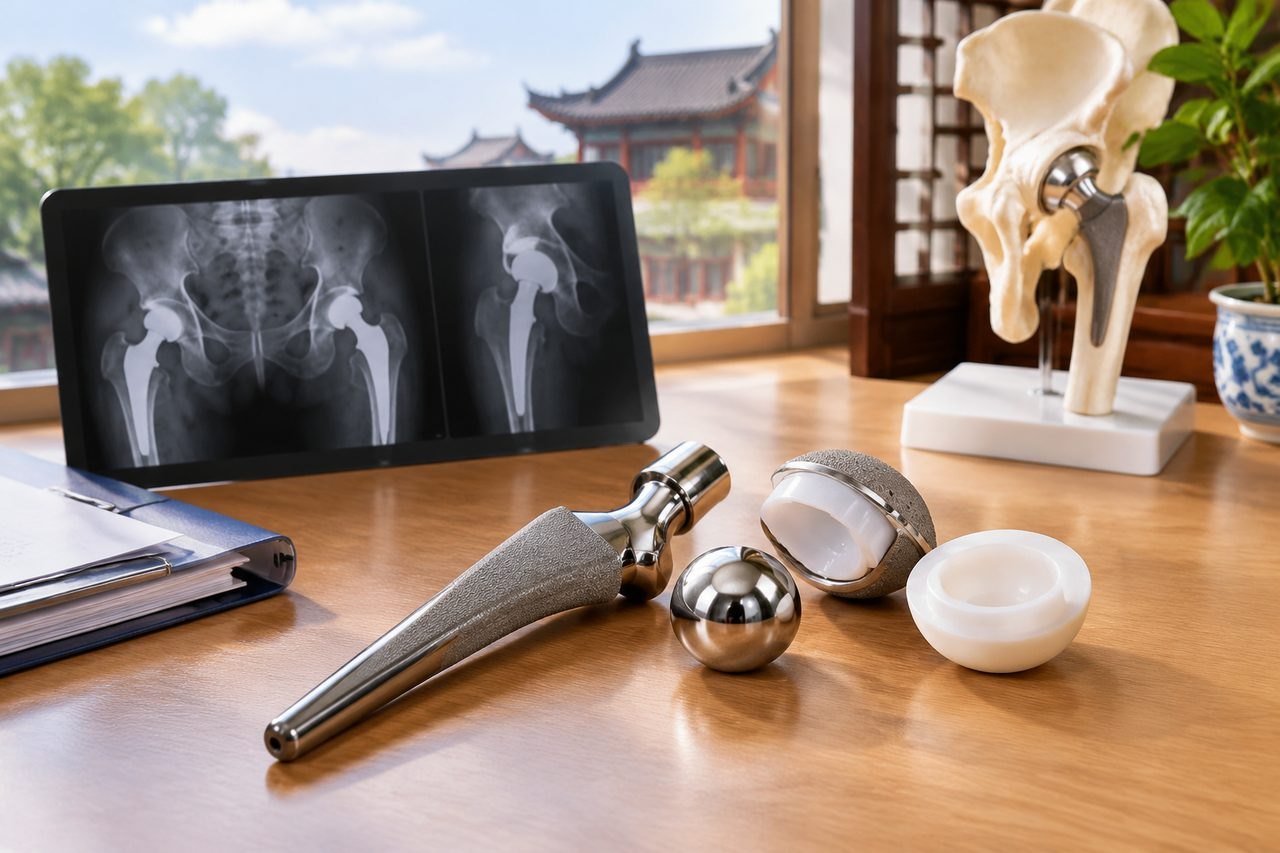
A hip replacement has several parts. The acetabular component sits in the pelvis socket. The femoral component goes into the thigh bone. A bearing surface, such as a liner or head, sits between them. In a revision, one or more of these may be exchanged. Which ones depends on what has failed, what remains well fixed, and what the surrounding bone can support. The original operation note and implant details tell the surgeon what was put in, when, and through which approach. That information changes the surgical plan before you ever travel.
This is also why a general description such as 'I had a hip replacement years ago' is not enough. The revision team needs to know whether the previous operation was a total hip replacement, a partial replacement, or a resurfacing, and whether any earlier revision has already taken place. Each of those histories points to a different set of questions about fixation, bone stock, and soft tissue.
Which records to gather before asking about revision in China
The practical task is to assemble a clear record of your previous hip surgery. You do not need to send a complete lifelong medical archive at first contact. A focused summary plus the key operative and imaging documents is enough for an initial review. The aim is to let a clinician see what was implanted and what has changed since.
Start with the operation note from the original hip replacement, if you can obtain it. This usually names the approach, the components used, and any intraoperative findings. Implant stickers or manufacturer cards are especially valuable because they identify the exact model and size. If you have had more than one hip operation, gather the notes for each. A discharge summary from the original admission can fill gaps when the full operative note is unavailable.
Imaging matters as much as the paperwork. Recent X-rays of the hip, and any CT or MRI scans your treating team has already arranged, help the revision surgeon assess component position, loosening, and bone loss. If you have older X-rays from previous years, bring those too, because comparison over time can show change that a single image cannot. Blood tests or aspirate results are relevant if infection has ever been suspected. Do not arrange new tests yourself for an overseas enquiry; ask the receiving team what they need.
A short written summary in English is useful. Include the date of each hip operation, the hospital, the surgeon if known, the reason for the operation, and any complications such as dislocation, infection, or fracture. This summary does not replace the original documents, but it helps the first reviewer understand the sequence.
- Original operation note for each hip procedure
- Implant stickers or manufacturer identification cards
- Discharge summaries if operative notes are unavailable
- Recent hip X-rays, plus any CT or MRI already performed
- Older X-rays for comparison over time
- Microbiology or aspirate results if infection was ever suspected
- A one-page English summary of dates, hospitals, and complications
What the revision team must confirm about failure and reconstruction scope
Understanding the previous implant is not only about identifying parts. It is about understanding why the revision is being considered. The AAOS notes that infection or bone loss can change reconstruction planning. Those two possibilities sit at the centre of many revision decisions, and both require information that only your records and the treating clinicians can provide.
If infection is a concern, the revision may need to be staged. A staged revision means the infected implant is removed, the joint is temporarily stabilised, and a new implant is placed at a later operation once infection is controlled. Whether a staged approach is proposed depends on the organism, the duration of infection, the condition of the bone and soft tissues, and the patient's overall health. This is a clinical judgement, not something that can be decided from a distance. Ask the treating team directly whether they are considering a single-stage or staged revision, and what information they still need to decide.
Bone loss is the other major variable. When bone around the socket or the femoral canal has been lost, the surgeon may need augments, cages, or special components to achieve stable fixation. The extent of bone loss is usually assessed from imaging, but the final judgement is made during surgery. This is why a records-based opinion can outline likely options but cannot promise a specific reconstruction. The operating surgeon must confirm the plan.
The same caution applies to the components themselves. A revision may replace some or all of the implant. Which parts are exchanged depends on what has failed and what can be safely retained. Ask the team to explain, in writing, what they expect to remove and what they expect to keep, and to note that this may change once surgery begins.
Rehabilitation and weight-bearing instructions after revision
Revision hip replacement often involves more surgical work than a first replacement, and rehabilitation is not automatically the same. The AAOS source notes that individual rehabilitation and weight-bearing instructions matter. That means the plan should come from the treating surgical and therapy team, based on the actual reconstruction performed, the quality of bone, and the soft tissue repair.
Before you commit to travelling, ask how rehabilitation would be coordinated. Will you receive physiotherapy in the hospital? Will there be a written home programme? Who will supervise your progress after discharge, and how will that work if you return home or stay in China? These are practical questions that affect recovery and safety. They are also questions the receiving team must answer, because rehabilitation protocols differ between patients and between surgical approaches.
Weight-bearing status is a specific example. Some patients may be allowed to bear weight fully after revision, while others may need protected weight-bearing for a period. The instruction depends on the reconstruction and cannot be assumed from the type of operation alone. Ask the surgeon what your expected weight-bearing status will be, what restrictions apply, and how those restrictions will be communicated to your physiotherapist.
If you plan to fly home after surgery, ask the treating team when it is safe to travel. This is a clinical decision based on wound healing, clot risk, and your general condition. Do not rely on a general timeline from another patient or an online forum.
How to frame your enquiry about revision hip replacement in China
A useful enquiry is specific. Instead of asking whether revision hip replacement is possible in China, describe your situation and ask what the hospital needs to assess it. State the date of your previous hip operation, the reason it is now being considered for revision, and any known complications. Attach the operation note, implant details, and recent imaging if you have them. If you do not have some documents, say so rather than waiting until you have everything.
Ask directly which implant and operation records the hospital requires. Ask whether a staged revision is being considered and what would determine that. Ask how rehabilitation and weight-bearing instructions would be coordinated, and who would provide them. Ask what the written plan would include and what remains undecided until after examination or imaging. These questions help you compare responses and understand the limits of a records-based opinion.
Be clear about what a remote review can and cannot do. A records-based opinion can help a surgeon understand your history and outline possible approaches. It does not establish final eligibility, hospital acceptance, or a guaranteed surgical plan. The hospital decides suitability after reviewing your case, and often after seeing you in person. An initial enquiry through ChinaSpecialistCare is free and does not require buying a proxy consultation. You can start with a brief summary by the enquiry form, email, or WhatsApp, and share records after first contact.
If your hip pain is severe, you have a fever, a wound that is draining, or you cannot bear weight, seek local medical assessment promptly. Do not delay necessary care while pursuing an overseas enquiry.
Sources & scope of this guide
References and official service information relevant to this guide.
This is general planning information and has not been individually reviewed by a doctor. Medical decisions and personal treatment advice come from your treating clinicians.