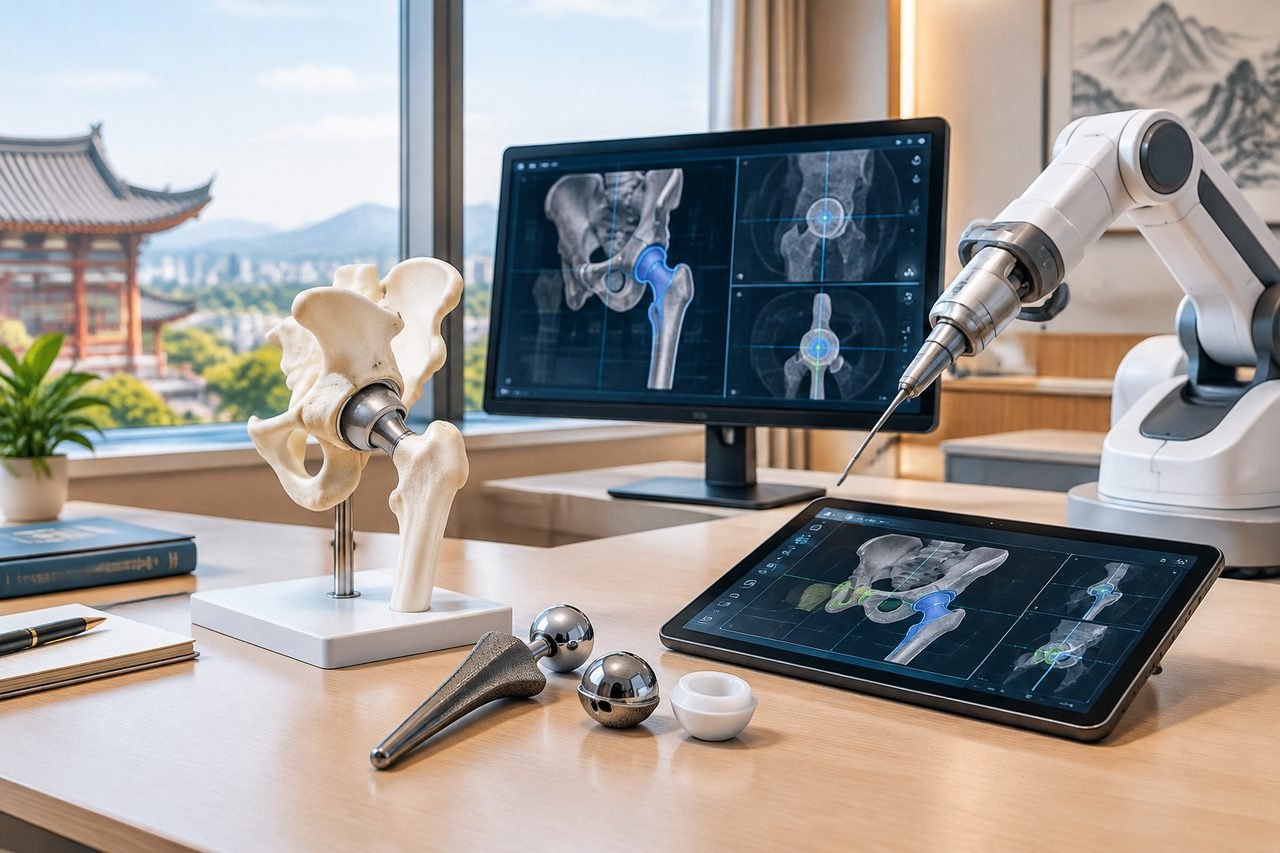
Why hip assessment comes before any robotic hip replacement decision
A hip replacement is not chosen because a technology is available. It is chosen because the hip joint has reached a point where non-surgical care no longer controls pain or function, and because the patient's overall health and bone quality make surgery reasonable. Hip assessment is the process that answers those questions. It includes your history, a physical examination, imaging of the hip and often a review of other joints, your medications and your home situation.
Robotic-assisted joint replacement adds a planning and surgical tool to that decision. The American Academy of Orthopaedic Surgeons explains that robotic tools assist joint-replacement planning and surgery, while the surgeon remains responsible for the operation. That single sentence matters for overseas patients: the robot does not decide whether you need a hip replacement, which implant fits your anatomy or whether you are fit for anaesthesia. The assessment does.
This is why a useful enquiry to a Chinese hospital is not 'Can I have robotic hip replacement?' but 'Here is my hip assessment so far. Does robotic assistance change the plan for my hip, and what still needs to be confirmed?' The first question invites a yes or no. The second invites a clinical answer.
What a hip assessment actually contains
A complete hip assessment usually brings together several strands. Your symptoms matter: where the pain sits, when it started, what makes it worse, how far you can walk and whether night pain disturbs sleep. Your examination matters: hip movement, leg length, gait and the strength of the muscles around the hip. Imaging matters: plain X-rays show joint space, alignment and bone quality, while other scans may be requested if the surgeon needs more detail.
Your general health matters just as much. Heart and lung conditions, diabetes, previous surgery, dental infections, blood-thinning medicines and allergies all affect surgical planning. So does your support at home after discharge. A hip replacement is a major operation, and the assessment is the point at which the treating team decides whether the benefits are likely to outweigh the risks for you.
For an overseas patient, the practical difficulty is that assessment is often split across two countries. Your local doctor may hold the X-rays and examination notes, while the Chinese hospital holds the surgical opinion. The useful step is to assemble a clear summary rather than a complete archive. A short history, the main question, recent imaging reports and a medication list give the receiving clinician enough to say what is missing.
How robotic assistance relates to the proposed hip operation
Robotic-assisted hip replacement is not a different operation from a conventional hip replacement. The aim is still to replace the damaged joint surfaces with implants. The robotic element is a tool used during planning and surgery, often to help position components according to a pre-operative plan. Whether that tool is used depends on the surgeon's judgement, the hospital's equipment and your hip anatomy.
This distinction changes what you should ask. Instead of asking only whether a robot is available, ask how robotic assistance would change your specific operation. Would it alter the approach to your hip? Would it change implant positioning, leg length or stability? Would it change the anaesthetic, the operating time or the hospital stay? If the answer is that it would not change the plan, that is useful information too.
It is also reasonable to ask what happens if the robotic system cannot be used on the day. Equipment, staffing and technical issues can affect any surgical plan. The treating surgeon should be able to explain the alternative and why it remains safe for your hip. No outcome can be guaranteed, with or without robotic assistance.
Technology, implant and surgeon are three separate questions
Overseas patients often treat robotic hip replacement as one package. It is more accurate to separate three elements. The technology is the robotic platform and its planning software. The implant is the cup, stem, bearing and head that will be placed in your hip. The surgeon is the person responsible for the operation and for deciding how the technology and implant are used.
Each element has its own questions. For the technology, ask which platform is proposed and whether it is used for planning, for execution or both. For the implant, ask which manufacturer and model are planned, what materials are used and what the expected lifespan depends on. For the surgeon, ask about their experience with your type of hip problem and with the proposed approach.
These questions are not a challenge to the clinical team. They are how you understand what you are agreeing to. A hospital may use one robotic platform for some cases and conventional instruments for others. The assessment should make clear which route is proposed for you and why.
What extra charges apply, and what the written quote should cover
Robotic-assisted surgery can involve costs beyond a conventional hip replacement, but the scope varies by hospital and by how the equipment is used. Without an approved figure for a specific hospital, the honest answer is that you need a written estimate for your own case. Ask the named provider how its estimate is structured and what is included, excluded or still undecided.
A useful request is a written breakdown that separates the hospital's charges from any coordination or interpretation fees and from your travel costs. Within the hospital estimate, ask specifically whether the robotic platform, the implant, imaging, anaesthesia, the operating theatre, the ward and follow-up visits are covered. If a line is not listed, ask whether it is included or whether it will be billed separately.
Do not assume that a quoted figure is final before the assessment is complete. Implant choice, the length of stay and any additional investigations can change the plan. The point of asking is not to negotiate a discount but to understand your financial exposure before you commit to travel. An initial enquiry is free and does not require buying a proxy consultation.
Rehabilitation planning and your next practical step
Rehabilitation after hip replacement begins before surgery. The assessment should establish your baseline: how you walk, what you can do at home and what help you will have. After surgery, the treating team will give you specific instructions about movement, wound care, medicines and follow-up. Those instructions belong to your clinical team, not to a general article.
For an overseas patient, the practical question is where rehabilitation will happen. Will you stay near the hospital for a period, or return home with a plan your local physiotherapist can follow? Ask the hospital how it shares discharge instructions and imaging with clinicians in your home country. A receiving physiotherapist or doctor can assess you independently; they do not need the original team's permission to do so.
Before you travel, confirm the appointment, the records the hospital wants and the questions you still need answered. If your symptoms are worsening or you have new pain, swelling or difficulty walking, seek local medical care first rather than delaying assessment for an overseas enquiry. When you are ready, send a short summary of your hip history, your main question and your recent imaging reports. The team can then tell you what is missing and what the relevant next step is.
Sources & scope of this guide
References and official service information relevant to this guide.
This is general planning information and has not been individually reviewed by a doctor. Medical decisions and personal treatment advice come from your treating clinicians.