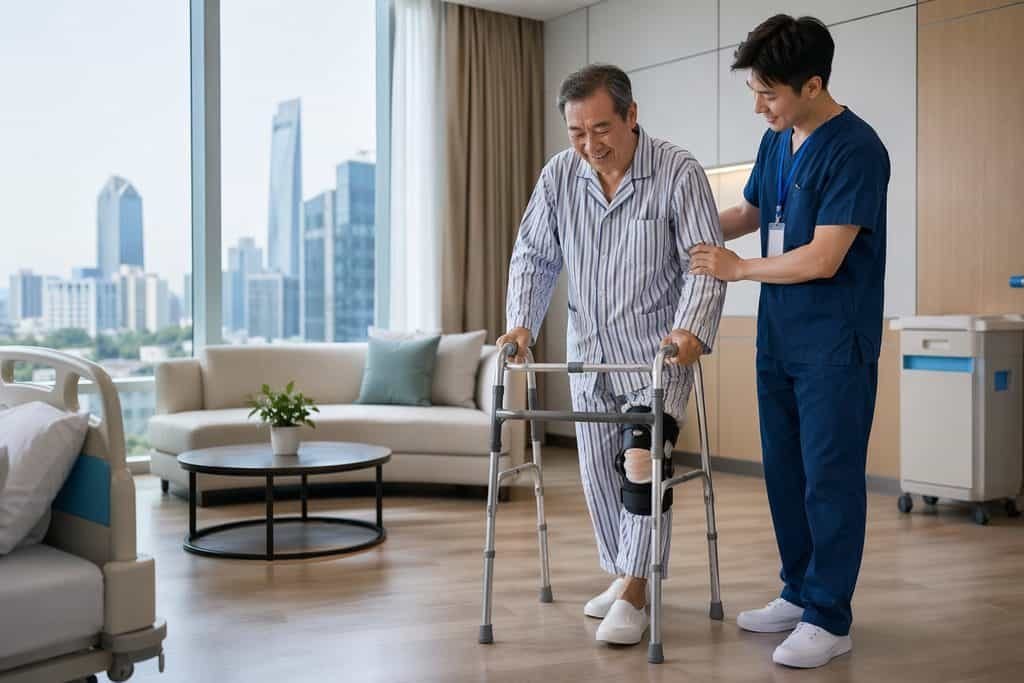
What the two teams actually need from each other
A knee replacement decision is not made from a single X-ray. The China hospital needs the record that shows why your knee is being considered for surgery, what has already been tried, and what the alignment and joint surfaces look like. Your home team needs to know what is being proposed in China, with which implant and whether robotic assistance is part of the plan, so it can comment on whether that matches the care you have already discussed.
This is a records exchange, not a transfer of authority. The China hospital decides suitability and the operative plan. Your home clinicians remain the people who know your history, your other conditions and your previous operations. Neither side should be asked to approve a plan it has not seen.
The most useful first step is a short list of what each side is missing. Ask the China team what it still needs before it can give a view, and ask your home team what it would want to see before commenting. That list becomes the handover.
Why robotic assistance is being proposed for your knee
Robotic assistance supports joint-replacement planning; it does not replace the surgeon's judgement about whether replacement is appropriate. The AAOS patient information on robotic-assisted joint replacement describes the technology as a planning and support tool, and suitability remains a surgeon-led decision. That distinction matters when you are comparing what is offered at home with what is offered in China.
Ask the China team to explain, in plain terms, what the robotic system would add in your case. Useful questions include: what does the planning step change about the proposed alignment or implant position; which platform is proposed; and what would happen if robotic assistance were not used. The answer should be specific to your knee, not a general description of the technology.
Do not assume that robotic assistance is automatically better for every knee, and do not assume it is available at every hospital. Availability, platform and whether it is appropriate for your anatomy are questions for the treating hospital. If the answer is vague, ask again before you treat it as a confirmed part of the plan.
What the written estimate should tell you
A quote for knee replacement can cover different things at different hospitals. Rather than assuming what is or is not included, ask the named hospital for a written estimate that separates the components you care about: the surgeon and hospital charges, the implant, any technology-related charge, imaging and tests, the ward or room, medicines, and follow-up visits.
Ask specifically how the estimate treats robotic assistance. Some hospitals may present it as part of the procedure; others may list it differently. The point is not to guess which is more common, but to get the hospital's own written scope. If a line is described as undecided, ask what would determine it and when you would be told.
Your home team can help you read the estimate. A surgeon or physiotherapist who knows your knee can say whether the proposed implant type, alignment approach and rehabilitation plan match what they would expect. They cannot confirm Chinese prices or hospital billing, and they should not be asked to. Keep those two questions separate.
The records that need clarifying
Records are frequently incomplete in ways that matter. The China team may have a recent X-ray but no standing long-leg alignment film, or a discharge summary that does not state which implant was used previously. Your home team may have the operative note but not the rehabilitation record showing how you recovered.
Ask each side what it is missing rather than sending everything. A focused request is easier to answer and less likely to delay a decision. If a record does not exist, say so; a clinician can work with a known gap, but not with a silent one.
Imaging should be sent in a format the receiving team can open, and reports should be accompanied by the images where possible. Ask the China hospital what format it accepts and whether it needs the original files or a disc. Do not assume that a report alone is enough for surgical planning.
- Recent knee imaging, including any alignment or weight-bearing views that exist.
- Previous knee surgery notes, including implant details if a replacement has already been done.
- The current medication list and relevant medical history.
- The rehabilitation record and current function, including walking distance and aids used.
- The specific question your home team wants answered.
How postoperative reviews would be arranged
The handover does not end at surgery. Ask the China hospital how follow-up would work after you return home: which reviews happen before discharge, what would be done remotely, and what your home team would be asked to check. Ask who would receive the operative note and discharge summary, and in what language.
Your home physiotherapist or surgeon may be willing to take over rehabilitation, but that is their decision and depends on their own assessment. Do not assume that only the original surgical team can assess you afterwards. A receiving clinician can review your progress independently, provided they have the records.
If a review is planned in China, ask what it involves and whether it can be combined with other appointments. If it cannot, ask what the alternative is. The answer should be a concrete arrangement, not a general promise of support.
Ask what the discharge summary will contain and who will write it. A summary that lists the implant, the approach used, any restrictions and the rehabilitation milestones is more useful to a receiving clinician than a one-line note. If the China team uses a template in Chinese, ask whether an English version can be provided for your home team.
Ask how a problem would be handled after you leave. If you develop swelling, reduced movement or a wound concern at home, who should you contact first, and what information would the China team need to respond? This is not a request for a guarantee of remote care; it is a request for a named route and a clear expectation of what can and cannot be assessed from a distance.
Ask whether any review in China would require a separate appointment, a separate fee or a separate trip. If the answer is that a review is included in the surgical package, ask what that includes in practice: a consultation, imaging, a dressing change or a physiotherapy session. If it is not included, ask what the hospital would charge and how it would be arranged.
Finally, ask your home team what it would need in order to take over your rehabilitation. A physiotherapist may want the operative note, the discharge summary and a clear statement of any weight-bearing or range-of-motion restrictions. A surgeon may want the implant details and the alignment plan. Getting that list before you travel is easier than reconstructing it afterwards.
The exchange works best when both sides know what the other is waiting for. A short written summary, updated as answers arrive, keeps the handover moving without turning it into a second clinical opinion. If a question cannot be answered yet, record that it is outstanding rather than leaving it unspoken.
A practical way to run the exchange
Put the exchange in writing. A short shared summary with the diagnosis, the proposed procedure, the implant and technology scope, the outstanding records and the questions for each side keeps both teams working from the same page. Update it as answers arrive rather than starting a new thread each time.
Name one contact on each side. On the China side, that may be a coordinator or the hospital's international office; on your side, a clinician or a family member who can gather records. A single point of contact reduces the chance that a question is answered twice or not at all.
Set a review point. Ask the China team when it expects to be able to give a view, and ask your home team when it can respond. If either side needs more information, that should be stated rather than left as silence. A preliminary reply is useful only if it tells you what is still missing.
ChinaSpecialistCare can help with the practical side of this exchange: gathering records, arranging interpretation, and requesting a specialist appointment so the questions above reach the right team. The hospital decides suitability, and no outcome is guaranteed. An initial enquiry is free and does not require buying a proxy consultation.
Start with a brief summary of your knee problem, what has been done so far, and the specific question you want answered. The team will tell you what is missing and what the relevant next step is.
Sources & scope of this guide
References and official service information relevant to this guide.
This is general planning information and has not been individually reviewed by a doctor. Medical decisions and personal treatment advice come from your treating clinicians.