
Home / Orthopedics / Robotic-Assisted Knee Replacement
Orthopedic technology guide · 机器人辅助膝关节置换术

Robotic Knee Replacement in China

Considering robotic knee replacement in China? Start with knee alignment, implant scope and technology charges. This guide helps you identify the relevant records, questions for the receiving team and the scope of an individual estimate before a visit is agreed.

Orthopedic surgeon explaining robotic knee replacement planning to an international patient

Medical records & cost enquiry

Robotic Knee Replacement: assessment and cost questions

For Robotic-Assisted Knee Replacement, the budget depends on the proposed care and the hospital. A useful estimate needs to distinguish:

  • Partial or total replacement and implant plan
  • Robotic planning and equipment charges
  • Admission and rehabilitation

Hospital medical fees, travel and our coordination services are separate. Any paid specialist review or coordination service is explained and agreed before you proceed.

Your next step

Start with your question

Tell us your diagnosis and what you need. Our free initial review checks the information and helps identify a suitable next step; it is not a specialist opinion or a hospital quotation.

Request a case-based estimate

Not ready to send records? Ask us first. Where hospital review is appropriate, we can help request an estimate. No travel commitment or mandatory proxy consultation.

Planning robotic knee replacement in ChinaHospital review · individual costs · visit and follow-up

Plan the visit around knee alignment, implant scope and technology charges. Agree the assessment route before travel.

Records for the robotic knee replacement review

Tell us what you already have: Diagnosis and main symptoms; Recent weight-bearing knee X-rays; Full-length standing alignment image, if available. Start with a short summary; after first contact we explain which records the receiving team needs and how to share them.

Confirm the proposed scope and costs

Before asking for a personal estimate, clarify: Partial or total replacement and implant plan; Robotic planning and equipment charges; Admission and rehabilitation. The receiving team confirms the proposed scope and hospital charges; coordination is agreed separately.

Visits and care after returning home

Ask why robotic assistance is proposed for your knee, what the estimate includes and how postoperative reviews would be arranged. Tell us if you need interpretation or English-language documents, and confirm the relevant arrangements with the receiving team.

What does “robotic” knee replacement mean?

Robotic-assisted knee replacement is a way of planning and carrying out a total or partial knee replacement. The implant is not a robot, and the system does not independently decide what operation to perform. The surgeon selects the procedure, reviews the plan and controls the instruments throughout surgery.

Different systems use different workflows. Some create a three-dimensional model from a pre-operative CT scan; others collect anatomical points during the operation. The technology may help the surgeon plan component size and position and guide bone preparation within defined limits.

Technology is a tool, not a diagnosis

A patient still needs an appropriate indication for total or partial knee replacement. A robotic platform cannot turn an unsuitable operation into a suitable one.

Who may be considered?

The clinical reasons for replacement are broadly the same as for conventional surgery: advanced joint damage, pain or stiffness that substantially limits life, supportive imaging and insufficient relief from appropriate non-surgical treatment. The team must also assess medical fitness for anaesthesia, rehabilitation and clot prevention.

Robotic assistance may be available for selected total or partial replacement systems. It may not be offered when the hospital’s platform does not support the required implant or procedure. Previous hardware, severe deformity, imaging limitations and the surgeon’s preferred workflow can also affect whether it is used.

Questions to ask before choosing a platform

  • Is the proposed operation total or partial replacement, and why?
  • Does this system require a CT scan or use information collected during surgery?
  • Which implant systems are compatible with the platform?
  • How many similar cases has the surgical team performed?
  • What happens if the robotic system cannot be used or completed as planned?
  • Does using the technology change the quotation, imaging or travel schedule?

Key points for this treatment
Surgeon-ledthe robot does not operate alone
Planninganatomy guides the surgical plan
Total or partialdepends on the chosen system
Same recoverydriven by the actual replacement
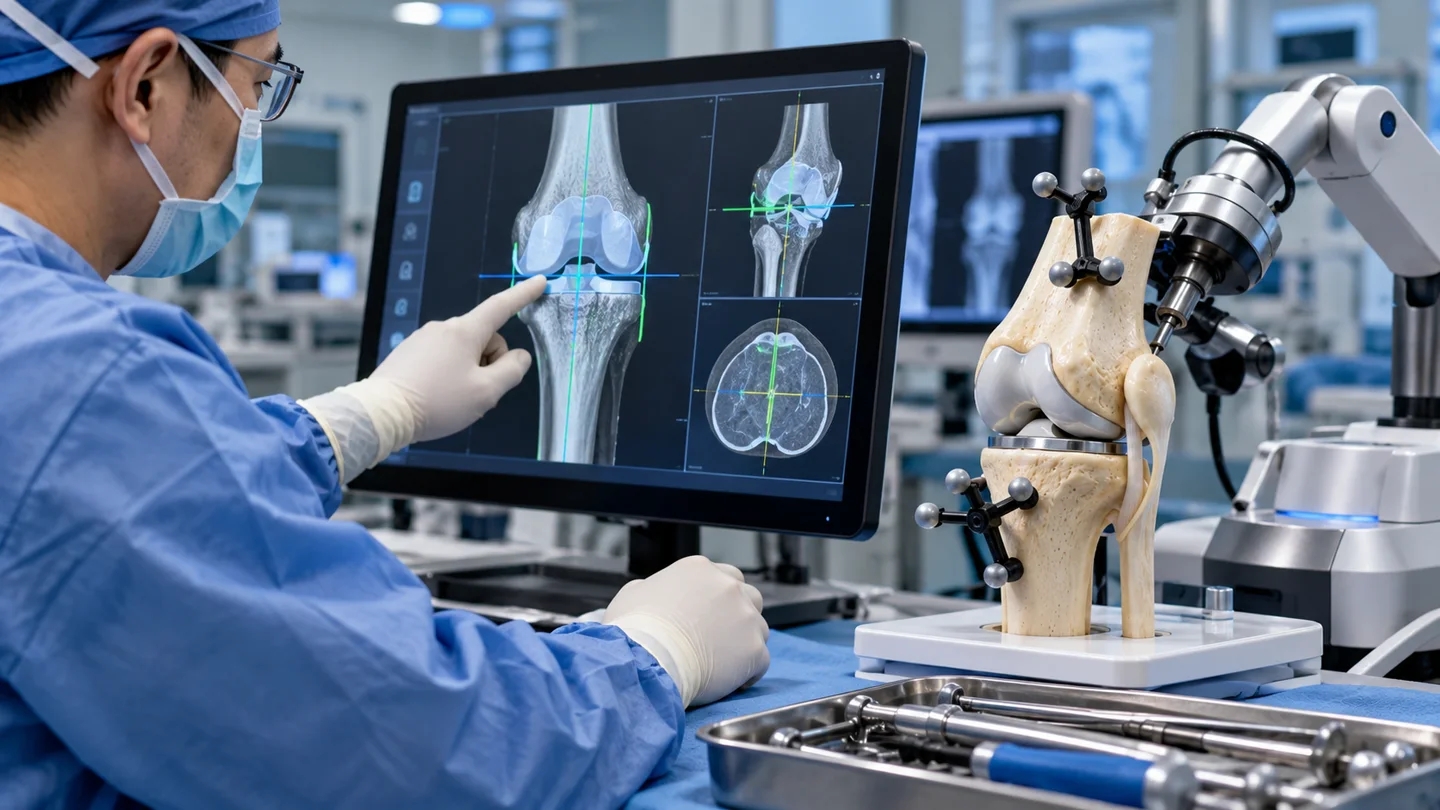
Surgeon using a knee planning workstation with tracking equipment and robotic guidance arm
Surgeon-controlled planning and executionThe surgical team interprets the anatomy, approves the plan and controls the instruments; the robotic system provides guidance within that workflow.

How the robotic-assisted workflow works

1. Build the plan

The system creates a representation of the knee using a pre-operative scan or anatomical mapping performed during surgery. The surgeon reviews alignment, bone shape, implant size and the intended position of the components.

2. Register and track the knee

Tracking arrays or pins may be attached to the femur and tibia so the system can follow the knee’s position. The surgical team checks that the digital representation corresponds to the patient’s anatomy.

3. Prepare the bone and place the implant

The surgeon uses a robotic arm, navigation display or guided cutting instrument to prepare bone within the planned boundaries. The team then places the implant, checks stability and movement, and adjusts the plan when clinically necessary.

If the robotic workflow cannot continue, the surgeon may complete the replacement using conventional instruments, provided that this possibility has been included in the consent and operative plan.

What does the evidence say?

Robotic systems can improve the accuracy or consistency of some measurements and component positioning, but positioning is not the only factor that determines pain relief, function or implant survival. Rehabilitation, infection prevention, soft-tissue balance, medical health and the experience of the entire team also matter.

No guaranteed outcome advantage

AAOS clinical guidance reports no significant short-term difference in function, outcomes or complications between robotic-assisted and conventional total knee arthroplasty; long-term benefit remains unproven. Patients should be cautious about promises of a “perfect fit,” painless surgery or automatically faster recovery.

The useful comparison is not “robot versus no robot” in isolation. Ask whether the proposed operation is correct, whether the surgeon is experienced with that exact workflow, and how the hospital manages anaesthesia, infection prevention, rehabilitation and follow-up.

Hospital stay and recovery

Recovery is determined primarily by whether the patient has a total or partial replacement and by their health and function—not by the presence of a robot. Patients are generally encouraged to stand and walk with support soon after surgery. Pain control, wound care, clot prevention and physiotherapy begin in hospital.

International patient practising supervised walking during rehabilitation after knee replacement
The operation still requires ordinary rehabilitationSafe walking, knee movement and progressive strengthening remain central regardless of which instruments were used during surgery.
Early phasePain control, supported walking and clot prevention
First weeksWound review, motion and progressive activity
Later recoveryStrength, endurance and swelling continue to change
TravelLong-haul plans require surgeon clearance

Risks and limitations

The replacement itself carries risks such as infection, blood clots, bleeding, stiffness, persistent pain, fracture, nerve or blood-vessel injury, instability and implant loosening or wear. Robotic workflows can add considerations including:.

  • Small additional incisions or bone pins used for tracking.
  • Rare pin-site fracture, infection or soft-tissue irritation.
  • Radiation exposure when a pre-operative CT scan is required.
  • Longer setup or operative time during some workflows.
  • System, registration or equipment problems requiring a conventional fallback.
  • Additional cost without a guaranteed improvement in patient-reported outcome.
Seek urgent medical help

Sudden chest pain, shortness of breath, increasing calf swelling, high fever, wound drainage or rapidly worsening pain requires urgent clinical assessment.

Before hospital review

Records for robotic knee replacement assessment

The same core records are needed whether the hospital proposes conventional or robotic-assisted replacement.

Diagnosis and main symptoms
Recent weight-bearing knee X-rays
Full-length standing alignment image, if available
CT or MRI images and reports, if obtained
Previous knee surgery records
Medication list and allergies
Medical history and anaesthesia issues
Mobility level and treatment goals
Ask whether a new scan is required

Some robotic systems require a specific CT protocol. Do not repeat imaging before the destination hospital confirms what its platform needs.

Tell us what you need

Ask about your care,
your hospital and your budget.

You can ask about suitability, an expert opinion, an appointment or the likely medical cost. If you are unsure, choose “Not sure — please advise”.

This enquiry is aboutRobotic-Assisted Knee ReplacementNot sure — please advise

How a personal estimate is prepared

  1. Tell us about your case.Describe your diagnosis, main question and preferred city, if any.
  2. Share the relevant records.We explain what is needed and how to send it by WhatsApp or email.
  3. Request a hospital estimate.Where appropriate, we help request hospital review and a cost estimate. Any paid review is agreed first.

This is an enquiry, not an order or payment. Proxy consultation is not mandatory. Any service scope is agreed separately before you proceed.

Ask about Robotic-Assisted Knee Replacement

A first enquiry is free. Email and permission to respond are required; the other details are optional. Any paid clinical review or coordination is discussed separately.

Included automatically so we know which procedure you are asking about.
A preference, not a confirmed appointment.
Please do not send passport numbers, card details or full medical files in this first enquiry. We will explain which records are needed next.

Send a short summary first. This is an enquiry, not an order, payment or confirmed appointment.

No booking or payment is made by sending this enquiry.
Editorial transparency

Medical sources

Patient information is based on established orthopedic guidance. Content updated 5 October 2026. This is patient information, not an individual clinical assessment.