What a Missing Record Actually Changes
A missing record changes how much a surgeon can assess before you travel. It does not change whether you can ask a question. The useful distinction is between records that support the decision to operate and records that support the technical plan for the operation.
For robotic knee replacement, the surgeon needs to understand your knee alignment, the condition of the joint surfaces, previous surgery or injury, and your general health. Some of that comes from imaging. Some comes from clinical examination. Some comes from the operation note if you have had surgery before.
If a recent weight-bearing X-ray is missing, the surgeon may not be able to judge alignment or the degree of joint damage from the records alone. If an older imaging report exists but the images themselves are absent, the report may describe findings without giving the surgeon the pictures needed for planning. If a previous operation note is missing, the surgeon may not know what implant or bone cuts were used before.
None of this means the case is rejected. It means the first reply may be a request for specific documents rather than a treatment plan. That request is useful information: it tells you what the clinical team considers necessary before it can discuss robotic assistance for your knee.
Which Documents Matter Most for a Knee Assessment
The exact list depends on your history and on what the receiving hospital asks for. Rather than sending everything you own, it helps to sort records into four groups and check which group has a gap.
The first group is imaging. This includes the actual image files, not only the written report, for X-rays, CT or MRI of the knee. Ask the imaging centre for a copy in a standard digital format on a disc or through a secure link. If you only have films, ask whether a digital copy can be issued.
The second group is clinical notes. These include clinic letters, consultation summaries and any record of knee injections, arthroscopy or previous knee surgery. If you have had a knee replacement before, the operation note and the implant details matter because revision planning differs from first-time surgery.
The third group is general health information. This includes your current medication list, relevant blood test results, and records of heart, lung, kidney or bleeding conditions. The treating team uses this to judge anaesthetic and surgical risk, not to decide the knee plan alone.
The fourth group is your own description. A short written summary of when the pain started, what makes it worse, what you can still do, and what you have already tried is genuinely useful. It helps the clinician match the records to your actual symptoms.
Who to Ask for Each Missing Item
Different records sit with different holders, and asking the right office saves time.
Imaging images and reports are held by the radiology department or imaging centre that performed the scan. Ask for the images and the report together. If the centre has closed or merged, ask the hospital medical records department where the images were archived.
Clinic letters and consultation notes are held by the clinic or hospital that provided the care. Ask for a copy of the letter sent to your referring doctor, because that often summarises the assessment more clearly than the raw notes.
Operation notes and implant details are held by the hospital where the surgery took place. If you do not know the implant model, the operation note or the implant sticker record is the place to look. If that hospital no longer holds the file, ask your current orthopaedic clinic whether it has a copy.
Blood tests and general health records are held by the laboratory or clinic that ordered them. If you are unsure which results are relevant, ask the receiving clinical team which specific tests it wants rather than sending a large unrelated archive.
Why Robotic Assistance Is Being Proposed for Your Knee
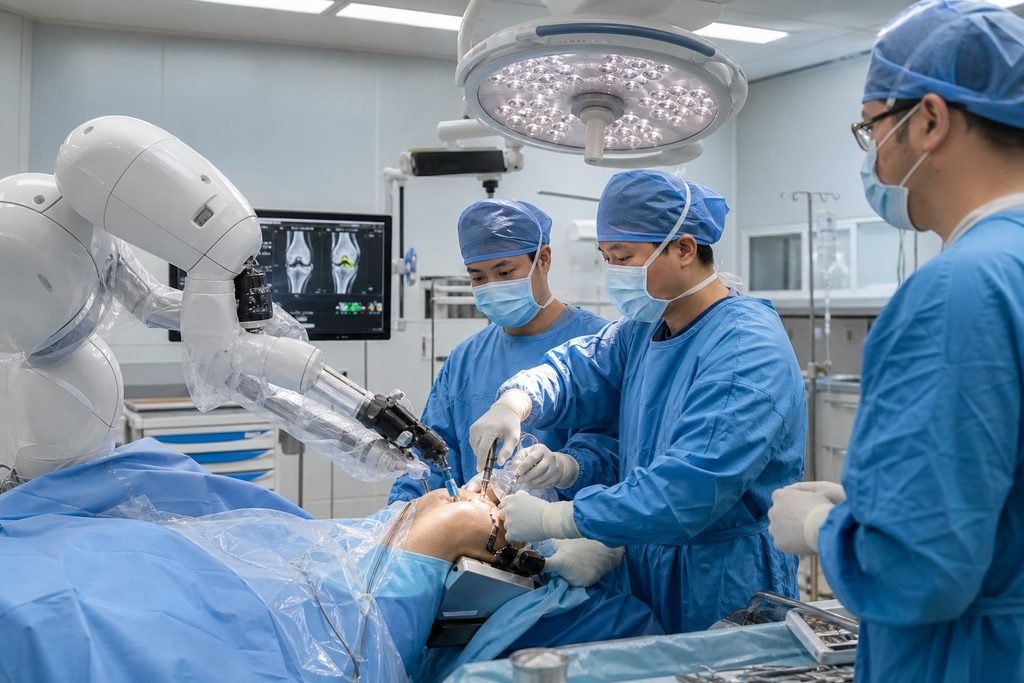
Robotic assistance supports joint-replacement planning. It is not a robot-only operation, and it is not automatically better for every knee. The surgeon still decides whether it is suitable, and the clinical judgement remains with the treating team.
This is worth clarifying early, because it affects what records the hospital wants. Ask why robotic assistance is being considered in your case. Possible reasons a surgeon may raise it include the need for precise alignment, complex anatomy, or a previous knee replacement. The answer should come from the surgeon assessing you, not from a general description of the technology.
Ask which robotic platform is proposed and what that platform requires before surgery. Some systems rely on a preoperative CT scan; others use intraoperative data. If a specific scan is part of the plan, that scan becomes one of the records you need to arrange, and the hospital should tell you whether it can be done locally or after arrival.
Ask what would change if robotic assistance were not used. A clear answer helps you understand whether the technology is central to your treatment or one option among several. If the surgeon cannot explain the difference in your case, that is a reasonable point to raise before committing to travel.
What the Estimate Should Cover Before You Decide
A records-based estimate is only useful if you know what it includes. Ask the named hospital or provider for a written quote that separates the components rather than a single total.
Ask whether the quoted figure includes the surgeon fee, anaesthesia, the hospital stay, standard implants, and any technology charge linked to robotic assistance. Ask whether imaging done before or after arrival is billed separately. Ask how complications or a longer stay would be handled. These are questions for the provider issuing the quote, because billing arrangements differ between hospitals.
Knee alignment, implant scope and technology charges are three separate variables. A quote built on partial records may be provisional. If the hospital has not seen your imaging, it may give a range or ask for more information before confirming a figure. That is normal and not a reason to assume the case is unsuitable.
Keep the quote and the record request together. If the hospital asks for a specific scan before quoting, arrange that scan first, then ask for the estimate to be updated. This avoids comparing figures that were based on different information.
Coordination fees and hospital charges are separate. Hospital consultations, tests, treatment, medicines and rooms are paid to the hospital or relevant provider. Ask the provider what its written quote includes rather than assuming a standard structure.
How Postoperative Reviews Would Be Arranged
Recovery planning matters as much as the operation itself, especially if you are travelling from another country. Ask how wound checks, stitch or staple removal, physiotherapy and follow-up imaging would be scheduled, and whether any of these can be done locally at home.
Ask who would be responsible for reviewing you after discharge and how you would contact that team if a problem arose. Ask what written instructions you would receive, and in what language. Ask whether the hospital can share records with your local doctor so that care continues without a gap.
Physiotherapy is a separate clinical judgement. The receiving physiotherapist or surgeon decides what is appropriate for your knee, and a local physiotherapist can assess you independently. You do not need the original surgical team for every rehabilitation decision, but you do need clear discharge information to hand over.
If you are planning to fly home after surgery, ask the treating team when it considers travel safe for you. This is an individual clinical decision based on your recovery, wound healing and risk of clot, not a fixed number of days. Do not book travel before the clinical team confirms it is appropriate.
Sources & scope of this guide
References and official service information relevant to this guide.
This is general planning information and has not been individually reviewed by a doctor. Medical decisions and personal treatment advice come from your treating clinicians.