
What the robot actually does during mitral repair
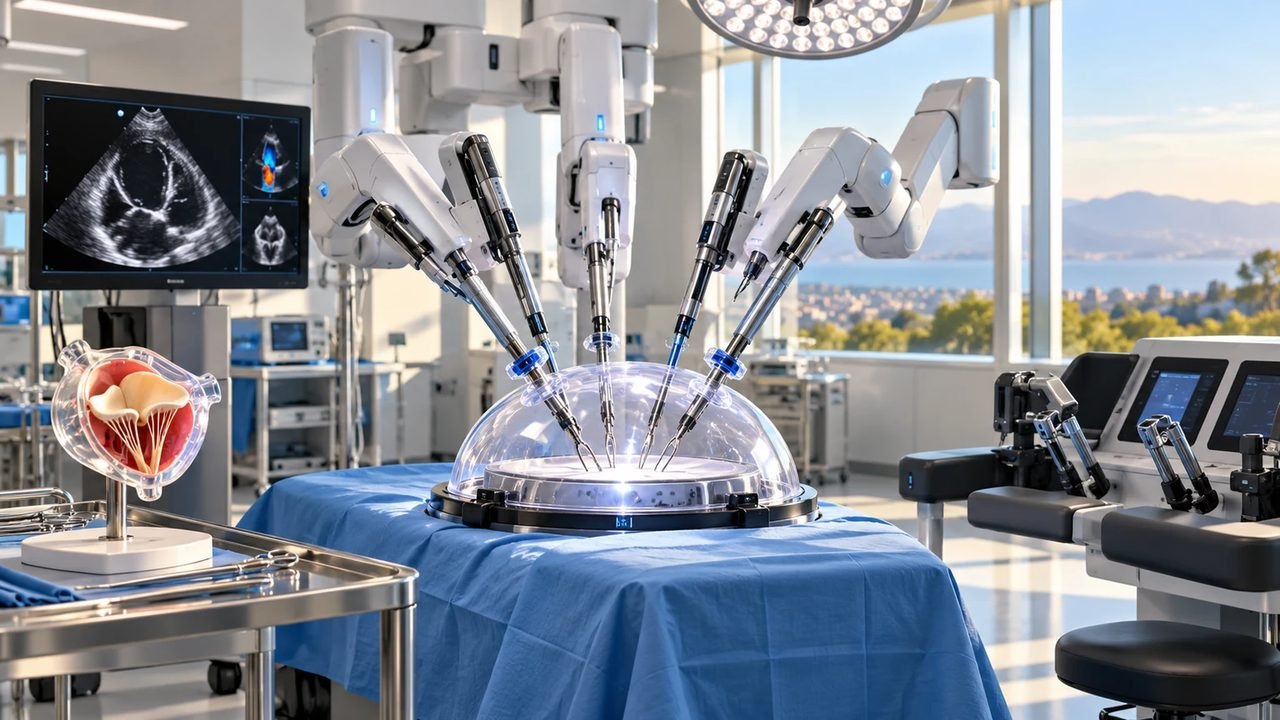
The word 'robotic' can suggest that a machine performs the operation. It does not. The surgeon sits at a console and moves instrument arms through a few small openings between the ribs, while a bedside team stays with you. The system translates the surgeon's hand movements into precise motions inside the chest, with a magnified three-dimensional view of the valve.
The operation itself is a mitral valve repair, not a separate procedure invented by the robot. The surgeon reshapes or supports the valve leaflets and the ring around them so the valve closes more completely. Repair, where the anatomy allows it, preserves your own valve rather than replacing it. Whether repair is feasible is a clinical judgement made from imaging and, sometimes, from what the surgeon finds during the operation.
Compared with a full sternotomy, the robotic route avoids dividing the breastbone. That changes the recovery experience, but it does not make the operation minor. Cardiopulmonary bypass is still used, the heart is still stopped and restarted, and the same serious risks of cardiac surgery apply. Treat the robotic approach as a different way in, not a lower-risk category of operation.
One practical consequence is that the surgeon depends heavily on preoperative imaging. The team needs a clear picture of the valve's structure, the direction and severity of the leak, and the condition of the surrounding heart. If the images are incomplete or the anatomy is complex, the team may plan a different approach.
Who is usually considered, and who is not
Robotic mitral repair is generally discussed for patients with mitral regurgitation or another mitral valve problem who are judged suitable for surgical repair and for whom a minimally invasive route is appropriate. Age alone does not decide this. The treating team looks at the valve anatomy, heart muscle function, lung function, previous chest surgery, body habitus and other conditions that affect anaesthesia and healing.
Some patients are better served by conventional open repair, by a catheter-based procedure such as mitral TEER, or by medical management while further assessment is done. Previous chest surgery, dense adhesions, certain patterns of valve calcification and other anatomical features can make the robotic route unsuitable. These are general considerations, not rules you can apply to yourself.
This is where the roles separate. A coordinator can help you reach a cardiac surgical team and organise records. That team decides whether you are a candidate, which operation it recommends and whether it can offer the robotic approach in your case. No enquiry, review or preliminary reply establishes surgical eligibility, and a records-based opinion is a step towards a decision rather than the decision itself.
If you have active breathlessness at rest, chest pain, fainting or rapidly worsening symptoms, seek local urgent assessment rather than planning travel. Deferring care to arrange an overseas operation is not appropriate when your condition is unstable.
The records a Chinese cardiac team will want to see
A mitral valve decision is made from images and measurements, not from a diagnosis line in a discharge letter. The most useful starting set is your most recent echocardiogram report with the images themselves, ideally including the measurements of valve function and chamber size. If you have had a transoesophageal echocardiogram, include it. Cardiac catheterisation or coronary CT results, ECG reports and any Holter monitoring are also relevant.
The team will want to understand your symptoms and your current medicines, including anticoagulants and anything that affects blood pressure or heart rhythm. A recent chest X-ray, blood tests and lung function results may be requested depending on your history. If you have had previous heart surgery, the operative report matters because it changes what is technically possible.
Records should be legible and, where possible, in English or accompanied by a translation. Ask the receiving team what format it accepts and whether it needs original discs or accepts digital files. Do not send passport numbers, payment details or a complete lifetime archive at first contact. A short summary with the key reports is enough to begin.
Expect the team to ask for updates or additional tests. Missing information is a reason for the team to request more, not a reason to assume you are ineligible. Equally, a complete file does not guarantee acceptance; the decision rests with the clinicians who examine you and review the imaging.
What to ask the surgical team before committing
The questions that matter are specific to your valve and to the hospital's own practice. Ask whether repair or replacement is planned, and what the plan is if repair proves impossible once the surgeon is inside the chest. Ask how many robotic mitral repairs the surgical team performs and what proportion of its mitral operations are repairs rather than replacements. A team's own figures are more meaningful than general claims.
Ask what conversion to open surgery would involve and how often it happens at that centre. Conversion is a recognised possibility in minimally invasive cardiac surgery and is a safety plan, not a failure. Ask about the specific risks in your case, including bleeding, stroke, infection, rhythm disturbance and the possibility that the repair does not hold and further intervention is needed.
Ask about the recovery you should expect in general terms, what follow-up imaging is planned, and when you would be fit to travel home. The team should give you its own guidance rather than a generic timeline. Ask who will manage your anticoagulation and cardiac follow-up after you return to your home country, and whether the Chinese team will communicate with your local cardiologist.
Finally, ask what the written treatment plan and quote cover. Hospital fees, our coordination fees and travel costs are separate, and the scope of a hospital quote is something to confirm with that hospital rather than assume.
How care in China is arranged around the operation
Cardiac surgery in China is concentrated in tertiary hospitals, and robotic cardiac programmes exist at selected centres. Public tertiary hospitals and private international hospitals are both possible routes, and the right choice depends on the surgical team's experience with your specific valve problem rather than on a general ranking. Ask directly whether the hospital you are considering has an active robotic mitral programme.
Our role is non-clinical coordination. We can help identify a suitable cardiac surgical team, prepare your records, arrange appointments and support admission logistics after a hospital accepts you. We do not diagnose, decide suitability or perform the operation, and we cannot promise a named surgeon, hospital acceptance or an outcome. A proxy consultation, where our doctor takes your records to a specialist while you remain at home, is optional and not a prerequisite for treatment.
Practical arrangements worth clarifying early include the ward type, whether English interpretation is available during consent discussions and ward rounds, and who can accompany you. Consent conversations about the operation and its risks should happen before any sedation, with interpretation you understand. Post-operative supervision and transport need the treating team's instructions, not a coordinator's assumptions.
Visa documentation, length of stay and fitness to fly are administrative and clinical questions for the relevant authorities and your treating team. We can discuss document assistance, but we cannot guarantee a visa or set a recovery timeline.
Costs, estimates and the limits of a remote opinion
We do not publish a fixed price for robotic mitral repair, and no figure should be treated as a quote. The cost of the operation depends on the hospital, the surgical plan, the devices and materials used, the length and type of hospital stay, and the tests required before and after surgery. A written estimate based on your records is the only meaningful starting point.
Ask the hospital what its quote includes and excludes, and ask the same of any coordination service. Hospital charges, our coordination fees and travel expenses are separate. Do not assume that a published range for another cardiac procedure applies to yours, and do not treat an estimate as a guarantee of the final bill.
A records-based opinion can clarify whether robotic repair is plausible for your anatomy and what further imaging is needed. It cannot replace the surgeon's direct assessment, and it does not establish that the operation will go ahead. Treat any preliminary view as a step towards a decision, not the decision itself.
The next step is to gather your echocardiogram images and key reports and send a short summary through the enquiry form, email or WhatsApp. An initial enquiry is free and does not commit you to a proxy consultation or to travelling. The cardiac team will tell you what it needs and whether it can assess you.
Sources & scope of this guide
References and official service information relevant to this guide.
- Heart valve repair
- https://www.nhlbi.nih.gov/health/heart-valve-diseases/treatment
- https://www.escardio.org/Guidelines/Clinical-Practice-Guidelines/Valvular-Heart-Disease-Guidelines
This is general planning information and has not been individually reviewed by a doctor. Medical decisions and personal treatment advice come from your treating clinicians.