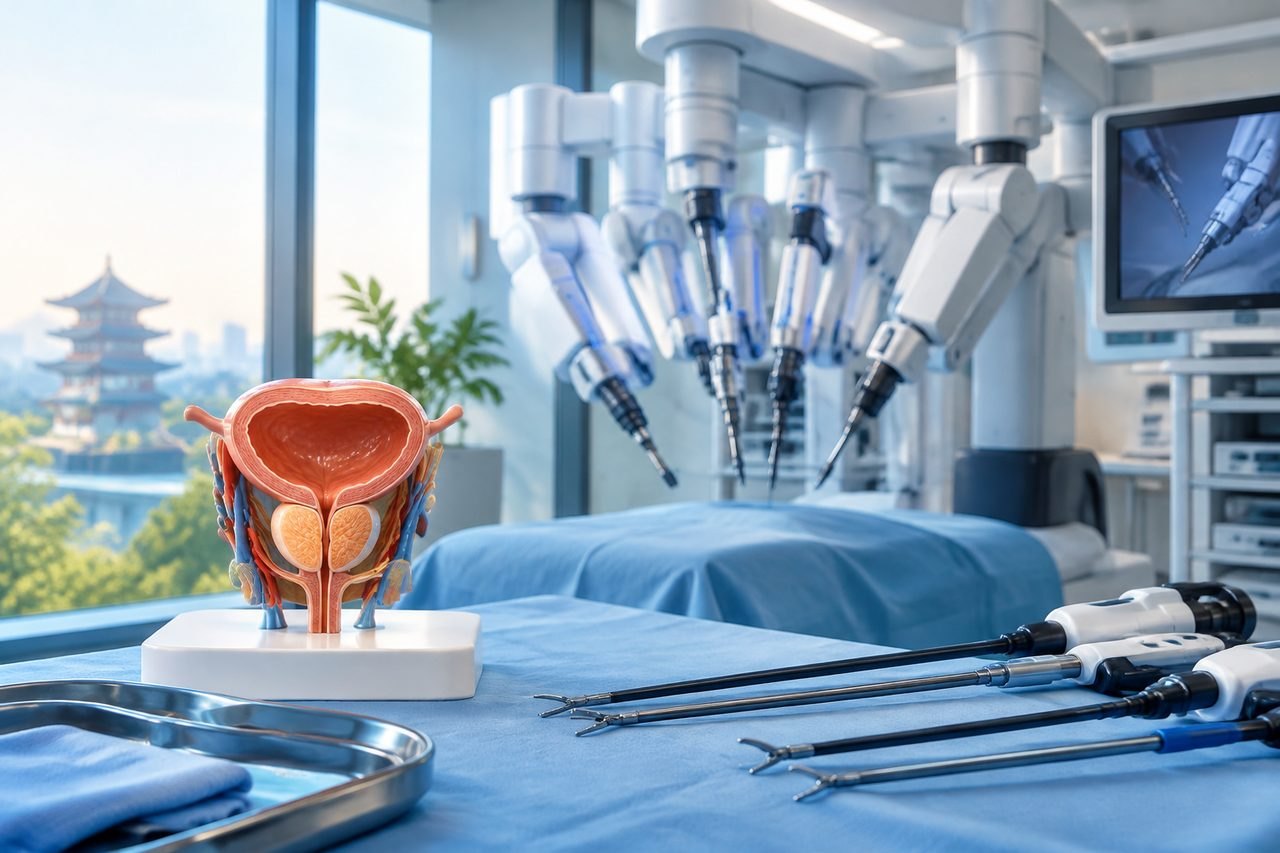
What Operation Scope Actually Covers
Radical prostatectomy removes the prostate for selected prostate cancers, and robotic instruments are controlled by the surgeon rather than acting independently. Within that general description, scope is a set of decisions the operating team makes about how much tissue to remove, what to preserve, and how to reconstruct the join between the bladder and the urethra. Those decisions are not identical for every patient, and they are not all settled before you arrive.
Scope usually includes the extent of the prostate and surrounding tissue removed, whether the surgeon attempts to preserve the neurovascular bundles that run close to the prostate, how the bladder neck and urethral anastomosis are handled, and whether any pelvic lymph nodes are sampled or removed. Each of these has a reason, and each has a trade-off. Removing more tissue may improve cancer control in some situations but can affect continence and erectile function. Preserving more tissue may protect function but may leave cancer behind if the disease extends beyond the capsule.
This is why a useful conversation about scope is not "what is the standard operation?" but "what are you planning for my cancer, and why?" The answer should connect to your biopsy results, your PSA history, your imaging, and your overall health. If the team cannot explain the link between your staging and their plan, that is a signal to ask more questions before committing.
It also helps to separate two things that patients often merge: the cancer operation and the recovery plan. Scope decisions during surgery shape what recovery looks like, including catheter management, continence, and erectile function. Asking about them together gives you a more realistic picture than asking about the operation alone.
Cancer Staging and How It Changes the Plan
Staging is the foundation of scope. Before surgery, the team uses PSA, biopsy findings such as Gleason score, digital examination, and imaging to estimate whether the cancer is confined to the prostate or may have spread. That estimate is not perfect. Final staging comes from the pathology examination of the removed prostate and any lymph nodes, which is why the operating plan can shift during surgery.
Ask the team how they classify your risk group and what that means for the extent of surgery. A patient with low-risk, confined disease may be offered a nerve-sparing approach aimed at preserving function. A patient with higher-risk features may be advised to include wider margins or lymph node sampling. These are not arbitrary choices; they follow from the staging information available before surgery.
You should also ask what the team will do if the intraoperative findings differ from the preoperative estimate. For example, if the surgeon sees evidence of extension beyond the prostate, will they change the planned nerve preservation or extend the lymph node dissection? Knowing the contingency plan in advance helps you understand the reasoning rather than being surprised by a change.
Finally, ask whether the team recommends any additional staging before surgery. This is a clinical decision for them, not something you should request based on a general checklist. If they recommend imaging or a repeat biopsy, ask what question that test is meant to answer and how it would change the operation.
Functional Priorities: Continence and Sexual Function
Most patients considering robotic prostatectomy care about two functional outcomes: staying dry and preserving erectile function. Scope decisions directly affect both. Nerve-sparing surgery aims to preserve the bundles responsible for erections, but it is only appropriate when the cancer is not touching or invading those bundles. Continence depends on the sphincter mechanism, the bladder neck, and how the anastomosis heals.
Ask the team how they weigh cancer control against functional preservation in your case. There is no universal answer. A younger patient with low-risk disease may reasonably prioritise nerve preservation. An older patient with higher-risk disease may reasonably prioritise wider removal. The right balance depends on your cancer characteristics, your baseline function, and your own priorities.
Be specific about your baseline. Tell the team about your current erectile function, any urinary symptoms, and any medications or conditions that affect either. This information shapes what is realistic to expect and what techniques the surgeon may consider. It also gives you a baseline against which recovery can be measured.
Ask what the team can tell you about expected function after surgery in your situation. No surgeon can guarantee continence or potency, and anyone who does should be treated with caution. But a good team can explain the factors that influence your likelihood and the support available during recovery, including pelvic floor exercises and, where appropriate, medication or other interventions.
Catheter Care and the Immediate Recovery Plan
After radical prostatectomy, a urinary catheter is normally left in place for a period to allow the anastomosis to heal. The duration is a clinical decision based on the operation and your recovery, not a fixed number you should assume in advance. Ask the team how long they expect the catheter to stay, who will remove it, and what instructions you will receive for care at home or in your accommodation.
Catheter care is practical but important. Ask about hygiene, how to manage the drainage bag, what to do if the catheter blocks or dislodges, and which symptoms should prompt urgent contact. You should also ask what arrangements are in place if you are staying in China after discharge and need a catheter-related review. This is a coordination question as much as a clinical one.
Ask when and how the team will assess your continence after catheter removal. Some patients regain control quickly; others need time and pelvic floor training. Knowing the follow-up plan helps you prepare mentally and practically, especially if you are travelling home after surgery.
If you are planning to fly home after surgery, ask the team when they consider it safe for you to travel. This is a clinical judgement based on your recovery, not a standard interval. Do not book travel until the treating team has advised you.
Pathology Review and What Happens After Surgery
The pathology report on the removed prostate is the most important document after surgery. It tells you the final Gleason score, whether the margins are clear or positive, whether there is extracapsular extension, and whether any lymph nodes contain cancer. These findings determine whether you need additional treatment, such as radiotherapy or hormone therapy, and how closely you need to be monitored.
Ask the team when the pathology report will be available and who will explain it to you. Ask whether the report will be reviewed by a pathologist with urological expertise and whether you can receive a copy in a language you understand. If you are returning home, ask how the report and follow-up recommendations will be shared with your local doctors.
Follow-up after prostatectomy typically involves PSA testing at intervals set by the treating team. The schedule depends on your pathology results and your overall risk. Ask what the plan is for your first year and how it will be adjusted based on your PSA. Do not assume a fixed schedule; it should be individualised.
If the pathology shows features that require additional treatment, ask how that decision will be made and who will be involved. In some cases, a multidisciplinary team reviews the results. Ask whether that is the process at your hospital and how you will be informed of the recommendation.
Questions to Ask Before You Commit
The most useful thing you can do before agreeing to surgery in China is to ask the treating team a focused set of questions and listen carefully to the answers. You are not expected to make clinical decisions yourself, but you are entitled to understand the reasoning behind the plan.
Ask how they have staged your cancer and what that staging means for the extent of surgery. Ask whether nerve-sparing is planned and why. Ask about the possibility of lymph node removal and what would trigger it. Ask how they will handle a change in findings during the operation.
Ask about the catheter, continence, and erectile function in concrete terms: what to expect, what support is available, and who to contact if something goes wrong. Ask when the pathology report will be ready and how follow-up will be arranged, especially if you are returning home.
Finally, ask for a written summary of the proposed plan and the alternatives discussed. A written record helps you review the information calmly and share it with your family or local doctors. If the team cannot provide this, ask what they can provide instead.
An initial enquiry to ChinaSpecialistCare is free and does not require buying a proxy consultation. You can share a brief summary of your diagnosis and your main question, and the team will help identify missing information and suggest a relevant next step. The hospital decides whether surgery is suitable for you.
Sources & scope of this guide
References and official service information relevant to this guide.
This is general planning information and has not been individually reviewed by a doctor. Medical decisions and personal treatment advice come from your treating clinicians.