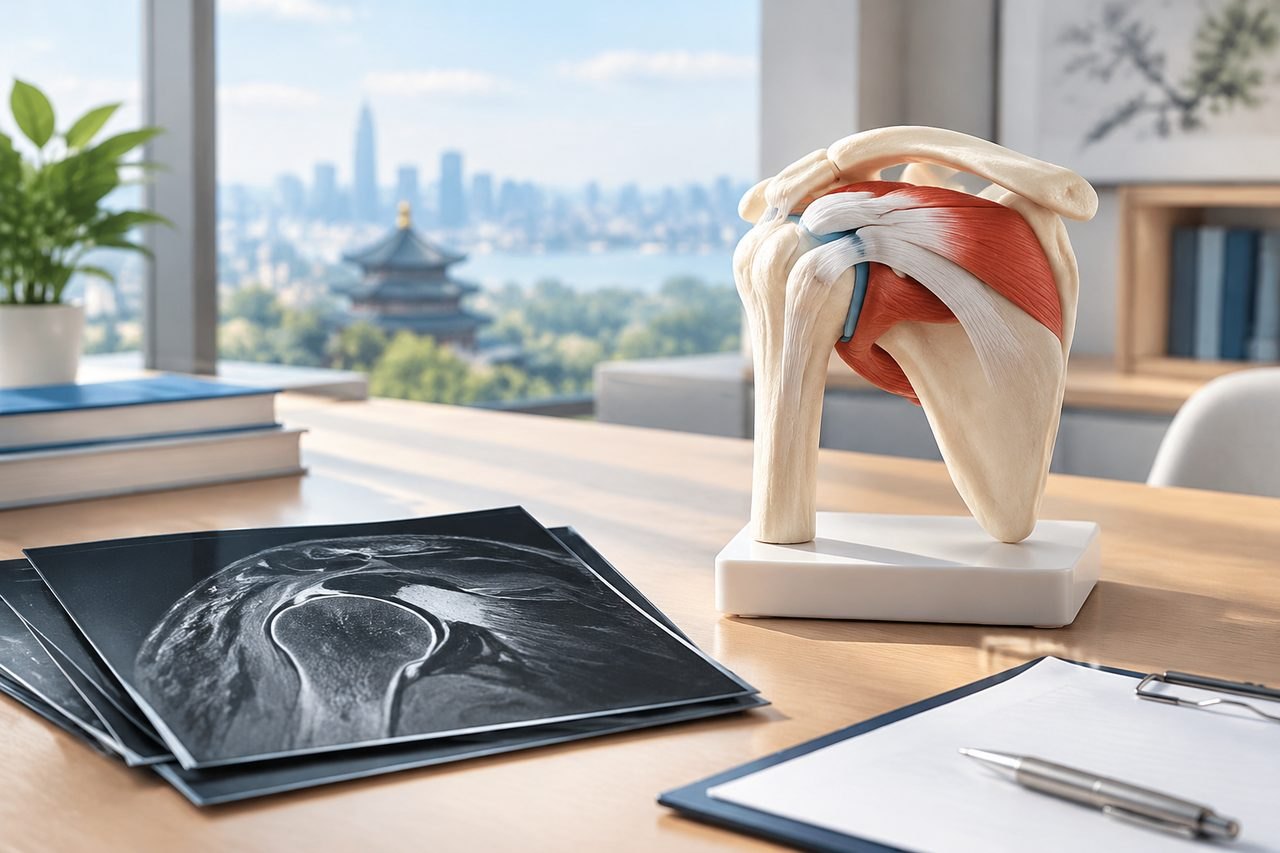
What an old scan already answers, and what it leaves open
An MRI or ultrasound report from your home country usually answers a structural question: is there a tear, where is it, and how large does it appear. That is genuinely useful. It tells a surgeon whether the rotator cuff is involved at all, and it gives a baseline for comparison. If the report is recent and the images are available, not just the written summary, a receiving team can often form a preliminary view without repeating the study.
What the old scan does not answer is the surgical question. A rotator cuff repair reattaches torn tendon to bone, and whether that is feasible depends on things a static image may not settle: how much tendon retraction has occurred, how much muscle has changed, and whether the remaining tissue looks like something a surgeon can anchor and expect to hold. Those judgements are made by the treating clinician, often with the images in front of them and sometimes with an examination.
This is why two patients can arrive with similar-looking reports and receive different recommendations. The report describes the tear. The assessment decides what, if anything, to do about it. Not every tear needs surgery, and not every tear is repairable. That distinction is clinical, not administrative, and no coordinator or article can make it for you.
Why the receiving surgeon may want new imaging
There are legitimate reasons a Chinese hospital may ask for a repeat or additional study, and they are not automatically about distrust of your original scan. Image quality varies. A report may summarise findings without the sequences a surgeon needs to plan an approach. Time may have passed since the original study, and a tear can change. The surgeon may also want imaging performed on equipment and in a format their own team reads routinely.
The reverse is also true: a good recent study with accessible images may be accepted, and a repeat may be unnecessary. Which applies to you is a question for the specific hospital and surgeon, not a general rule. When you contact a provider, ask directly whether your existing images are usable, what format they need, and whether they anticipate new imaging before any decision. That single question prevents a lot of wasted preparation.
It also helps to separate two different requests that can sound alike. One is diagnostic: the team needs to see the shoulder clearly. The other is planning: the team has decided surgery is plausible and wants detail for the operating plan. The first may be satisfied by your records. The second often happens closer to a decision, and sometimes only after an in-person examination.
What a new assessment is actually for
A fresh assessment is not a formality before surgery. It is where several questions get resolved together. Is the shoulder problem actually the rotator cuff, or is something else contributing? Is the tear the kind that tends to do well with repair, or the kind where other options deserve discussion? What is the patient's overall situation, including other conditions and previous shoulder problems, that might change the recommendation?
The examination matters here in a way imaging cannot replace. A surgeon tests movement, strength and specific positions to understand which tendons are involved and how the shoulder is compensating. That information shapes the conversation about whether repair is the right route, what an alternative might be, and what the patient should understand about the recovery period.
Rehabilitation is part of this same conversation, not an afterthought. After repair, rehabilitation protects the repair while movement and strength recover. That means the plan for the weeks after surgery is not generic; it depends on what was repaired and how. The treating team sets the specific restrictions and progression. Ask them what your rehabilitation would involve and who would supervise it, rather than assuming a standard schedule applies.
The records that make a remote first review useful
If you are considering care in China, the first contact does not require a complete medical archive. A short summary is enough to start. What helps most is the material that lets a clinician understand your situation quickly: the imaging report, the actual images if you have them, any previous shoulder treatment or surgery, and a clear statement of your main question.
Think about what your main question actually is. "Is my tear repairable?" and "Is surgery worth considering at all?" are different questions, and they may lead to different next steps. Writing your question down before you send anything helps the receiving team respond usefully instead of guessing what you want to know.
It is reasonable to ask what the team still needs after they see your summary. They may request specific additional views, a recent examination note, or a repeat study. They may also say the existing records are sufficient for a preliminary view. Either answer is useful, because it tells you whether to arrange more imaging at home or wait.
- A short written summary of your shoulder problem and how it affects you.
- The imaging report, and the images themselves if they can be shared.
- Any previous shoulder surgery, injection or treatment, with approximate dates.
- Your main question, stated in one or two sentences.
- Relevant other conditions or medications, mentioned briefly rather than in full detail.
What a new assessment cannot confirm from a distance
A records-based review can give a considered opinion, but it has limits, and it is worth being clear about them before you plan anything. A remote review cannot examine your shoulder. It cannot test strength or movement directly. It cannot settle whether the tissue will hold a repair, because that judgement often depends on what the surgeon sees and feels during the procedure itself.
It also does not establish that a hospital will accept you for treatment, that a particular surgeon will take your case, or that surgery is the right choice for you. Those are decisions for the treating hospital and licensed clinicians after they have what they need. A preliminary opinion is a step in a process, not a clearance.
This matters for planning. If you are arranging travel around an expected operation, you are building on an assumption that has not yet been confirmed. A more reliable approach is to treat the first review as a way to learn what the team thinks and what they still need, then decide about travel once the clinical picture is clearer. Urgent or worsening symptoms should be assessed locally without waiting for an overseas enquiry.
How to frame your enquiry so the answer is useful
The most useful enquiries are specific and short. Instead of sending everything at once, lead with the question you want answered and the records that speak to it. If you have a recent MRI report and images, say so and ask whether they are sufficient for a preliminary view. If your main concern is whether repair is possible, say that plainly. The team can then tell you what they need rather than working through material that does not address your question.
It also helps to ask about scope in writing. If the hospital provides an estimate or plan, ask what it covers, what it does not, and what could change it. Coordination services and hospital medical fees are separate, and the hospital's own written scope is the document that matters for its charges. Do not rely on a general impression of what a quote includes.
For patients who want a structured starting point, ChinaSpecialistCare can review a brief summary, identify what is missing, and suggest the relevant next step. That initial review is free and does not commit you to anything. It is not a diagnosis and not a promise of acceptance. If you later want a records-based opinion from a specialist, that is a separate, optional step, and it is not a prerequisite for every appointment or operation.
A practical next step: gather your imaging report, the images if available, and one clear sentence about what you want to know. Send that short summary through the enquiry form, email or WhatsApp, and ask the team what they still need. You can share fuller records after that first contact. The hospital decides suitability, and the treating clinician decides what the assessment should include.
Sources & scope of this guide
References and official service information relevant to this guide.
This is general planning information and has not been individually reviewed by a doctor. Medical decisions and personal treatment advice come from your treating clinicians.