Home / Orthopedics / Rotator Cuff Repair
Orthopedic patient guide · 肩袖修复术

Rotator Cuff Repair in China

Considering rotator cuff repair in China? Explore the reference costs, prepare your shoulder reports and ask what the proposed repair would involve. Plan for the specialist assessment, support after the procedure and rehabilitation as well as the hospital visit.

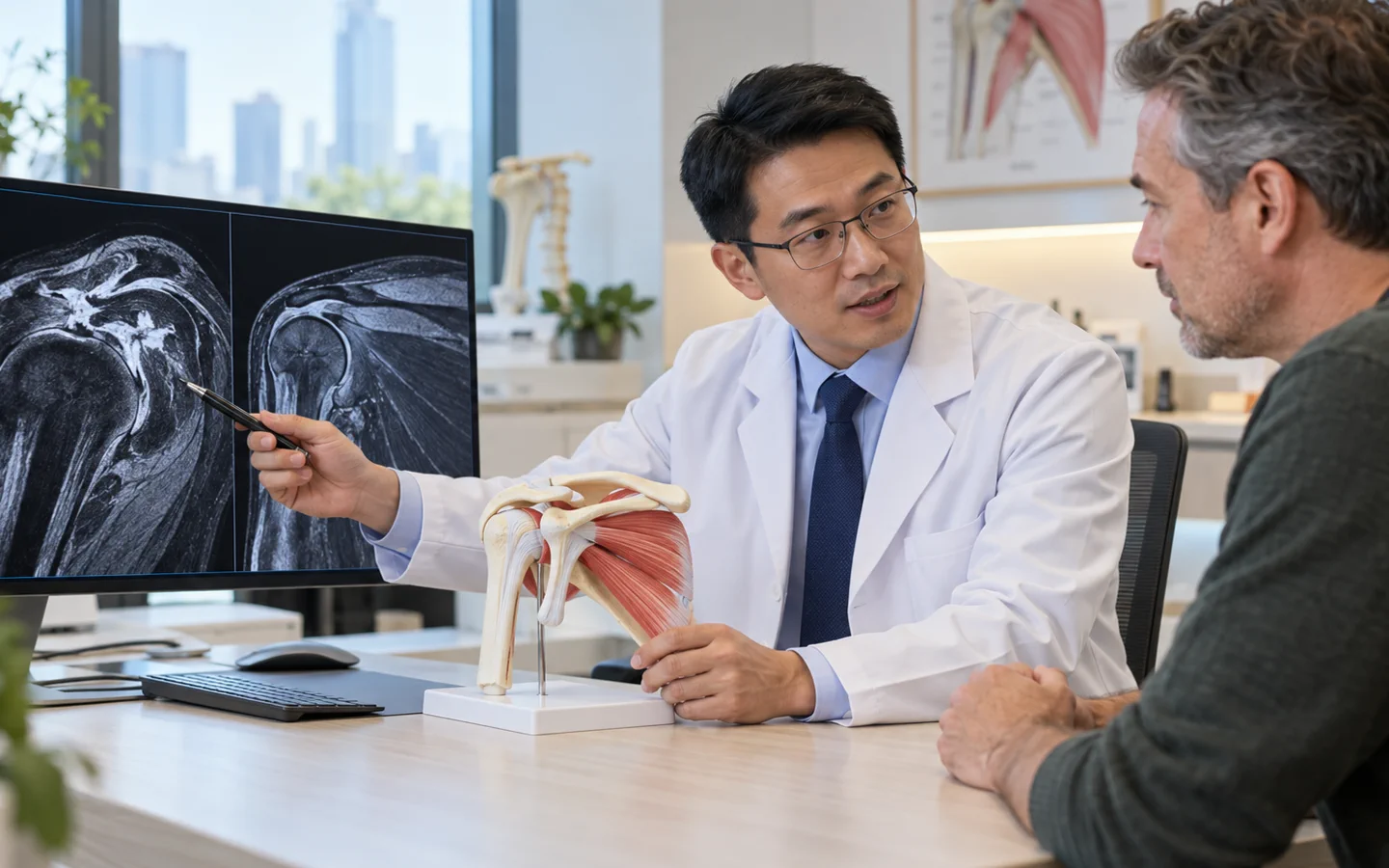
Chinese shoulder specialist reviewing rotator cuff MRI and shoulder model with an international patient

Medical cost reference

Indicative · not a quotation

Rotator cuff repair costs in China

US$4,900–9,000

Original USD reference

Other currencies are approximate equivalents, not a quote or payment rate. Reference FX: ECB · 2 October 2026. Local snapshot, not live.

Rotator cuff repair; tear size, anchors and associated procedures affect costs.

This published reference range is a starting point for planning, not a fixed price or a China-wide average. Cities, public and private hospitals, procedure details and individual care needs affect costs. The hospital must confirm what is included and provide an estimate after reviewing your case.

  • Tear extent and proposed repair
  • Anchors and associated shoulder procedures
  • Protection, rehabilitation and follow-up

Hospital medical fees, travel and our coordination services are separate. Any paid specialist review or coordination service is explained and agreed before you proceed.

Your next step

Start with your question

Tell us your diagnosis and what you need. Our free initial review checks the information and helps identify a suitable next step; it is not a specialist opinion or a hospital quotation.

Request a case-based estimate

Not ready to send records? Ask us first. Where hospital review is appropriate, we can help request an estimate. No travel commitment or mandatory proxy consultation.

Planning shoulder surgery and support in ChinaHospital review · individual costs · visit and follow-up

Confirm the proposed care and practical help you may need before arranging a visit.

Prepare your shoulder history

Tell us about the diagnosis, symptoms, previous treatment and available imaging reports. The specialist needs to assess the tear and your situation before deciding whether repair is appropriate.

Clarify the proposed repair

Ask what the estimate includes for the repair, anchors and any associated shoulder procedure, plus admission and review visits. A published range is not a personal quotation.

Discuss help and rehabilitation

Ask about sling use, everyday assistance, rehabilitation instructions and return-travel readiness. Confirm the review schedule and how your home rehabilitation team will receive the hospital's plan.

What rotator cuff repair can address

The rotator cuff centres the shoulder joint and helps lift and rotate the arm. Tears may be acute after injury or develop gradually. Symptoms and disability do not always match tear size, and some tears can be managed with activity change, pain treatment and physiotherapy.

Repair reattaches torn tendon to bone. The chance of healing depends on tear size, chronicity, tendon retraction, fatty muscle change, smoking, diabetes, age and rehabilitation. Pain can improve even if imaging later shows incomplete structural healing, but the limits should be discussed honestly.

Repairability can change over time

An acute traumatic tear with weakness deserves timely specialist review. A chronic massive tear may retract and develop muscle degeneration, making complete repair less predictable.

Who may be considered?

Repair may be considered for patients with:.

  • An acute traumatic full-thickness tear with meaningful weakness.
  • Persistent pain or loss of function after an appropriate non-surgical programme.
  • A repairable tear likely to progress in an active patient.
  • A tear associated with other treatable shoulder pathology.
  • Medical fitness and ability to protect the repair during rehabilitation.

What the hospital needs to assess

Examination distinguishes cuff weakness from stiffness, arthritis, nerve dysfunction and pain inhibition. X-rays show arthritis and bone shape; ultrasound or MRI defines tendon number, retraction, muscle quality and associated biceps or labral disease. The surgeon reviews onset, prior injections, work demands and whether the patient can manage a sling and therapy.

Key points for this treatment
Four tendonsform the rotator cuff
Repairabilitydepends on tendon and muscle quality
Biological healingtakes months
Alternativeschange with age, arthritis and tear pattern
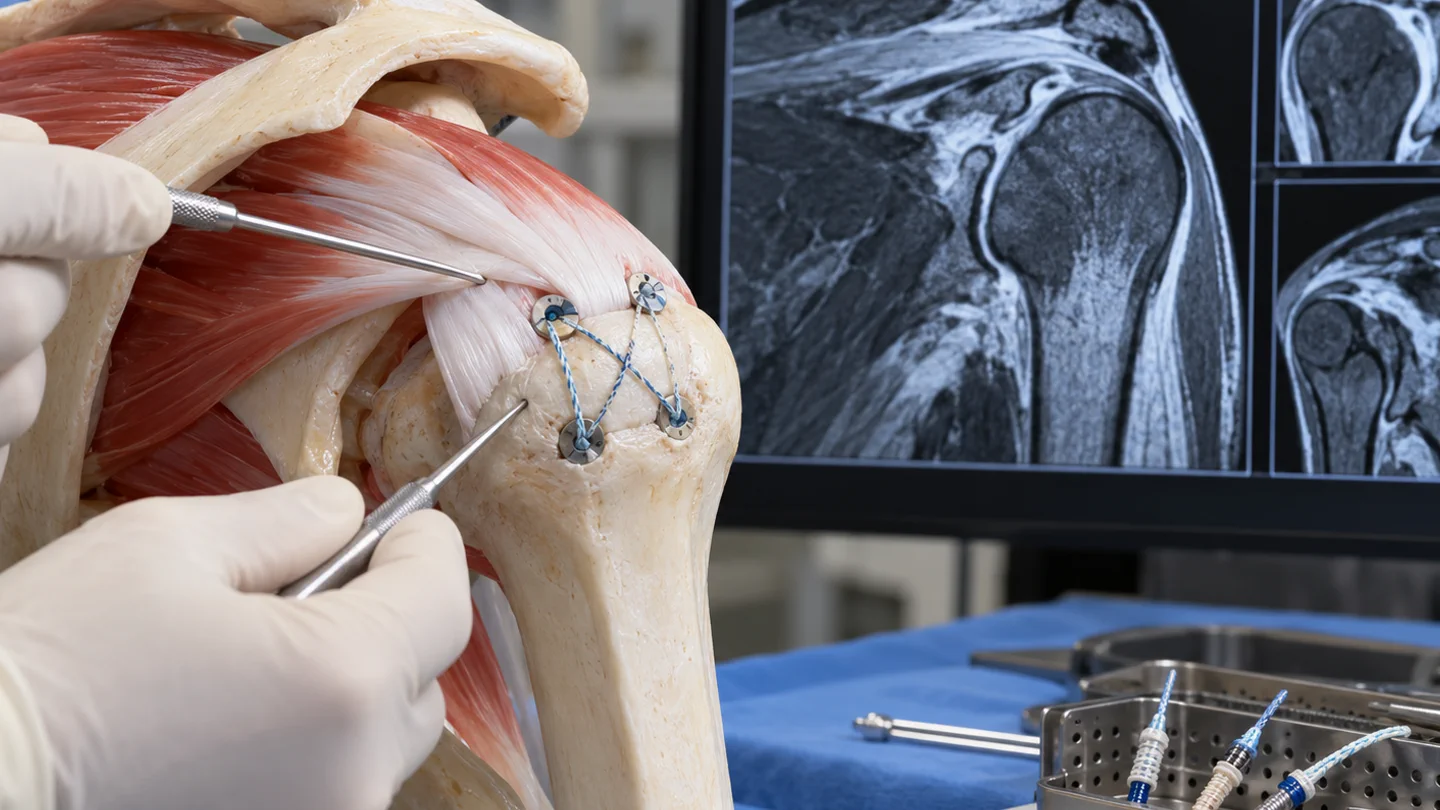
Shoulder tendon model with suture anchors beside MRI during rotator cuff repair planning
The plan starts with tissue qualityThe surgeon maps the tear, mobilises what can heal and anticipates whether biceps treatment, partial repair or another reconstruction may be needed.

Repair and alternatives for irreparable tears

Most repairs are arthroscopic. The tendon is mobilised, the bone attachment is prepared and sutures in anchors secure the cuff. Acromial or biceps procedures are added only when indicated. Single- or double-row patterns describe fixation strategy, not a universal hierarchy.

If the tendon cannot be restored without excessive tension, options may include debridement, biceps treatment, partial repair, graft-based reconstruction, tendon transfer or reverse shoulder replacement. Age, arthritis, deltoid function and goals determine which alternative is reasonable.

Complete repairRestores repairable tendon to bone
Partial repairBalances remaining force when full repair is unsafe
ReconstructionSelected graft or tendon-transfer strategies
Reverse replacementFor selected irreparable tears with major dysfunction or arthritis

Hospital stay and recovery

A sling protects the repair while early hand and elbow motion continues. Shoulder exercises usually move from passive to active and later resisted work. Starting too aggressively can stress healing; excessive protection can contribute to stiffness.

Tendon-to-bone healing takes months. Return to overhead work or sport requires motion, endurance and strength as well as surgeon clearance. International follow-up should specify who adjusts exercises and how a setback will be assessed.

International patient performing protected shoulder therapy with a Chinese physiotherapist after rotator cuff repair
Healing tissue sets the paceMovement is restored in stages so the shoulder does not become stiff without loading the new repair too early.
ProtectionSling and prescribed passive motion
ControlActive movement after adequate healing
StrengthProgressive resistance in a later phase
ReturnWork and sport depend on function and tear size

Risks and realistic expectations

Risks include infection, stiffness, blood clot, nerve injury, anchor problems, persistent pain, incomplete healing or re-tear. Larger chronic tears and poor muscle quality have higher structural failure risk. Surgery cannot restore normal tendon tissue or guarantee previous strength.

Seek urgent medical help

Fever, wound drainage, sudden severe pain after a fall, new hand weakness or numbness, chest pain or breathlessness requires prompt assessment.

Before hospital review

Medical records checklist

A shoulder review needs the actual MRI or ultrasound images and a clear account of weakness, pain and prior treatment.

Shoulder MRI or ultrasound DICOM files
Standard shoulder X-rays
Injury date and onset pattern
Strength, sleep and overhead-function history
Physiotherapy and injection history
Previous shoulder operations
Smoking, diabetes and medication information
Work, sport and rehabilitation support
Send original imaging when possible

Radiology reports are useful, but original DICOM files let the specialist examine anatomy, alignment, tissue quality and prior implants directly.

Tell us what you need

Ask about your care,
your hospital and your budget.

You can ask about suitability, an expert opinion, an appointment or the likely medical cost. If you are unsure, choose “Not sure — please advise”.

This enquiry is aboutRotator Cuff RepairNot sure — please advise

How a personal estimate is prepared

  1. Tell us about your case.Describe your diagnosis, main question and preferred city, if any.
  2. Share the relevant records.We explain what is needed and how to send it by WhatsApp or email.
  3. Request a hospital estimate.Where appropriate, we help request hospital review and a cost estimate. Any paid review is agreed first.

This is an enquiry, not an order or payment. Proxy consultation is not mandatory. Any service scope is agreed separately before you proceed.

Ask about Rotator Cuff Repair

A first enquiry is free. Email and permission to respond are required; the other details are optional. Any paid clinical review or coordination is discussed separately.

Included automatically so we know which procedure you are asking about.
A preference, not a confirmed appointment.
Please do not send passport numbers, card details or full medical files in this first enquiry. We will explain which records are needed next.

Send a short summary first. This is an enquiry, not an order, payment or confirmed appointment.

No booking or payment is made by sending this enquiry.
Editorial transparency

Medical sources

Patient information is based on established professional, government and health-service guidance. Content updated 5 October 2026. This is patient information, not an individual clinical assessment.