
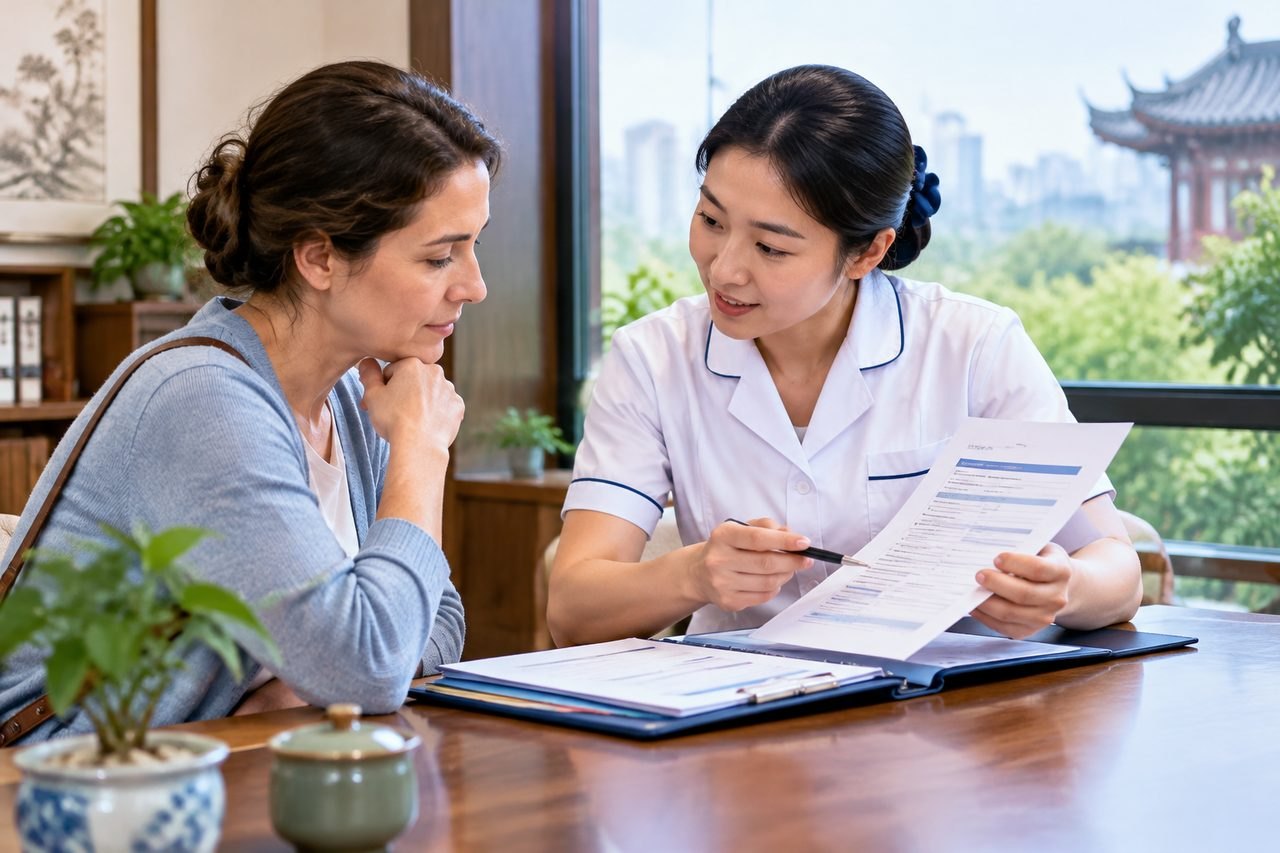
Where Ruijin hematology sits in Shanghai
Ruijin Hospital is affiliated with Shanghai Jiao Tong University School of Medicine. Its Shanghai address is 197 Ruijin Second Road, Huangpu District. The blood-disease clinical center has a longstanding focus on leukemia and other malignant blood diseases, connecting clinical questions with laboratory investigation.
The hematology specialty placed third in the Fudan project's 2023 national specialty reputation list. This is a historical department-level reference, not a current ranking of individual clinicians or separate disease programs. The distinctions within hematology matter more when deciding which team should assess a particular enquiry.
Leukemia, lymphoma and multiple myeloma are not interchangeable labels. An enquiry should identify the diagnosis already recorded by the treating clinicians and the unresolved decision. This allows discussion of the relevant clinical group rather than relying on the hospital name alone.
Leukemia: the APL differentiation story and the molecular work behind it
Acute promyelocytic leukemia, or APL, is a distinctive part of Ruijin's research history. Wang Zhenyi's differentiation-therapy work reached clinical application in 1986, followed by a Blood paper in 1988. The approach investigated maturation of malignant cells and became part of the hospital's translational research tradition.
Chen Saijuan, Chen Zhu and Chen Guoqiang contributed molecular investigations. The historical account describes PLZF fusion mechanisms and later DNMT3A and genomic research. These findings concern disease biology; a molecular research topic alone does not determine an individual treatment plan.
For a leukemia review, ask which question another opinion would address: clarification of an established subtype, interpretation of previous findings, or review of a proposed plan. The academic history explains an area of expertise, while the clinical team must assess the individual records and decide what further information is needed.
Lymphoma: genomics, metabolism and a real-world CAR-T study
Zhao Weili's research has centred on aggressive lymphomas that are more frequent in Asian populations, with work on natural killer/T-cell lymphoma genomics and on metabolism, epigenetics and resistance-associated pathways in peripheral T-cell lymphoma. This is laboratory and translational science aimed at understanding why some lymphomas behave aggressively and where targeted approaches might act.
A Ruijin-authored October 2023 report describes a New England Journal of Medicine comment on a Chinese multicenter, non-interventional real-world CAR-T study in relapsed or refractory large B-cell lymphoma. Zhao Weili co-led the study with Wu Depei of Soochow First Affiliated Hospital and Hu Yu of Huazhong Union Hospital. The latter two are collaborators at other hospitals, not Ruijin staff.
The account describes assessment and multidisciplinary follow-up involving hematology, intensive care, neurology, respiratory medicine, infection, cardiology and pathology-imaging services. Wu Wen contributed clinically and Chen Saijuan provided academic guidance. This observational evidence concerns a defined lymphoma group; it is not a randomized trial or confirmation of treatment eligibility for an overseas enquirer.
Myeloma and the kidney: a 2025 retrospective study
A 2025 paper in the Journal of Shanghai Jiao Tong University (Medical Science) examined myeloma and renal function. Lin Tong, Tao Yi, Jin Shiwei, Sun Miao and corresponding author Mi Jianqing reported a retrospective Ruijin study, published online on 21 July. Mi is identified as a chief physician and professor.
It reviewed newly diagnosed myeloma patients seen between October 2021 and September 2023, comparing sequential time-period groups receiving chemotherapy with or without plasma exchange. The renal-function observations were not from a randomized comparison. The study illustrates an intersection between blood-disease care and kidney complications, without establishing which approach an individual patient should receive.
A patient with both concerns can ask how the hematology opinion would connect with the existing renal assessment. Clarify the clinical decision to be reviewed and who would coordinate the explanation. A publication can identify a research interest, but does not by itself establish a current treatment offer or recruitment opportunity.
Who leads what, as of the dated reports
A school-of-medicine report on 16 April 2025, covering a committee meeting held on 11 April, records Zhao Weili as a Ruijin deputy president and director of the Shanghai Institute of Hematology. The same report identifies Chen Saijuan as a Chinese Academy of Engineering academician and director of the National Research Center for Translational Medicine (Shanghai), and Chen Zhu as a Chinese Academy of Sciences academician. These institutional and research roles are distinct from the clinician assigned to an individual assessment.
The Merieux-Guangci France-China program described in that report supports academic talent and research exchange. It concerns scientific collaboration, rather than arrangements for overseas patients. A research institute, translational center and clinical department have different responsibilities, even where their staff collaborate.
Wang Zhenyi's legacy is documented separately. A 10 December 2024 official report describes a 5 December tribute to Wang Zhenyi as a recipient of the Medal of the Republic, recognising an academic career, teaching and the APL differentiation-therapy research. This is a personal honor recognizing his academic contribution. Shen Zhixiang is described in that report as a Ruijin tenured professor and former hematology chief, not the current head.
Research honors and a tradition of case-based teaching
Zhao Weili received the 12th Shanghai Natural Science Peony Award in January 2018. The university account highlights aggressive lymphoma mechanisms, genomics and targeted research. It also records National Natural Science Foundation distinguished-young-scholar support, a national innovation-talent designation and a State Council allowance. Her research contributions received Ministry of Education natural-science and science-and-technology-progress first prizes, and a Huaxia Medical Science first prize as first contributor.
A May 2020 hospital account describes Wang Zhenyi's difficult-case discussions as an open-book-exam style of teaching. Clinicians presented complex information for discussion, connecting observations with possible explanations. Secure video links extended this educational exchange to a medical consortium. This dated example illustrates clinical reasoning and professional teaching, not a promise of a current remote-consultation service.
Practical questions before you plan around Ruijin
Before arranging travel, summarize the confirmed diagnosis, previous care and decision requiring another opinion. Ask what records and translations the receiving team needs, what can be assessed remotely, and what requires an in-person visit. Confirm the proposed assessment and fee scope in writing after acceptance. Urgent or deteriorating symptoms need local care rather than waiting for an overseas plan.
ChinaSpecialistCare can help organise a hematology enquiry, prepare records and coordinate assessment arrangements after hospital acceptance. We are independent of Ruijin Hospital and cannot guarantee a named clinician, therapy or outcome. A brief initial enquiry is free; purchasing an optional proxy consultation is not a prerequisite for that enquiry.
Sources & scope of this guide
References and official service information relevant to this guide.
- Blood disorder and blood cancer care
- Fudan 2023 historical national specialty reputation list
- Shanghai Jiao Tong University School of Medicine historical Ruijin blood-disease clinical-center overview
- Shanghai Jiao Tong University School of Medicine April2025 leadership and academic exchange
- Shanghai Jiao Tong University School of Medicine October2023 CAR-T real-world lymphoma research
- SJTU medical journal 2025 primary retrospective myeloma study
- Shanghai Jiao Tong University School of Medicine Zhao Weili 2018 Shanghai natural-science honor
- Shanghai Jiao Tong University School of Medicine December2024 Wang Zhenyi Medal of Republic tribute
- Shanghai Jiao Tong University School of Medicine May2020 multidisciplinary case-discussion education
This is general planning information and has not been individually reviewed by a doctor. Medical decisions and personal treatment advice come from your treating clinicians.