What the home clinician actually needs from the China admission
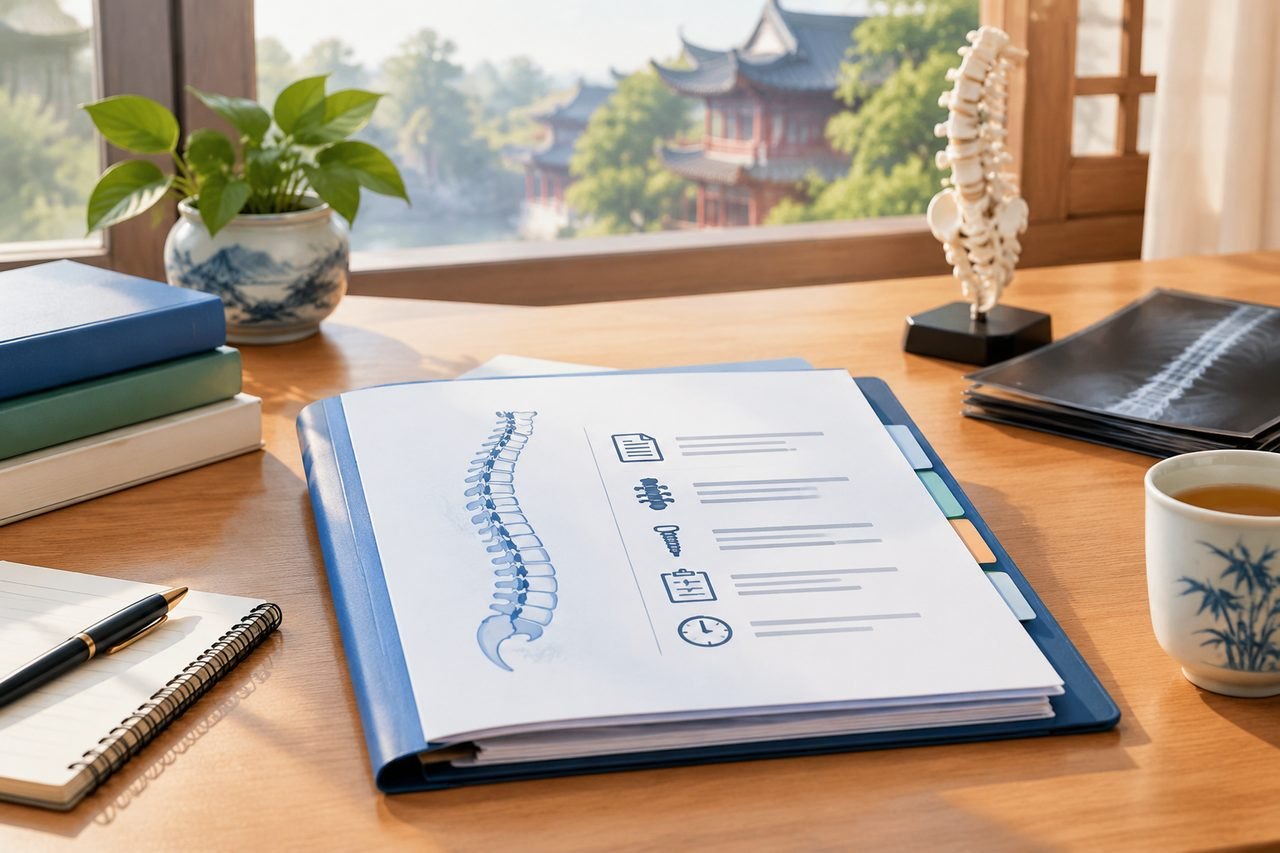
The handover is not a single discharge letter. It is a set of documents that lets a clinician who never met you understand what was done, what was implanted, what was found, and what remains open. Ask the receiving clinician, before you leave China if possible, which items they want and in what format. Their answer decides what you chase.
The core operative record is the operation note or surgical report. It should state the date, the procedure performed, the approach, and the spinal levels treated. For fusion surgery, the levels instrumented and fused are the detail your home team will look for first, because it frames every later question about movement, imaging and rehabilitation. If the note is in Chinese, ask whether the hospital can provide an English version or a translation you can hand over.
Implant documentation matters separately. Ask for the device name, manufacturer, model or reference number, and any implant card or sticker set. This is not a clinical decision by itself, but it is the information a home clinician or imaging department may need later. If the hospital issues an implant passport, keep the original and a scan.
Discharge documentation should include the discharge summary, medication list with doses, wound-care instructions, and any restrictions the surgical team set. Restrictions are the part home clinicians most often need in writing, because they govern what you are allowed to do in the weeks after you land.
Rehabilitation details: what to send, not what to prescribe
Rehabilitation after fusion surgery is not a single protocol that transfers cleanly between countries. The China team may have started mobilisation, given a walking or breathing routine, or referred you to a physiotherapist. Your home physiotherapist will make their own assessment and plan, and they are entitled to do so. Your job is to give them the raw material.
Ask the China team for the physiotherapy notes, any exercise sheets, the dates and content of sessions, and a short statement of what you were cleared to do at discharge and what remained restricted. If you were given a brace or support, ask for its name, wearing schedule and the reason it was prescribed. If you were not given one, that is also worth recording.
Do not ask the China team to write a rehabilitation prescription for your home provider to follow. Ask instead for a factual summary: what was done, what you tolerated, what was limited, and what the surgical team wanted reviewed. Your home physiotherapist can then decide how to proceed, and they may want to speak with the surgical team or review imaging before starting.
One practical question to settle before you fly: who at the China hospital can your home clinician contact if a detail is unclear? Get a named department, an email address and, if possible, the treating surgeon's office contact. A generic hospital switchboard is rarely enough for a clinical query.
Unresolved results and pending tests
Some results may not be final when you leave. Histopathology, microbiology, genetic studies or specialised imaging reports can take time, and the timeline is set by the laboratory, not by your travel date. Ask the China team, in writing, which results are still pending, when they expect them, and how they will reach you.
Decide in advance who receives those results. If the hospital will release them only to you, you become the courier. If they can send them directly to your home clinician with your written consent, that reduces the risk of a gap. Ask what their release process requires, because consent forms and identity checks differ between hospitals.
For any pending result, ask the China team what the interim plan is. If a result changes management, who will tell you, and how quickly? If you will already be under the care of a home clinician, agree who is responsible for acting on the result. A result that arrives but is not routed to anyone is effectively lost.
Keep a simple tracking list: test name, date taken, expected result, who will receive it, and the date you last chased it. This is administrative, not clinical, but it makes a gap visible before it becomes a problem.
Will your home clinician accept the China records?
Acceptance is not automatic and it is not something ChinaSpecialistCare can guarantee. A home clinician or hospital may accept the records as information while still wanting their own assessment, their own imaging, or a consultation before continuing care. That is a clinical judgement, not a comment on the quality of the China operation.
Ask your home clinician directly: will you accept these records for continuing care, do you need anything translated or certified, and do you want the imaging on disc or via a link? Some practices want the radiology images themselves, not just the report. Ask the China hospital for the imaging files in a standard format before discharge, because requesting them later from another country is slower.
If your home clinician wants to speak with the China surgeon, ask both sides what they need to make that possible. Time zones, language and hospital permissions all affect whether a call happens. It is reasonable to ask, but it is not guaranteed, and it should not delay your local care.
If your home clinician declines to take over without a fresh assessment, that is their call. Your next step is to follow their process, not to argue the China records should be enough.
Communication, language and who is responsible
Cross-border handover fails most often at the handover point, not in the operating room. Two things help: a named contact on each side, and a written summary in a language both sides read. Ask the China hospital whether an English discharge summary is available. If not, ask whether a certified translation can be arranged and who pays for it.
Clarify responsibilities explicitly. Who sends the records? Who receives them? Who books the first home appointment? Who follows up the pending result? Write the answers down and share them with your home clinician. If you are using a coordination service, agree in writing what they will and will not do, because coordination is not clinical care and does not replace the treating team's judgement.
Keep your own copy of everything. A folder with the operative note, implant details, discharge summary, medication list, imaging disc and pending-results list is the single most useful thing you can carry home. If documents arrive later by email, add them to the same folder.
For context on the procedure itself, the ChinaSpecialistCare scoliosis correction reference explains what the operation involves and how planning enquiries are handled. It is a starting point for questions, not a substitute for your own clinicians' advice.
A practical sequence for the last days in China
Start the handover before discharge, not after you land. Ask the ward team for the documents listed above and confirm which are ready and which will follow. Request the imaging files and implant details while you are still in the building, because these are the items most often delayed.
Confirm the pending-results plan in writing: which results, expected timing, who receives them, and who acts. Give the hospital your home clinician's contact details with your written consent if they will send records directly.
Book your first home appointment before you travel if your home clinician's schedule allows, and tell them what is coming. Ask what they want to see first. If they want a translation, start it early rather than at the appointment.
Finally, ask the China team one direct question: if my home clinician has a question about the operation, who do they contact and how? A named route is worth more than a general promise of follow-up.
If you are still planning care rather than handing it over, an initial enquiry with ChinaSpecialistCare is free and asks only for a brief summary of your situation and main question. It is not a diagnosis, not a promise of hospital acceptance, and not a substitute for your own clinicians' assessment.
Sources & scope of this guide
References and official service information relevant to this guide.
This is general planning information and has not been individually reviewed by a doctor. Medical decisions and personal treatment advice come from your treating clinicians.