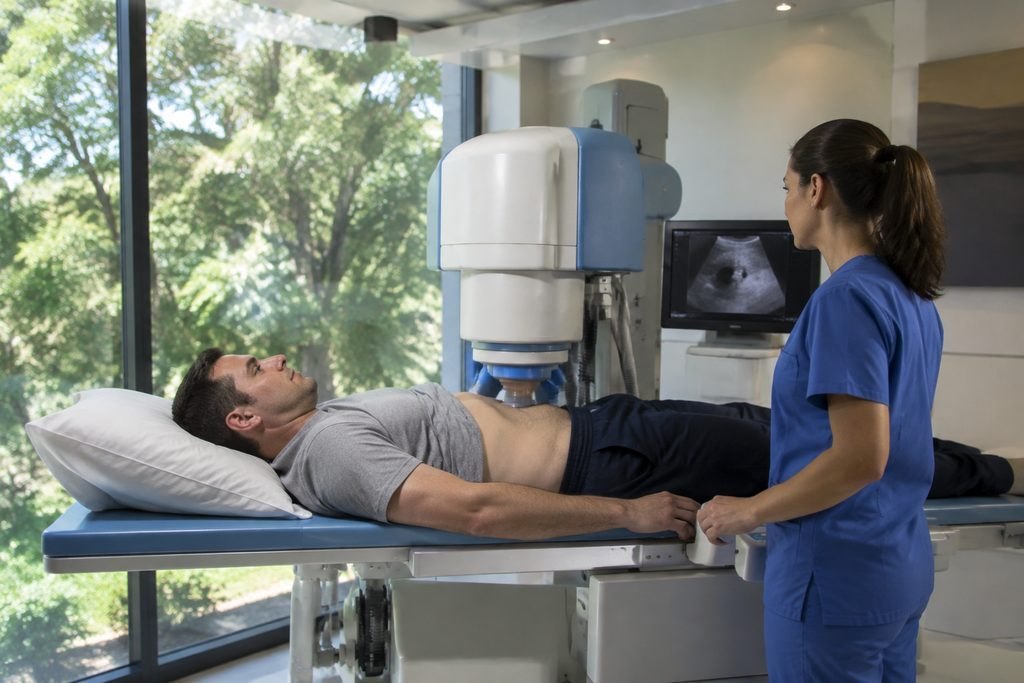
Why New Imaging Can Change a Shock Wave Lithotripsy Plan
Shock wave lithotripsy uses external shock waves to break a kidney stone into smaller fragments. The treating team's plan depends on what the imaging shows: stone size, position, hardness and whether urine flow is blocked all influence whether this approach is appropriate. A CT scan, ultrasound or X-ray taken at a different time can show a stone that has moved, grown or changed in appearance. That is why a plan built on older images may need to be revisited rather than simply confirmed.
This is not a reason to distrust the earlier plan. It is a reason to treat the new images as the current basis for the decision. The question is not whether the original plan was wrong, but whether the same approach still fits the stone as it appears now. The treating urologist, not a coordinator or an article, decides that.
If you are an overseas patient, the practical consequence is that you should not treat a previous written plan as final until the team has seen and commented on the new imaging. Ask for a short written statement of what changed and what it means for the proposed treatment.
Reconfirm Whether the Stone Is Still Suitable for This Approach
Suitability is the first thing to reconfirm. Shock wave lithotripsy is not the right choice for every stone. The treating clinician weighs stone characteristics, the kidney's drainage, any infection, bleeding risk and the patient's overall health. New imaging can shift that assessment in either direction: a stone that looked favourable may now look less so, or a previously uncertain case may become clearer.
Ask the team directly: does the new imaging change whether shock wave lithotripsy is suitable for this stone? If the answer is that suitability is uncertain, ask what alternative approaches are being considered and what information would settle the question. You do not need to choose between procedures yourself; you need to know whether the proposed one is still on the table.
It also helps to ask whether the new imaging changes the urgency. A stone causing obstruction or infection may need attention sooner than a stable stone. That is a clinical judgement, and it should come from the treating team, not from a general article.
Ask How the Sessions Are Now Planned
Shock wave lithotripsy often requires more than one session, and follow-up checks assess the result. The number and spacing of sessions depend on the stone's response, the equipment used and the treating team's protocol. When new imaging arrives, the session plan may need to be recalculated rather than carried over.
Ask the team to explain, in writing if possible, how many sessions are now anticipated, what determines whether an additional session is needed, and what follow-up imaging will be used to judge whether fragments remain. Do not assume a fixed number of sessions or a fixed interval between them; these are clinical decisions that vary with the individual case.
If you are planning travel, ask whether the session plan affects how long you would need to stay. The answer belongs to the treating team and the hospital, and it should be confirmed before you book anything.
Confirm Who Reviews Residual Stone Findings
After treatment, follow-up checks look for residual fragments. Who reviews those findings, and how the result is communicated, matters for your next steps. Ask the team to name the clinician or service responsible for reviewing follow-up imaging and for deciding whether further treatment is needed.
If you return home between sessions, ask how follow-up imaging would be arranged and who would interpret it. A scan done elsewhere may need to be shared with the treating team in China, and the team should confirm what it needs to see. Do not assume that any scan will be accepted without review.
This is also the point to clarify what happens if fragments remain. The treating team should explain the options and the reasoning, rather than leaving you to infer them from a report.
What to Put in Writing Before You Commit
A clear written summary reduces the risk of acting on an outdated plan. Ask the treating team or the hospital's international office for a short document that states the current assessment, the proposed approach, the session plan and the follow-up arrangements. This is not a contract; it is a record of the clinical position at this point.
The reason a written record matters here is that the change may be small on paper but large in practice. A stone that has shifted position, or one whose appearance on the new scan suggests it may respond differently to shock waves, can move the team from 'proceed as planned' to 'reassess first'. If that shift is only discussed verbally, it is easy to carry the old plan in your head and act on it. A short written statement gives you something concrete to compare against the earlier plan and to share with anyone advising you at home.
If you are working with a coordination service, keep the clinical and the practical separate. The hospital decides suitability and treatment. Coordination can help with records, interpretation and appointment requests, but it does not decide whether the stone is suitable or how many sessions are needed.
Ask what the hospital's written estimate or plan includes and what remains undecided. Do not rely on a verbal summary for anything that affects travel or payment.
It also helps to ask what the new imaging does not show. A scan taken at one point in time is a snapshot; it may not capture how the stone is behaving or whether the kidney's drainage has changed since. If the team says the picture is incomplete, ask what further information would make the decision clearer and whether that information can be gathered before you travel.
Finally, ask how the revised plan would be communicated if it changes again. Stones can move, and a plan that is current today may need revisiting after a further scan or a first session. Knowing in advance who will tell you, and how quickly, prevents you from discovering a change only when you arrive.
None of this requires you to interpret the imaging yourself or to second-guess the urologist. Your role is to make sure the decision is being made on the current picture and that you have it in writing. That is a reasonable thing to ask for, and a treating team that is used to overseas patients will understand why you are asking.
- A short statement of what changed after the new imaging.
- Whether shock wave lithotripsy is still considered suitable.
- The current session plan and what determines additional sessions.
- Who reviews follow-up imaging and how results are shared.
- What the hospital's written plan or estimate includes and what is still open.
Next Step: A Focused Enquiry, Not a New Commitment
You do not need to restart the whole process. Send the new imaging and a short summary of your main question to the treating team or, if you are using one, to a coordination service that can pass the records to a relevant specialist. An initial enquiry is free and does not require buying a proxy consultation.
The useful next step is to ask the treating team to reconfirm suitability, session scope and follow-up responsibility in light of the new imaging. If you would like help organising records, interpretation or a specialist appointment request, ChinaSpecialistCare can assist with that practical side while the hospital makes the clinical decisions.
Keep the question narrow: does the new imaging change the proposed plan, and if so, what is the revised plan? That answer, in writing, is what you need before making travel or treatment decisions.
Sources & scope of this guide
References and official service information relevant to this guide.
This is general planning information and has not been individually reviewed by a doctor. Medical decisions and personal treatment advice come from your treating clinicians.