Three different replies hide behind one polite message
When you send kidney stone imaging and a short history to a hospital in China, the reply you get usually falls into one of three categories, even when the wording looks similar. The first is a receipt acknowledgement: the international office or coordinator confirms the files arrived and may give a reference number. The second is a request for more information: the team names specific missing items, such as a recent CT report, the stone size and location, or details of previous stone treatments. The third is a clinical assessment, where a urologist has actually looked at your imaging and comments on whether shock wave lithotripsy is a reasonable option for your stone.
These are not stages of equal weight. A receipt acknowledgement tells you the message was not lost. A request for more information tells you a clinician or coordinator has identified a gap that matters for the decision. A clinical assessment is the only one that begins to answer your actual question. If the reply does not say which of the three it is, you cannot yet tell whether anyone has reviewed your stone.
The practical move is to reply with one short message that asks the hospital to state, in writing, whether a urologist has reviewed the imaging, and if not, what is needed before that review can happen. This is a reasonable administrative question, not a demand for a guarantee.
What the reply can and cannot confirm about your stone
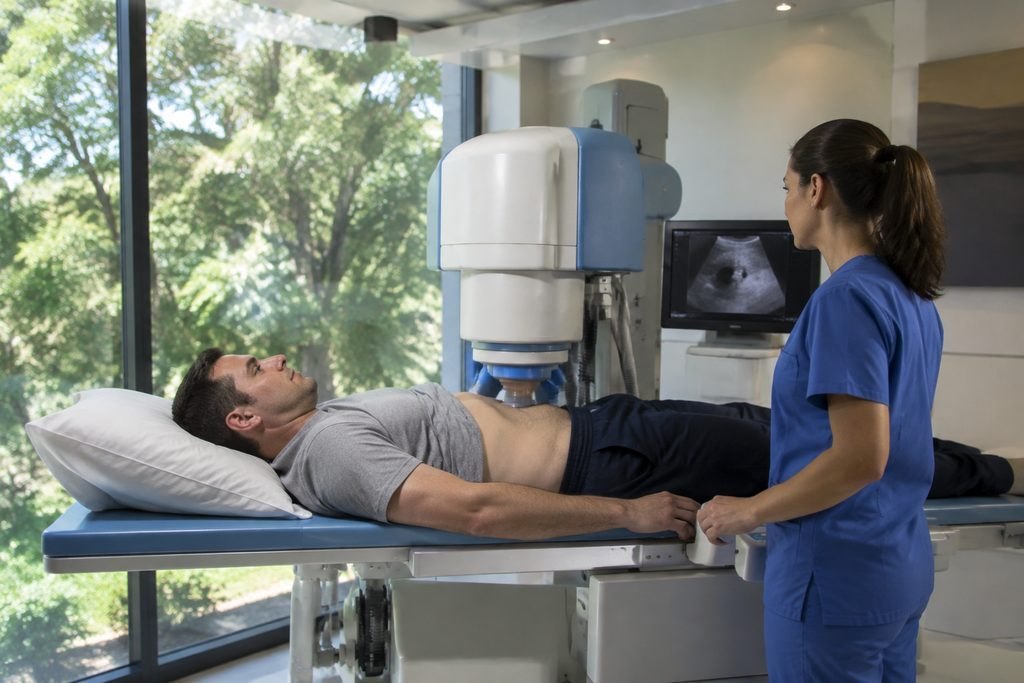
Shock wave lithotripsy uses focused acoustic pulses to break a kidney stone into smaller fragments. More than one treatment session may be needed, and follow-up checks assess whether the fragments have cleared. That much is general. What no preliminary reply can settle is whether your particular stone is suitable for this approach.
Suitability depends on factors the treating urologist must weigh: stone size, stone location within the urinary tract, stone composition or density as suggested by imaging, the condition of the kidney and surrounding anatomy, whether there is infection or obstruction, and your overall health and medication list. Some of these are visible on CT or ultrasound; others require the clinician's judgement and sometimes additional tests. A coordinator cannot make that call, and a reply that does not mention your stone's specifics has not made it either.
This is why a message saying "your records have been received and we will arrange an appointment" is not the same as "your stone is suitable for shock wave lithotripsy." The first is logistics. The second is a clinical opinion that should name the imaging reviewed and the reasoning. If you receive the first, treat it as an opening, not a conclusion.
It also matters that suitability is not the same as a plan. Even when a urologist considers shock wave lithotripsy appropriate, the number of sessions, the interval between them, and the follow-up imaging schedule are decisions made for your case, often adjusted as results come in.
The questions that turn a receipt into a review
You do not need a long list. A focused set of questions, sent in one message, will usually get you a clearer answer than a broad request for "more information." Ask the hospital to confirm, item by item, what has actually happened so far.
First: has a urologist reviewed my imaging, and if so, which images and reports were reviewed? Second: based on what has been reviewed, is shock wave lithotripsy being considered, or is another approach being discussed? Third: if more information is needed, exactly which documents or tests are missing, and can they be done locally before travel? Fourth: if shock wave lithotripsy is being considered, how are treatment sessions planned for a case like mine, and who reviews the result after each session? Fifth: what would make this plan change?
These questions are not a challenge to the hospital's judgement. They are the difference between a message that confirms arrival and a message that tells you where your case actually stands. A useful reply will name the imaging reviewed, state whether a clinical opinion exists, and identify any remaining gaps. A vague reply will repeat that records were received without addressing the stone.
Why the missing answers matter for your decision
If you are considering care in China, the reply is the first real signal about how your case will be handled. A reply that names your stone's size and location, comments on whether shock wave lithotripsy is reasonable, and explains what follow-up would involve gives you something to weigh. A reply that only acknowledges receipt leaves the central question open, and you should not treat it as encouragement to book travel.
There is also a safety dimension. Shock wave lithotripsy is not appropriate for every stone, and some situations call for ureteroscopy, percutaneous surgery, or other approaches instead. If a hospital's reply does not address suitability, you cannot assume the treatment you asked about is the treatment you would receive. The treating team decides that after reviewing your case, and their decision may differ from your initial request.
Finally, the reply shapes your practical planning. Whether you might need one session or several, whether follow-up imaging is expected before you fly home, and whether any pre-treatment tests are needed locally all affect how you arrange time, work, and travel. None of these can be settled from a receipt acknowledgement.
A practical order for your next messages
Start by replying to the hospital's message with a short, numbered request. Keep it to the five questions above, and ask for a written response. Written answers are easier to compare if you contact more than one hospital, and they give you a record of what was actually said.
If the reply asks for more records, send only what is requested and confirm receipt. If the reply is another acknowledgement without clinical content, ask directly whether a urologist has reviewed the file. If the reply says a review has happened but does not mention your stone, ask which imaging was reviewed and what the opinion was.
If a step cannot be completed, for example if a requested scan is not available locally, say so and ask whether an alternative document would be acceptable or whether the review can proceed with what you have. Do not assume that a missing item ends the process; ask what the hospital can work with.
If you would like help organising records, requesting a specialist appointment, or arranging interpretation for these exchanges, ChinaSpecialistCare can assist with those non-clinical coordination steps. The hospital still decides suitability, session planning, and follow-up. An initial enquiry is free, and you do not need to purchase a proxy consultation to ask a hospital a direct question.
What a clear reply should contain
A reply you can act on will usually do four things. It will confirm which records were received and reviewed. It will state whether a urologist has formed an opinion on your stone and whether shock wave lithotripsy is being considered. It will identify any remaining information the team needs. And it will explain, at least in outline, how sessions and follow-up would be planned for your case.
If any of those four are missing, you have a specific question to ask rather than a general worry. That is the useful outcome of reading a preliminary reply carefully: not certainty about your treatment, but a clear next question. The hospital's clinical team remains the only party that can confirm suitability and plan treatment.
Sources & scope of this guide
References and official service information relevant to this guide.
This is general planning information and has not been individually reviewed by a doctor. Medical decisions and personal treatment advice come from your treating clinicians.