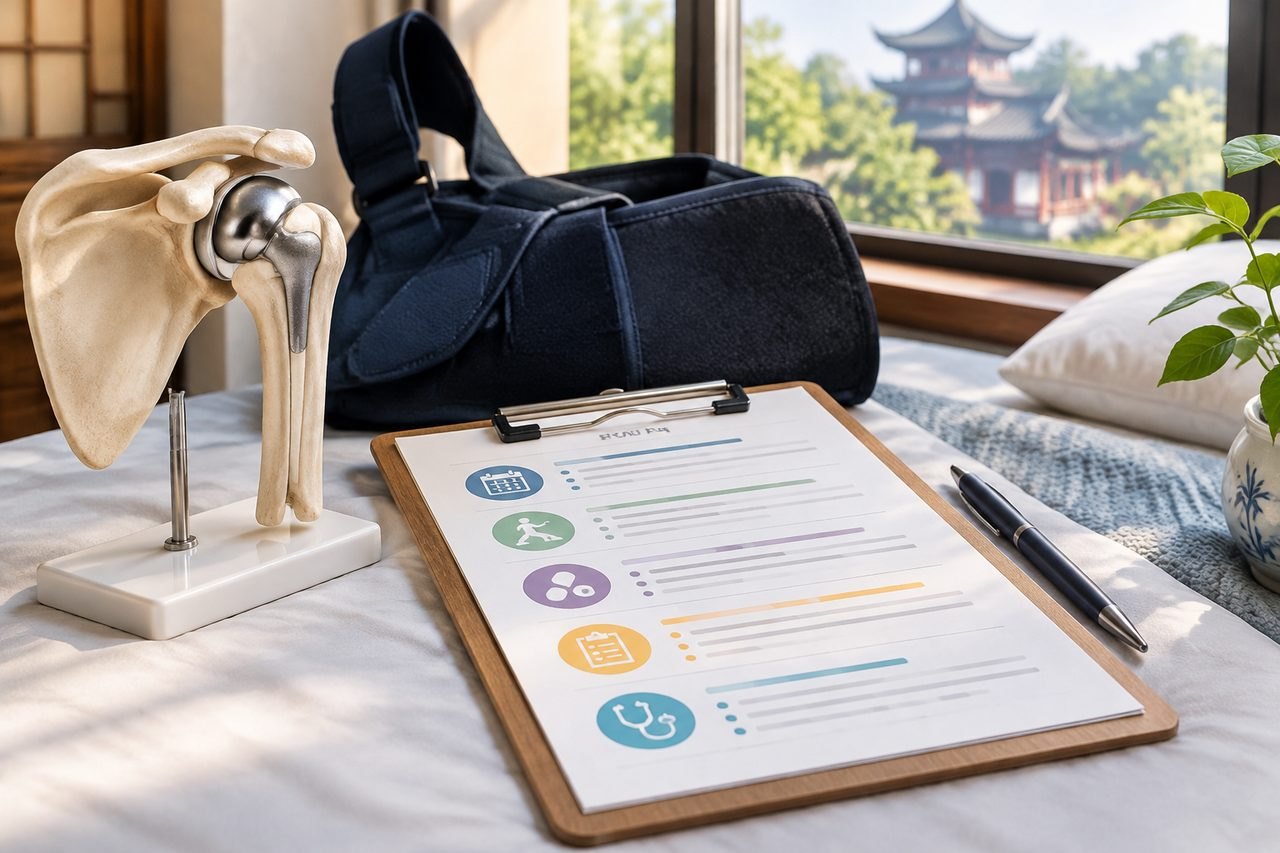
Why a verbal follow-up promise is not enough after shoulder replacement
Shoulder replacement uses artificial components, and conventional and reverse designs differ; the choice depends on the shoulder condition. That clinical decision belongs to the treating surgeon, but the follow-up arrangement around it is something you can ask to see in writing. A discharge summary that says only 'review as needed' leaves you guessing who to contact, what to send and what counts as a problem.
A written follow-up plan is not a second opinion or a guarantee. It is a practical record of what the treating team has already decided, translated into names, dates and contact routes you can act on from another country. If any element is still undecided, the plan should say so rather than imply a commitment that has not been made.
The most useful version is short. One page naming the responsible clinician or clinic, the review points, the imaging or wound checks requested, the rehabilitation instructions given, the contact route for questions and the records you will carry home will do more than a long generic handout.
What to ask the hospital to record before discharge
Ask for the plan in a form you can keep and share with your local clinician. If the hospital provides it in Chinese, ask whether an English version or an interpreted explanation can be arranged; confirm this with the specific hospital rather than assuming it is standard.
The clinical content must come from the treating team. Your role is to make sure the plan answers the questions you will face at home, and that each answer names a person or office rather than a department in general.
- Which replacement type was used, and what the operative note says about the components and approach.
- Who is responsible for follow-up review, and through which clinic, department or named contact.
- Which review points are planned, and what will be assessed at each one.
- Which imaging, wound checks or blood tests are requested, and where they should be done.
- Which rehabilitation instructions apply to this shoulder, and who supervises progression.
- What restrictions apply to movement, lifting, sling use and daily activities, and for how long.
- Which symptoms or changes should prompt urgent local assessment rather than a routine message.
- Who answers non-urgent questions between reviews, and through which channel.
- Which records, images and reports you will receive before you leave.
Questions that decide whether the plan is usable at home
A plan can look complete and still fail when you try to use it. The test is whether each item can be carried out by someone who was not in the operating room. Ask the treating team to confirm the points below, and ask your local clinician whether they can work within the arrangement described.
Start with imaging. If the plan asks for a review X-ray or other scan at a set point, ask whether that imaging can be done near home and whether the treating team will read images sent from abroad. If remote reading is offered, ask what format and resolution the hospital needs, how the images are transferred, and how long a response takes. If remote reading is not offered, ask what the alternative is: a local radiologist's report sent back, a return visit, or a review only if symptoms change. Each answer changes what you pack, what you book and what you tell your local clinic.
Then test the rehabilitation side. Shoulder rehabilitation is not a hip or knee protocol; the muscles, movement precautions and progression differ, and the treating team's instructions should be specific to this shoulder and this procedure. Ask who supervises progression, what the local physiotherapist is authorised to change, and how the treating team wants to be told if progress stalls or pain increases. If the written plan names exercises but not the person who adjusts them, that gap is worth closing before you leave.
Contact arrangements deserve the same scrutiny. A named clinic, a named route and an expected response window are more useful than a general department address. Ask what happens outside working hours, who triages non-urgent questions, and which findings should go to the treating team rather than to a local emergency service. If the treating team cannot be reached, ask what the agreed fallback is.
Finally, ask your local clinician directly whether they can work within the arrangement described. A plan that assumes cooperation your local team cannot provide is not yet usable. If they raise a concern, ask the treating team to address it in writing rather than resolving it verbally at the airport.
If the answers are vague, that is useful information. It tells you which parts need clarification before you travel, rather than after a problem appears.
- Can the planned imaging be done locally, and will the treating team review images sent from abroad?
- If a review is remote, how is it arranged, and what does the hospital need from you beforehand?
- Who decides whether rehabilitation should progress, and how is that decision communicated?
- What should your local clinician do if they disagree with part of the plan?
- Which findings should be sent to the treating team, and which need immediate local care?
- If the treating team cannot be reached, what is the agreed alternative?
Responsibility, language and the limits of a written plan
A written plan clarifies who does what; it does not transfer clinical responsibility to a coordinator or to the patient. Diagnosis, prescriptions, suitability and treatment decisions belong to the treating hospital and licensed clinicians. Your local clinician retains independent judgement about care in your home country, and the plan should be written so that it can be discussed rather than simply followed.
Language is part of usability. If the plan is in a language your local clinician does not read, ask how it will be explained or translated, and confirm who provides that. Interpretation during a hospital visit is a coordination service, not clinical care, and it does not replace the treating team's own instructions.
A written plan also has limits. It cannot predict how your shoulder will heal, and it should not promise an outcome. If a document implies a guaranteed result or a fixed recovery path, ask the treating team to explain what is confirmed and what remains uncertain.
Practical next step before you commit to surgery in China
Before travelling, ask the hospital you are considering to describe in writing how follow-up after shoulder replacement is arranged for international patients: who reviews the shoulder, how remote review works, which records you receive and who answers questions between visits. Ask which replacement type is proposed, what the estimate includes and how help with daily activities and rehabilitation would be arranged. These are reasonable questions at the enquiry stage, and the answers help you judge whether the arrangement fits your situation.
You can start with a short summary of your diagnosis, main question and available records. An initial enquiry is free and does not require buying a proxy consultation; the hospital decides suitability, and a records-based opinion does not establish final acceptance or a treatment plan. If your shoulder symptoms are worsening or you have an urgent problem, seek local care first rather than waiting for an overseas reply.
For background on the procedure itself, see the shoulder replacement reference page.
Sources & scope of this guide
References and official service information relevant to this guide.
This is general planning information and has not been individually reviewed by a doctor. Medical decisions and personal treatment advice come from your treating clinicians.