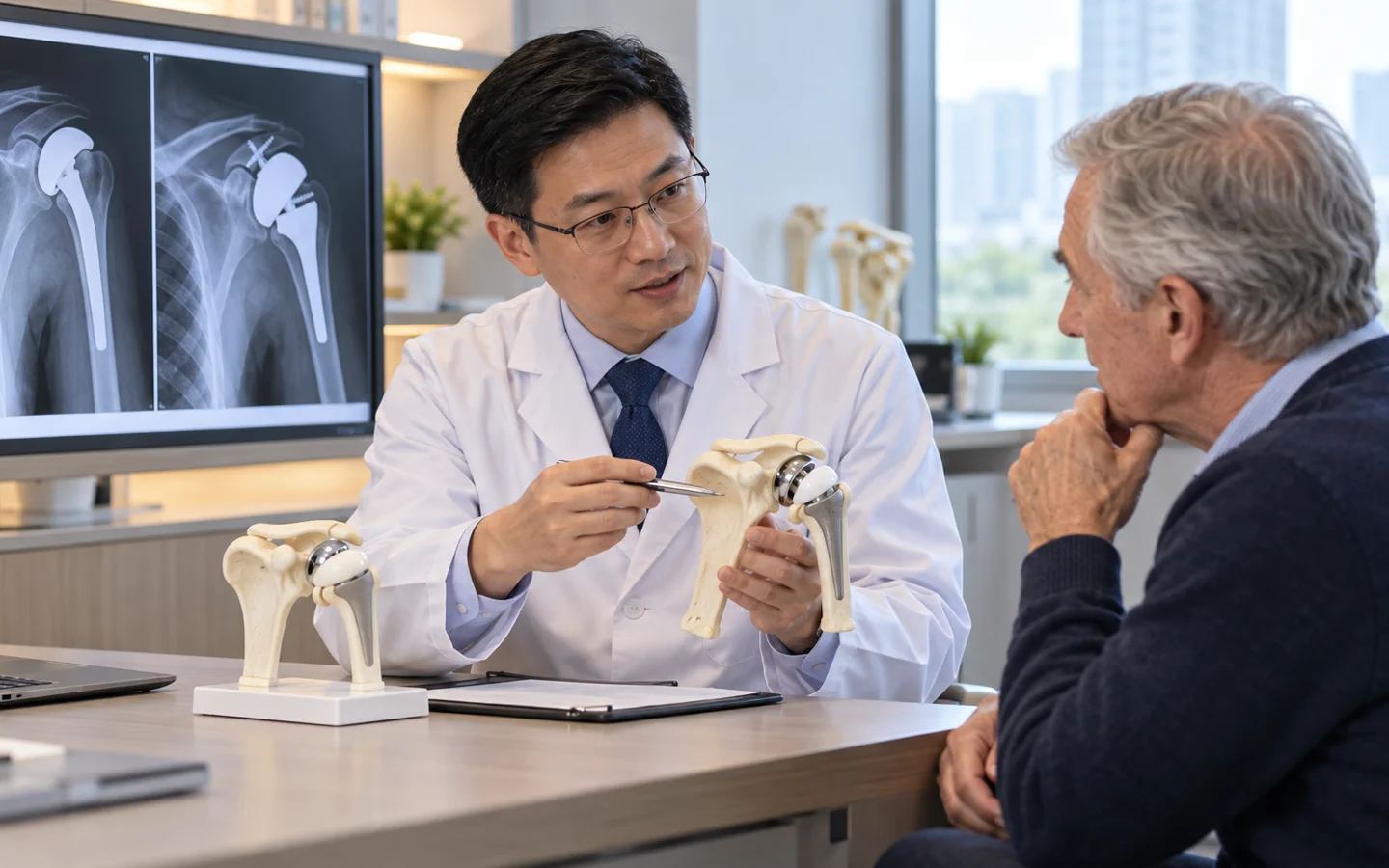
What shoulder replacement changes
Shoulder replacement removes damaged joint surfaces and replaces them with metal and plastic components. It is most often considered for severe pain and loss of function from glenohumeral arthritis, cuff-tear arthropathy, selected complex fractures or failure of an earlier reconstruction.
An anatomic replacement recreates the natural ball-and-socket relationship and depends on a functioning rotator cuff. A reverse replacement switches the ball and socket so the deltoid can elevate the arm when the cuff is irreparable. Hemiarthroplasty replaces only the humeral side and is reserved for selected situations.
A reverse shoulder is not simply a newer version of an anatomic replacement. Cuff integrity, glenoid bone, deltoid function, age and diagnosis determine which design—if any—is appropriate.
Who may be considered?
A shoulder specialist may discuss replacement when symptoms remain disabling despite suitable non-surgical care. Examples include:.
- Advanced arthritis with pain, stiffness and loss of daily function.
- Cuff-tear arthropathy with an irreparable rotator cuff.
- A complex proximal-humerus fracture that cannot be reconstructed reliably.
- A failed previous replacement or fracture fixation requiring revision.
- Adequate medical fitness and willingness to follow movement precautions.
What the hospital needs to assess
The review connects pain and function to examination and imaging. Standard X-rays show arthritis and alignment; CT may map glenoid wear and bone stock; MRI or ultrasound can assess the rotator cuff. The team also reviews deltoid function, nerve symptoms, prior operations, infection risk, bone quality and the patient’s work or sport goals.
Key points for this treatment
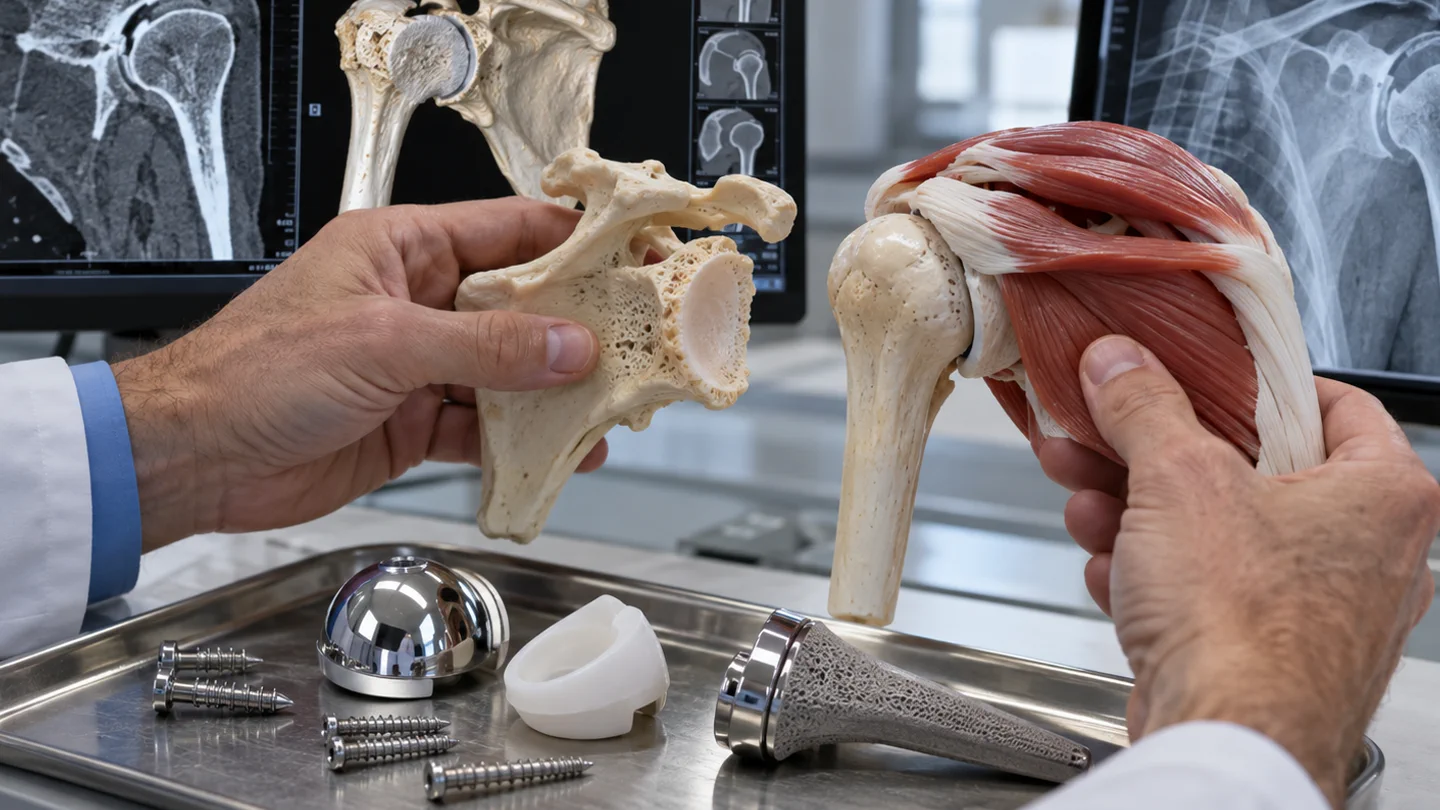
Anatomic, reverse and partial replacement
In an anatomic total shoulder replacement, a metal humeral ball articulates with a plastic glenoid component. In a reverse replacement, a ball is fixed to the glenoid and a socket sits on the humeral side. The surgeon balances soft tissues, restores stable tension and repairs the subscapularis when the approach and tissue permit.
Revision surgery may require removal of well-fixed components, bone graft or augmented implants. Navigation or patient-specific guides may assist positioning, but technology does not replace accurate diagnosis, infection exclusion and an experienced reconstruction team.
Hospital stay and recovery
A sling commonly protects the arm at first. Hand, wrist and elbow movement begins early, while shoulder motion follows the repair and implant. Lifting, pushing behind the body and supporting body weight through the operated arm may be restricted.
Rehabilitation moves from protected passive motion to active control and then strength. Progress differs after anatomic, reverse, fracture and revision surgery. International patients need a plan for wound review, therapy and X-rays after returning home.

Risks and realistic expectations
Risks include infection, bleeding, blood clots, fracture, nerve or vessel injury, stiffness, instability or dislocation, tendon failure, component loosening or wear, scapular notching after reverse replacement and the need for revision. Pain relief is common but normal shoulder motion and heavy-use capacity are not guaranteed.
Fever, wound drainage, increasing redness, sudden deformity, a new inability to move the arm, hand weakness or numbness, chest pain or breathlessness requires urgent medical assessment.