
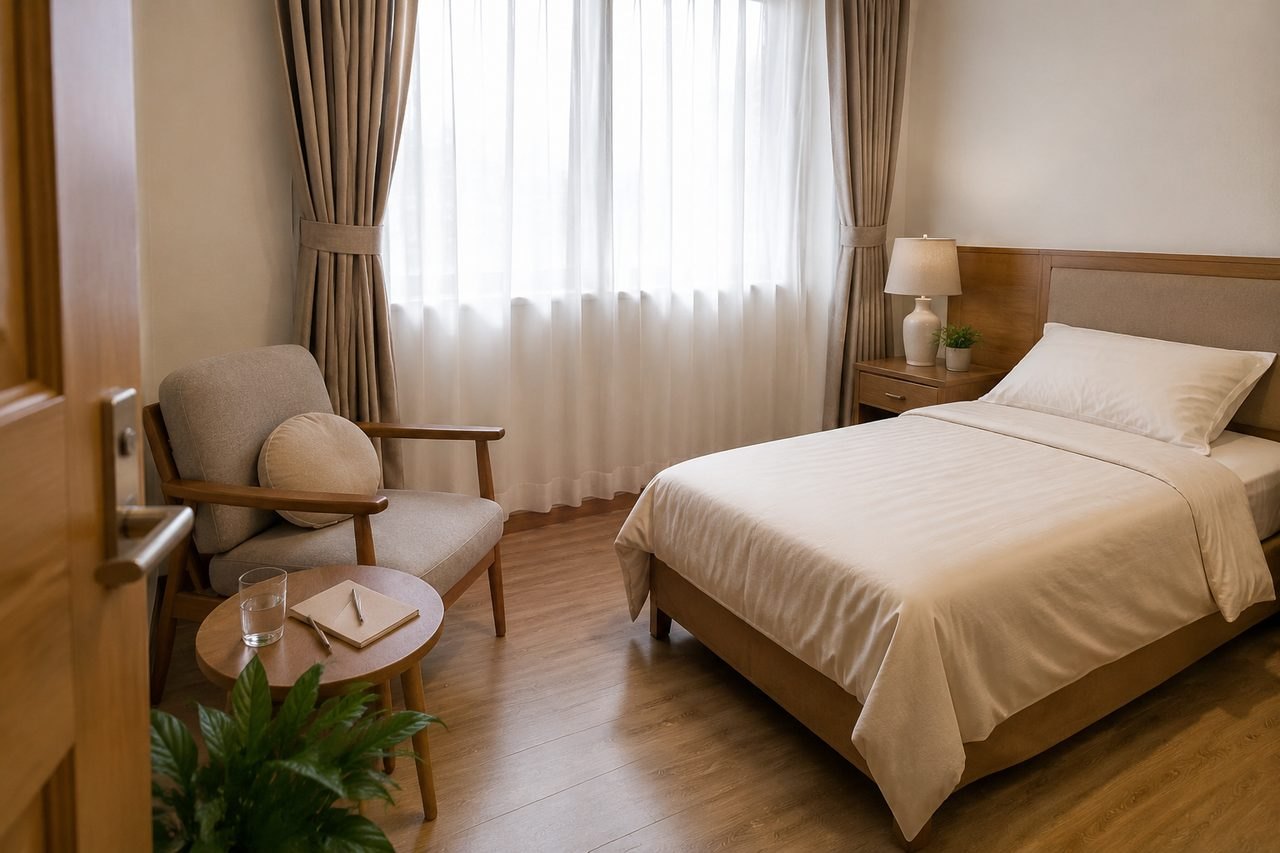
What a sleep assessment actually involves
A sleep assessment is a clinical process, and the sleep study is only one part of it. The consultation comes first: a clinician asks about how you sleep, how you feel during the day, whether you snore or stop breathing at night, whether you feel refreshed, and what medicines or other conditions might be involved. Only then does the team decide whether an objective sleep test adds useful information.
The best-known objective test is polysomnography, an overnight recording of brain activity, breathing, oxygen levels, heart rhythm, eye movement and muscle activity. It is used to investigate suspected sleep apnoea and other sleep disorders. Home sleep apnoea testing is a simpler option for some patients, but it measures fewer signals and is not suitable for every question. Which test fits your case is a clinical decision, not something a patient should choose from a menu.
This matters for international patients because the value of travelling for a sleep assessment depends on what you actually need. If your main problem is snoring and a clinician has already recommended surgery, the relevant pathway is different from suspected obstructive sleep apnoea that may need a CPAP trial. Read the sleep apnoea surgery reference separately if surgery is the question you are exploring.
One practical point: a single night in an unfamiliar bed can be unrepresentative, and clinicians know this. Ask the team how they will interpret a study that looks atypical, and whether repeat testing might be needed. Do not assume one recording settles everything.
The records that make a first appointment useful
You do not need to send a complete medical archive to make an initial enquiry. A short summary of the main problem, how long it has been present, relevant diagnoses, current medicines and any previous sleep tests is enough for a first conversation. Detailed records can follow once the likely route is clearer.
For a sleep assessment specifically, the most useful documents are usually a sleep diary kept over a couple of weeks, any previous polysomnography or home test reports with the raw summary pages, a list of medicines with doses, and relevant letters from your own doctor. If you use a CPAP or other device, bring the device data or a download of usage and pressure information. If you have had ear, nose and throat or breathing assessments, include those too.
Ask the receiving clinician which records they want rather than guessing. Different sleep questions need different evidence, and a clinician may reasonably ask for something your home team never mentioned. If a record is missing, say so; a clear gap is easier to work with than a document that turns out to be the wrong test.
Keep original reports in your own language and add a translation if you can. Interpretation support can be discussed separately, but the clinical reading of a test belongs to the treating team.
What a sleep study can and cannot tell you
Polysomnography produces a large amount of data, and the report is interpreted by a clinician in the context of your symptoms. A study can show whether breathing pauses, oxygen drops or sleep fragmentation occur, and it can support or argue against a diagnosis of sleep apnoea. It does not, by itself, explain every cause of poor sleep, and it does not decide which treatment you should have.
This distinction matters when you are considering care abroad. A report that shows moderate sleep apnoea does not automatically mean CPAP is right for you, nor that surgery is indicated. Those decisions depend on your anatomy, symptoms, other conditions, preferences and what the treating team can offer and monitor. Ask the clinician to explain what the result means for your particular case, what alternatives exist and what the follow-up would involve.
Be cautious about any service that promises a diagnosis from a single test or a remote review without a consultation. A records-based opinion can be useful for planning, but it is not the same as a full clinical assessment, and it cannot establish final suitability for treatment.
If your symptoms are severe, such as falling asleep while driving or at work, or you have been told you stop breathing and wake gasping, treat this as a reason to seek prompt local medical advice rather than waiting for an overseas appointment.
Choosing between hospital routes in China
Sleep assessment in China is offered in different settings. Public tertiary hospitals have respiratory, neurology, psychiatry and ear, nose and throat departments that may each see part of a sleep problem, and some have dedicated sleep centres. Private international hospitals may offer a more comfortable environment, English communication and pre-arranged appointments, subject to confirmation with the particular hospital.
There is no single best route. The right setting depends on your main question, the tests likely to be needed, your language needs and how much coordination you want. A sleep problem that may need surgery is assessed differently from one that mainly needs a CPAP trial, and a problem that overlaps with mood, medicines or another condition may need more than one specialty.
Ask the hospital directly about practical points that affect planning: whether the sleep study is done on site, how many nights are involved, whether an English-speaking clinician is available for the consultation and report discussion, and what the written plan and fee scope include. Do not assume that a foreign hospital's scheduling or billing practice applies in China.
If your case is complex or crosses specialties, a multidisciplinary review may be discussed. Its scope and fee are agreed first, and it does not guarantee acceptance or a particular treatment.
Costs, coordination and what remains the hospital's decision
Sleep assessment costs are not published as a single figure here, and they should not be. The consultation, the type of sleep study, any additional tests and the hospital setting all affect the estimate. Ask the named hospital for a written quote that states what is included, and ask separately what our coordination service would cover if you use it.
Hospital consultations, tests, treatment and rooms are paid to the hospital or relevant provider. Our coordination fees are separate. We do not collect or refund third-party payments, and we do not decide suitability, test choice or treatment.
A free initial case review is a non-clinical step: our team checks the available diagnosis, records and your main question, identifies missing information and suggests a relevant next step. It is not a diagnosis and not a promise of acceptance. A proxy consultation, where a doctor takes your records to a hospital specialist while you remain at home, is optional and is not a prerequisite for an appointment.
Be wary of any estimate presented as all-inclusive without a written scope. Ask what the quote covers and what would be billed separately by the hospital.
Preparing for the visit and the next step
If you decide to travel, prepare around the clinical question rather than a fixed itinerary. Confirm the appointment date and what the hospital expects you to bring. Ask whether the sleep study is booked at the same visit or separately, and whether you need to adjust any regular medicine beforehand; that is a question for your prescribing clinician, not for a coordinator.
Plan for the possibility that the first visit leads to further tests or a follow-up discussion. Do not book return travel on the assumption that everything will be finished in one appointment. Ask the hospital what its process looks like for your case and build your plans around the answer you receive.
Bring your sleep diary, device data, medicine list and previous reports. Arrange interpretation if you need it, and confirm with the hospital how the report will be explained to you. Keep copies of everything you hand over.
To start, send a brief summary through the enquiry form, email or WhatsApp. Explain your main sleep concern, list your current medicines and mention any previous sleep tests. An initial enquiry is free, and the hospital will decide whether an assessment in China is appropriate for you.
Sources & scope of this guide
References and official service information relevant to this guide.
This is general planning information and has not been individually reviewed by a doctor. Medical decisions and personal treatment advice come from your treating clinicians.