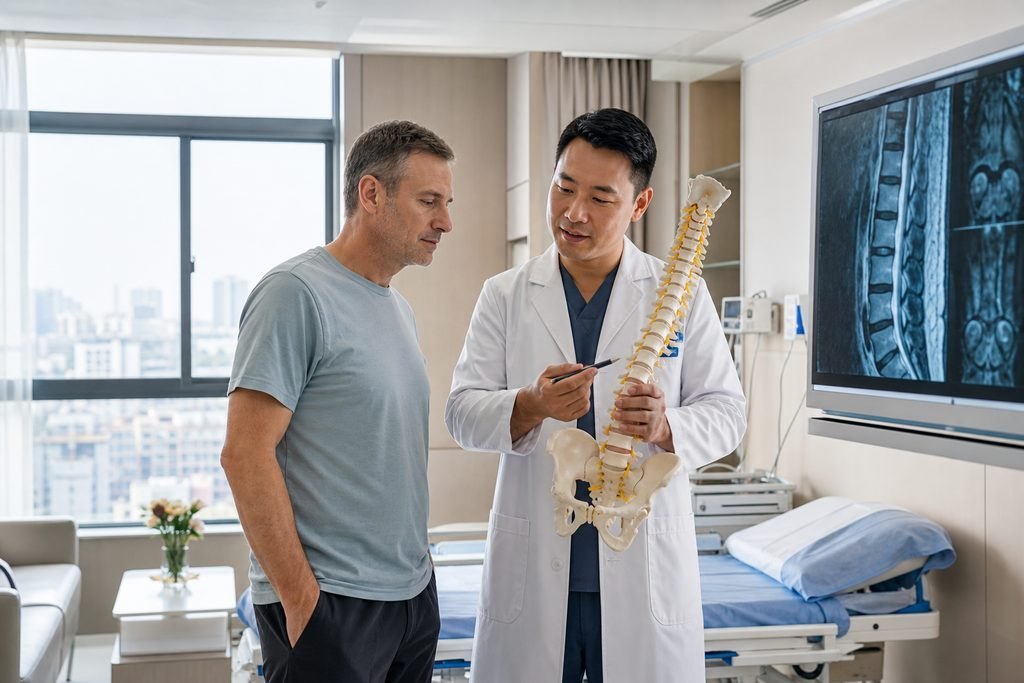
Why the diagnosis comes before the fusion plan
Spinal fusion is not a single operation with one fixed target. It joins vertebrae so that movement between them is prevented, and the clinical reason, the levels involved and the surgical approach all depend on the individual problem. That is why a hospital cannot meaningfully discuss fusion levels, implant scope or a treatment plan from an image alone or from a one-line diagnosis such as "back pain" or "disc problem".
For an overseas patient, this matters for a practical reason. If you ask a hospital in China whether fusion is possible without first clarifying what is being fused and why, the answer will either be vague or based on assumptions you cannot check. A useful assessment starts with the diagnosis, the levels under discussion and the question your own treating clinician has already raised.
It also matters for expectations. A fusion assessment is not a promise that surgery is needed, that it is suitable for you, or that you should travel. Some people who enquire are advised to continue non-surgical care; others are asked for more imaging or a specialist review before any plan is discussed. The hospital decides suitability, not the enquiry itself.
The three facts that change the whole assessment
Three pieces of information shape almost every later decision, and each one is often missing from an initial enquiry.
First, the region and levels. Fusion in the cervical spine and fusion in the lumbar spine involve different anatomy, different approaches and different questions about adjacent levels. "Spinal fusion" on its own does not tell a surgeon what is being considered. Ask your current clinician to state the region and the specific levels, for example which vertebrae are involved, and whether the proposal is a single-level or multi-level procedure.
Second, whether this is a first procedure or a revision. A revision raises different questions: what was done previously, what implants or bone graft were used, why the earlier procedure is being reconsidered, and what imaging since then shows. A hospital reviewing a revision needs the earlier operation records, not only the current scan.
Third, the implant scope. Fusion may involve instrumentation such as screws, rods or cages, and the choice depends on the levels, the diagnosis and the surgeon's judgement. This is not something a patient can select in advance, and it is not something an enquiry service can confirm. It is a question for the treating surgical team, and it belongs in the written plan you ask the hospital to provide.
What the diagnosis actually needs to contain
A diagnosis that is useful for a fusion assessment is more than a label. It should explain what is causing the problem, which levels are affected, and what has already been tried. If your records say only "degenerative disc disease" or "spinal stenosis", that may be enough to start a conversation but not enough to plan anything.
Ask your current clinician to clarify, in writing where possible, the working diagnosis, the affected levels, how long the problem has been present, what non-surgical treatment has been tried and with what result, and whether there are any neurological symptoms that need attention. If there is weakness, numbness, difficulty walking or problems with bladder or bowel control, that is a reason to seek local urgent assessment rather than to wait for an overseas enquiry.
It also helps to separate what is confirmed from what is still uncertain. If two clinicians have given different opinions, say so. If imaging has been repeated and the reports disagree, include both. A hospital reviewing your case can work with uncertainty, but it cannot work with a summary that hides it.
Records to prepare before you ask about fusion in China
You do not need to send a complete medical archive at first contact. A short summary is enough to begin, and the team can then explain what else is needed. The items below are the ones that usually decide whether a records-based review can say anything useful.
Prepare a one-page summary in English: the working diagnosis, the region and levels, whether this is a first or revision procedure, the main symptom and how it affects daily life, treatments already tried, and your single most important question. Then have the supporting documents ready to share when asked.
Supporting documents typically include recent imaging reports and the images themselves where available, operation records from any previous spinal surgery, discharge summaries, relevant laboratory results, a current medication list, and any specialist letters. If a document is in another language, ask whether a translation is needed and who should provide it.
Do not send passport numbers, payment details or a full archive through an initial enquiry form. Share records only through the channel the provider confirms, and ask how your information will be handled.
- One-page English summary with diagnosis, levels and your main question.
- Recent imaging reports, plus images if the hospital asks for them.
- Previous spinal operation records, if this is a revision.
- Discharge summaries and specialist letters.
- Current medication list and relevant laboratory results.
- Ask whether translated documents are required and who should prepare them.
Questions that belong to the treating surgical team
Some questions cannot be answered from a website or an enquiry service, because they depend on your examination, imaging and the surgeon's judgement. Write them down and put them to the clinical team directly.
Ask what the proposed procedure would involve at your specific levels, what alternatives have been considered, what the risks and benefits are for your situation, and what the evidence-based estimates of outcome and uncertainty are for someone like you. It is reasonable to ask a clinician about risk and outcome estimates; what no one can give you is a guarantee of an individual result.
Ask how many levels would be fused, whether any decompression is planned at the same time, and what the plan would be if the diagnosis turns out to be different from what the records suggest. Ask what rehabilitation would involve, who would supervise it, and how later review would work once you return home.
For care in China specifically, ask the hospital how its written estimate is structured, what it includes and excludes, and what remains undecided until after examination. Ask whether the assessment would be at a public tertiary hospital or a private international hospital, and what that choice means for scheduling, language and follow-up. These are questions to confirm with the named provider, not assumptions to carry from another country's system.
Rehabilitation, later review and the limits of a remote opinion
Fusion changes how part of the spine moves, so the plan after surgery is part of the decision, not an afterthought. Ask in advance who would supervise rehabilitation, what the restrictions would be, how progress would be assessed, and how a problem would be handled if it appeared after you returned home. The receiving clinician or physiotherapist makes their own assessment; they are not bound by the original team's plan.
Later review also needs a practical answer. Ask how imaging and clinical notes would be shared with your local clinician, and who would be responsible for follow-up questions. If you do not have a clear answer, that is worth resolving before committing to travel.
A records-based opinion has limits. It can help clarify whether fusion is being considered for a recognisable reason, what information is missing, and which specialist route might be relevant. It cannot examine you, cannot confirm final suitability, and does not establish hospital acceptance. A remote review is a step in planning, not a substitute for in-person assessment.
If your symptoms are worsening, or if you develop new weakness, numbness or bladder or bowel problems, seek local medical care promptly. An overseas enquiry should not delay that.
Sources & scope of this guide
References and official service information relevant to this guide.
This is general planning information and has not been individually reviewed by a doctor. Medical decisions and personal treatment advice come from your treating clinicians.