
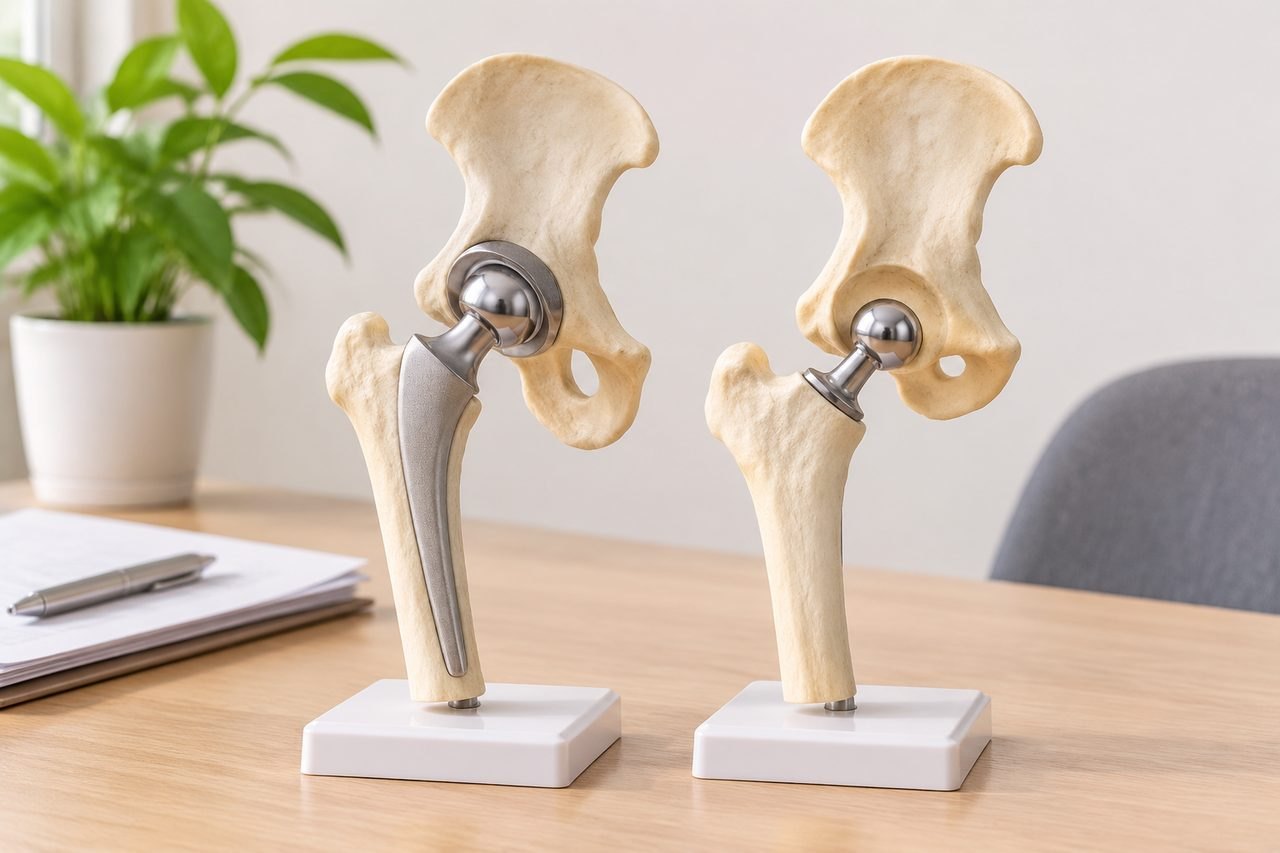
What each operation actually replaces
The clearest way to understand the difference is anatomical. The hip is a ball-and-socket joint: the rounded head of the femur sits in a cup-shaped socket in the pelvis, the acetabulum. A total hip replacement (also called total hip arthroplasty) replaces both sides of that joint with prosthetic components. A partial hip replacement replaces the femoral head and neck side only, and the patient's own acetabulum is retained.
That single difference drives most of the rest. Because a total replacement resurfaces both sides, it addresses disease that has damaged the socket as well as the ball. A partial replacement is used when the socket is judged sound and the problem lies at the femoral head. The UK National Institute for Health and Care Excellence describes hip replacement as an option for people with hip pain and disability from osteoarthritis or other hip conditions, and notes that the choice of procedure should reflect the individual's circumstances.
Neither operation is a smaller or lighter version of the other in a simple hierarchy. They are different operations with different indications, different implants and different follow-up questions. A patient who asks "which is better?" is really asking "which is appropriate for my hip?" — and that question can only be answered after imaging and clinical assessment.
Why partial replacement is usually discussed in a specific context
Partial hip replacement is most familiar in the treatment of a displaced fracture of the femoral neck, particularly in older patients, where the blood supply to the femoral head is compromised and the socket is expected to be healthy. In that setting the operation restores a working ball in the existing socket. The American Academy of Orthopaedic Surgeons discusses hip replacement among the surgical options for femoral neck fractures and stresses that treatment decisions depend on the fracture pattern, the patient's age, activity level and general health.
This context matters for overseas patients because it changes the question. If you have a fracture, the decision may be urgent and shaped by trauma assessment. If you have chronic hip pain from osteoarthritis or another joint disease, the decision is usually elective and shaped by imaging, symptoms and the condition of the socket. Bringing the wrong question to a surgeon — for example, asking for a partial replacement because it sounds less invasive when the socket is also damaged — can waste an appointment.
Partial replacement is not limited to fractures in every health system, and practice varies. Rather than assume a rule, ask the assessing surgeon directly why a partial rather than total replacement is or is not being considered in your case, and what the evidence is for that choice.
What the surgeon needs to judge suitability
The decision rests on information that must be in front of the treating team. Plain X-rays of the hip are the starting point; the surgeon will look at the joint space, the condition of the acetabulum, bone quality and any deformity. Cross-sectional imaging or other tests may be requested depending on the case, but which tests are needed is a clinical decision, not a fixed checklist for every patient.
Your history matters as much as the images. The surgeon will want to know how long pain has been present, what it prevents you from doing, whether you have had previous hip surgery or fractures, and what other medical conditions you have. Medicines that affect bleeding or bone healing, allergies, and any current infection are relevant. So is your functional goal: walking distance, independence at home, return to work.
Bone quality deserves particular attention because it influences implant fixation and the choice between procedures. If you have osteoporosis or have taken bone-affecting medication, say so. The surgeon may want a bone assessment before deciding. Do not assume that a particular scan or score is mandatory; ask what this hospital requires for your situation.
Records to gather before an overseas consultation
For a records-based discussion with a hospital in China, a focused set of documents is more useful than a complete archive. Recent hip X-rays in a standard format, any MRI or CT reports and images, a list of your current medicines with doses, and a short summary of your symptoms and previous treatments give the surgeon something to work with. If you have had a fracture, the injury films and the date of injury are essential.
Pathology or bone-density reports, if you have them, help the conversation about bone quality. So does a note of relevant conditions such as diabetes, heart disease or previous joint infection. You do not need to send passport numbers, payment details or your entire medical history at first contact; a brief summary and the key imaging are enough to begin.
One practical point: imaging taken abroad may need to be readable by the receiving team, and formats vary. Ask the hospital or your coordinator what file format and what time window of imaging they prefer before you send anything. This is an administrative question for the specific provider, not a universal rule.
Questions that make the comparison useful for you
A productive consultation produces answers to specific questions, not a general description of two operations. Ask which procedure is proposed for your hip and why, what the surgeon has seen on your imaging that supports that choice, and what would change the recommendation. Ask what implant type is planned and what the follow-up schedule involves. If a partial replacement is proposed, ask how the socket was assessed and what happens if it later becomes symptomatic.
Ask about risks in your own context rather than in the abstract. Both operations carry risks including infection, blood clots, dislocation, implant problems and anaesthetic complications; the treating team should discuss these with you and explain how they apply to your health. Ask what rehabilitation and weight-bearing instructions will follow, and who will supervise them. These are clinical discussions for the surgeon and physiotherapy team, and their judgement should be respected.
Finally, ask what the written treatment plan and fee quote include. Hospital charges, implant costs, tests, stay and follow-up are matters for the treating hospital to confirm in writing. Our coordination fees are separate from hospital charges. Without an itemised quote you cannot compare one route with another meaningfully.
Practical next steps for an overseas patient
ChinaSpecialistCare provides information and non-clinical coordination for international patients considering orthopedic care in China. We can help identify a suitable hospital and specialist team, prepare your records for a consultation, and coordinate appointment timing, admission preparation and interpretation. Hospital acceptance and the choice between total and partial hip replacement remain with the treating hospital and its clinicians.
An initial enquiry is free and asks only for a brief summary of your situation and main question. From there, we can explain what records would help and what the next step looks like. A proxy consultation, in which a doctor takes your records to a specialist while you remain at home, is optional and not a prerequisite for every appointment. If you would like to start, send a short summary through the enquiry form or by email, and we will suggest the relevant next step.
For patients who want to understand the procedure itself before deciding, our reference page on total hip replacement sets out the operation in more detail. Reading it alongside this comparison can help you frame better questions for the surgeon.
Sources & scope of this guide
References and official service information relevant to this guide.
- orthopedic care
- Related treatment reference
- NICE: Hip replacement and resurfacing arthroplasty (guidance)
- AAOS: Hip Fractures (OrthoInfo)
- AAOS: Total Hip Replacement (OrthoInfo)
This is general planning information and has not been individually reviewed by a doctor. Medical decisions and personal treatment advice come from your treating clinicians.