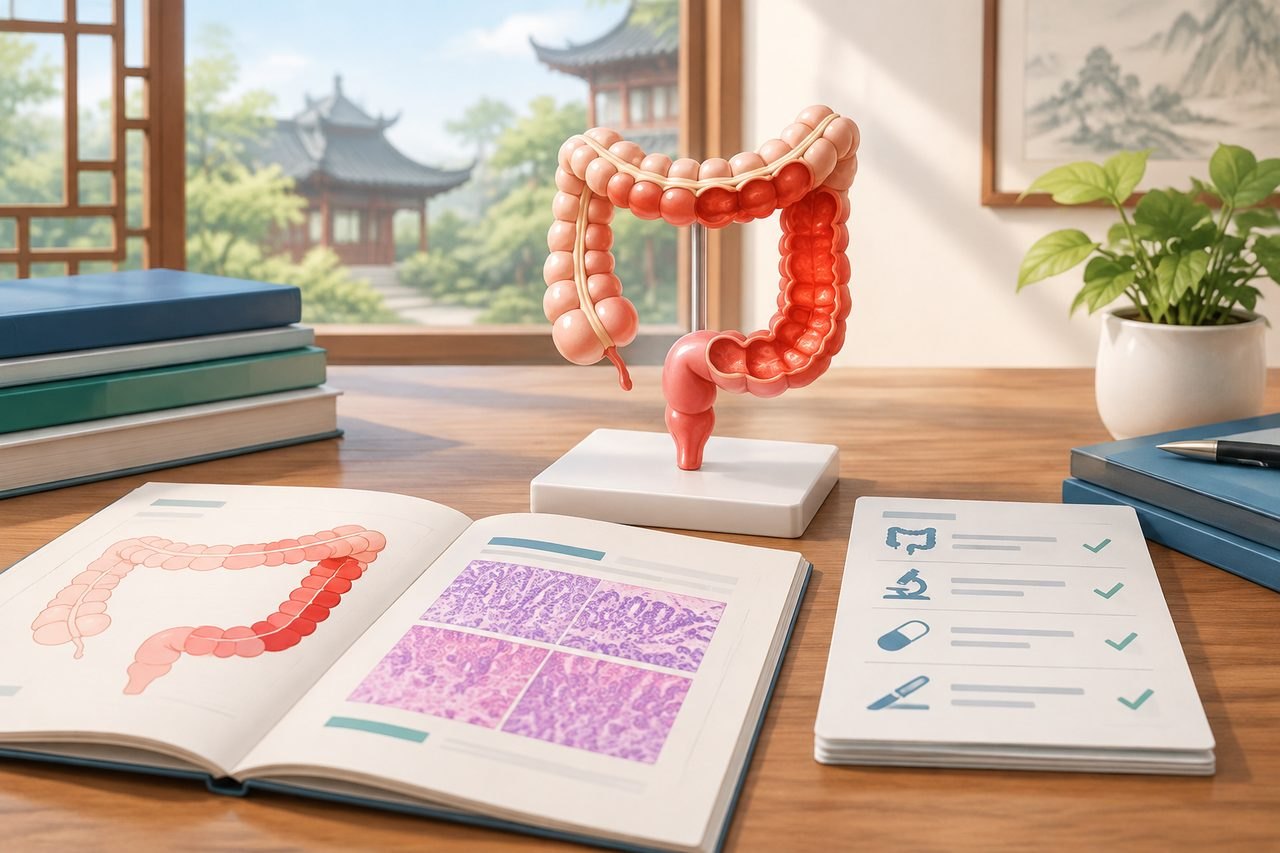
Why extent and pathology are the first things to clarify
Ulcerative colitis is not one uniform condition. Where the inflammation sits along the colon, how far it extends, and what the biopsy reports show are central to how clinicians think about severity and treatment. A review that begins without this information tends to produce generic advice rather than a decision about your actual situation.
Disease extent describes how much of the colon is involved. Pathology describes what the tissue samples showed when they were examined under a microscope. These are related but not identical: extent is about location and reach, pathology is about the character of the inflammation and whether other explanations have been excluded. If either is missing or outdated, a specialist may be unable to say whether your current treatment is appropriate or whether surgery should be discussed.
This matters for the overseas patient because the review is usually records-based first. You are asking a clinician who has not examined you to interpret documents. The clearer those documents are about extent and pathology, the more useful the opinion can be. The hospital still decides whether it can accept you and what it recommends.
What a useful extent record contains
Extent is usually documented through endoscopy reports and imaging. The endoscopy report should state which parts of the colon were examined and what was seen, rather than only giving a one-line conclusion. If the report describes inflammation reaching a certain segment, that description is more useful than a label alone.
Ask for the full endoscopy report, not just the summary letter. If a previous clinician wrote 'left-sided colitis' or 'pancolitis', the underlying report helps the reviewing team understand how that conclusion was reached and whether it still reflects the current picture. If your symptoms have changed since the last endoscopy, say so, because that may affect whether further assessment is needed.
Imaging such as CT or MRI may also be relevant, particularly if complications are being considered. Include those reports if they exist. If they do not, that is not necessarily a gap you must fill before enquiring; it is a question for the treating team about whether they need more information.
A practical point: keep the original language of the reports and add a translation if you have one. A translated summary can help communication, but the original document is what the clinician will rely on. Do not edit or paraphrase the findings when sending records.
What pathology adds that extent alone cannot
Pathology reports describe the tissue itself. They may comment on the pattern of inflammation, whether it is chronic, and whether features suggesting an alternative diagnosis are present. This is why a pathology review is not simply a repeat of the endoscopy report.
If you have had biopsies, ask for the full pathology report including the microscopic description, not only the final impression. The final line is useful, but the descriptive section often contains detail that a reviewing pathologist or gastroenterologist will want. If slides or blocks are available, ask whether the receiving hospital would like them sent; this is a question to confirm with that hospital rather than an assumption.
Sometimes the original pathology is incomplete or the interpretation is uncertain. In that situation, a pathology re-review may be suggested. That is a separate step from a clinical consultation and should be discussed on its own terms. It does not by itself establish a diagnosis or a treatment plan.
Be careful not to treat a pathology report as a fixed verdict that never changes. Reports reflect the sample taken at a point in time. If the clinical picture has moved on, the treating team may want to consider whether new sampling is needed. That decision belongs to them.
Linking extent and pathology to treatment response
Treatment for ulcerative colitis is tailored to the person and the severity of the disease, and possible approaches include medicines and surgery. That is the general principle. What it means for you depends on how extensive the disease is, what has already been tried, and how you have responded.
A treatment history is therefore part of the same conversation as extent and pathology. Which medicines were used, for how long, and what happened afterwards are questions the reviewing clinician will ask. If a treatment was stopped, the reason matters: was it lack of benefit, side effects, or another cause? A short factual timeline is more useful than a long narrative.
Do not change or stop any medicine on the basis of an overseas enquiry. Prescribing belongs to your treating clinician. If your symptoms are worsening, that takes priority over travel planning and should be assessed locally first.
When you send records, include the treatment history alongside the extent and pathology documents. This lets the reviewing team see whether the question is about optimising current therapy, considering a change, or discussing surgery. Each of those is a different conversation.
When surgery enters the discussion
Surgery is one of the possible approaches for ulcerative colitis, but whether it is appropriate for you is a clinical decision that depends on many factors, including extent, response to treatment, and your overall situation. A records review can help clarify whether surgery is worth discussing, but it does not decide that for you.
If surgery is being considered, the extent and pathology records become especially important, because the surgical team needs to understand how much of the colon is involved and what the tissue shows. They may also want to know about previous abdominal surgery, other medical conditions, and current medicines.
Ask the treating team what they would need in order to have a meaningful surgical discussion. This is a better approach than sending everything and hoping the relevant parts are found. A focused question, such as whether the current extent and pathology are sufficient for a surgical opinion, is more likely to get a useful answer.
Keep in mind that a review is not the same as hospital acceptance. The hospital decides whether it can offer care, and that decision may depend on information you have not yet provided. An initial enquiry does not commit you to any procedure.
Preparing your records and your questions
Start with a short summary of your situation: when you were diagnosed, what extent has been documented, what treatments you have tried, and what your main question is now. This helps the receiving team understand what you are asking before they read the full file.
Then prepare the key documents: the most recent endoscopy report, the pathology report, and a treatment history. If you have older reports that show how the disease has changed, include them, but make clear which are current. Do not send passport numbers, card details or a complete archive at the first contact.
Write down your questions in advance. Useful ones include: does the current extent and pathology record give enough information for a review; would the team want the original slides or blocks; what would they need to discuss surgery; and what would they need to confirm before any treatment change. These are questions to confirm with the specific provider, not assumptions about how any hospital works.
If you would like help organising this, ChinaSpecialistCare can review a brief summary and suggest the relevant next step. You can see the inflammatory bowel disease care page for the service context, and an initial enquiry is free. The hospital and its clinicians make the clinical decisions.
Sources & scope of this guide
References and official service information relevant to this guide.
This is general planning information and has not been individually reviewed by a doctor. Medical decisions and personal treatment advice come from your treating clinicians.