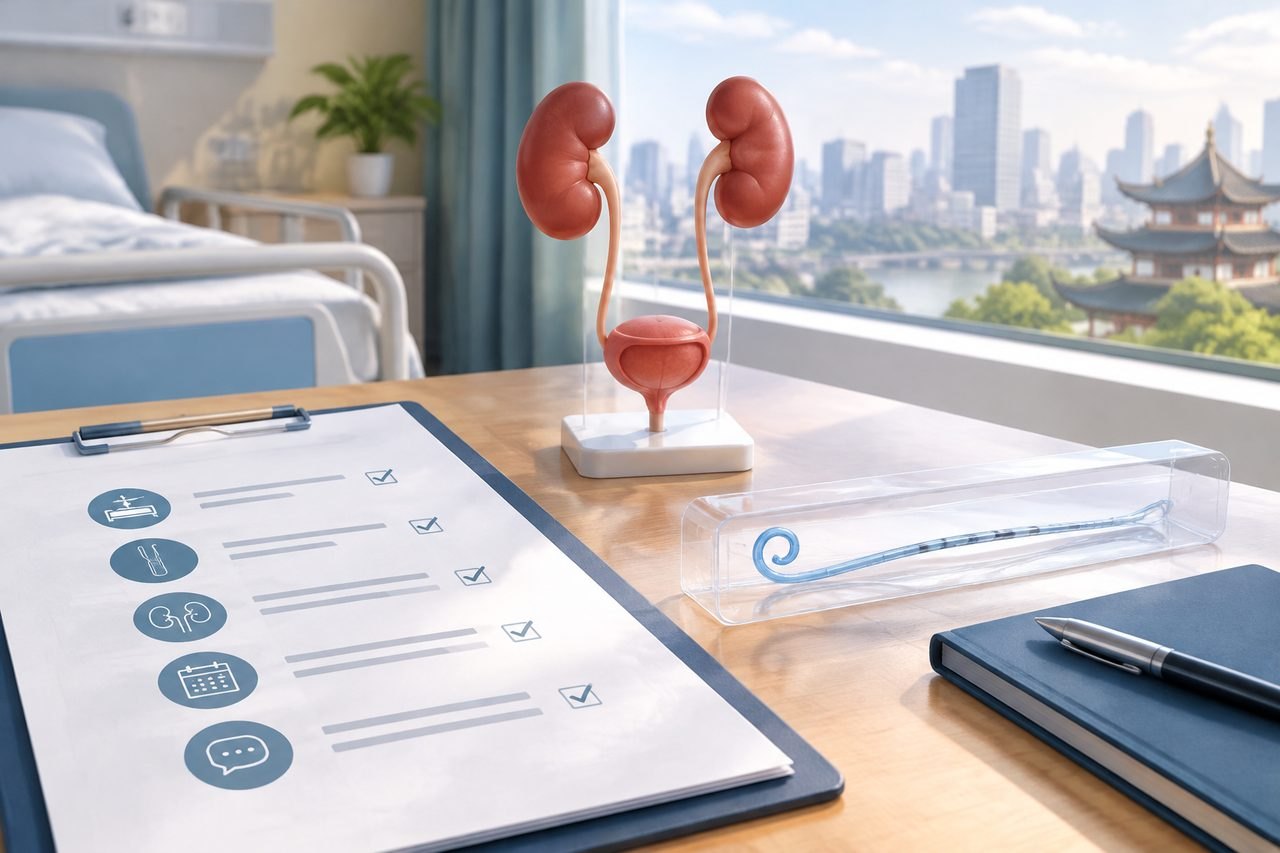
Why the consent conversation matters more than the procedure name
Ureteroscopy uses a telescope passed through the urinary tract to treat stones. The name of the operation tells you very little about what you are actually agreeing to. The same term can describe a straightforward stone removal, a procedure that is deliberately split into more than one session, or a treatment that ends with a temporary tube left inside you.
That is why the useful question is not only “what is ureteroscopy?” but “what exactly is being proposed for me, in what sequence, and what happens afterwards?” A consent form you sign in China should reflect a plan you can restate in your own words. If you cannot, the discussion is not finished.
Overseas patients carry an extra practical load here. A staged plan or a stent changes how long you may need to remain in the country, whether you can fly home on your original date, and whether a second appointment has to be built into the trip. None of those arrangements should be guessed at the last minute.
Is this a single procedure or staged treatment?
Treatment may be staged, meaning the clinician plans more than one session rather than completing everything at once. Staging can be proposed for reasons connected to the stone itself, to the ureter, or to how the first session went. The reason matters to you because it determines whether you are consenting to one event or to a course of care.
Ask directly: is this expected to be completed in one session, or is a second look or second procedure already anticipated? If a second stage is possible but not certain, ask what would trigger it. A plan that says “we will see” is not necessarily wrong, but you should know that the decision point exists and who makes it.
Then ask the scheduling question that follows from it. If a second session becomes necessary, how would it be arranged, and what would that mean for your return travel? You are not asking for a guarantee. You are asking what the team's working assumption is, so you can plan realistically.
It also helps to ask who will make the call on the day. If the operating clinician finds something that changes the plan mid-procedure, what are they authorised to do, and how and when would you or your family be told? Consent discussions should cover the possibility of a changed plan, not only the ideal path.
Will a ureteric stent be left in, and who removes it?
A temporary ureteric stent may be placed and may require a later removal appointment. This is one of the most important things to clarify before you agree to care, because it creates a second clinical event after the first one.
Ask whether a stent is planned, whether it is definite or decided during the procedure, and what it is intended to do in your case. Ask how long it is expected to stay, understanding that the treating clinician sets this based on your situation rather than a fixed rule. Ask who removes it, where, and how that appointment is booked.
The removal appointment is where overseas planning often comes unstuck. If the stent is placed in China but you intend to return home, you need to know whether removal can happen locally, whether the Chinese team will provide the documentation your home clinician needs, and what you should do if removal is delayed. These are questions for the treating team and, where relevant, your own clinician — not assumptions you can make from a general article.
Ask what symptoms or problems should prompt you to seek urgent care while the stent is in place, and who to contact in China and after you leave. Get this in writing if you can, along with any instructions about activity or fluids that the team wants you to follow.
What follow-up stone checks are planned, and where?
Removing the stone is not the end of the story. Follow-up checks look at whether stone material remains, whether the ureter is healing as expected, and whether further treatment is needed. Ask what checks are planned, roughly when they would happen, and whether they can be done at home or are expected in China.
If the team wants imaging or a clinic review after you return home, ask what information they will send and to whom. A short written summary, imaging files and a clear statement of what has been done make it far easier for another clinician to take over. Ask how you would obtain those records and whether there is a cost for copies or translations.
Ask also about prevention. If you have had a stone, clinicians may discuss diet, fluid intake or metabolic assessment. You can ask whether any of that is relevant to you and who would manage it — the Chinese team, your home urologist, or both. Do not change any medication or diet plan on the basis of a general article; that belongs with your treating clinician.
Questions that are still unanswered: how to tell
You can often sense when a consent discussion is incomplete. The plan is described in general terms, the follow-up is vague, or your questions are answered with reassurance rather than specifics. That is the moment to slow down, not to sign and hope.
A useful test is whether you can explain the plan to someone else in plain language: what will be done, whether it may be staged, whether a stent is involved, what the recovery and follow-up look like, and what the alternatives are. If you cannot, ask again. Interpretation support can help here, and it is reasonable to request that key points be written down.
Ask what the alternatives are, including doing nothing for now or treating the stone another way, and what the clinician sees as the main risks and benefits of each. You are entitled to ask about evidence-based risk estimates for your situation and to hear where uncertainty remains. No estimate guarantees your individual result.
Finally, ask what happens if you decide not to proceed, or want time to think. A decision made under pressure is a poor foundation for consent. If you need to discuss the plan with your own doctor at home before agreeing, say so.
Practical preparation and a sensible next step
Before travelling, gather the records that make a proper discussion possible: recent imaging and reports, blood and urine results, a list of your medicines and allergies, and any previous stone treatments. Ask the receiving team what they specifically need, rather than sending everything you have. If something is missing, ask what the limits of the assessment are and what would help.
Confirm the administrative side in writing where you can: who your named contact is, how the consent discussion will be conducted and in what language, and what the written estimate for the proposed care includes and excludes. Ask the provider how its estimate is structured rather than assuming a billing pattern. Hospital charges, any coordination fees and your travel costs are separate matters, and you should be able to see what each covers.
If you would like help with records, interpretation or requesting a specialist appointment in China, ChinaSpecialistCare can assist with that coordination. An initial enquiry is free and does not require buying a proxy consultation. The hospital and its clinicians decide suitability, the treatment plan and whether to accept you as a patient.
A good next step is to write down your three or four most important unanswered questions — staged treatment, stent and removal, follow-up checks, and what happens if the plan changes — and put them to the treating team before you consent. If your symptoms worsen or you develop fever, severe pain or difficulty passing urine, seek urgent local medical care rather than waiting on an overseas enquiry.
Sources & scope of this guide
References and official service information relevant to this guide.
This is general planning information and has not been individually reviewed by a doctor. Medical decisions and personal treatment advice come from your treating clinicians.