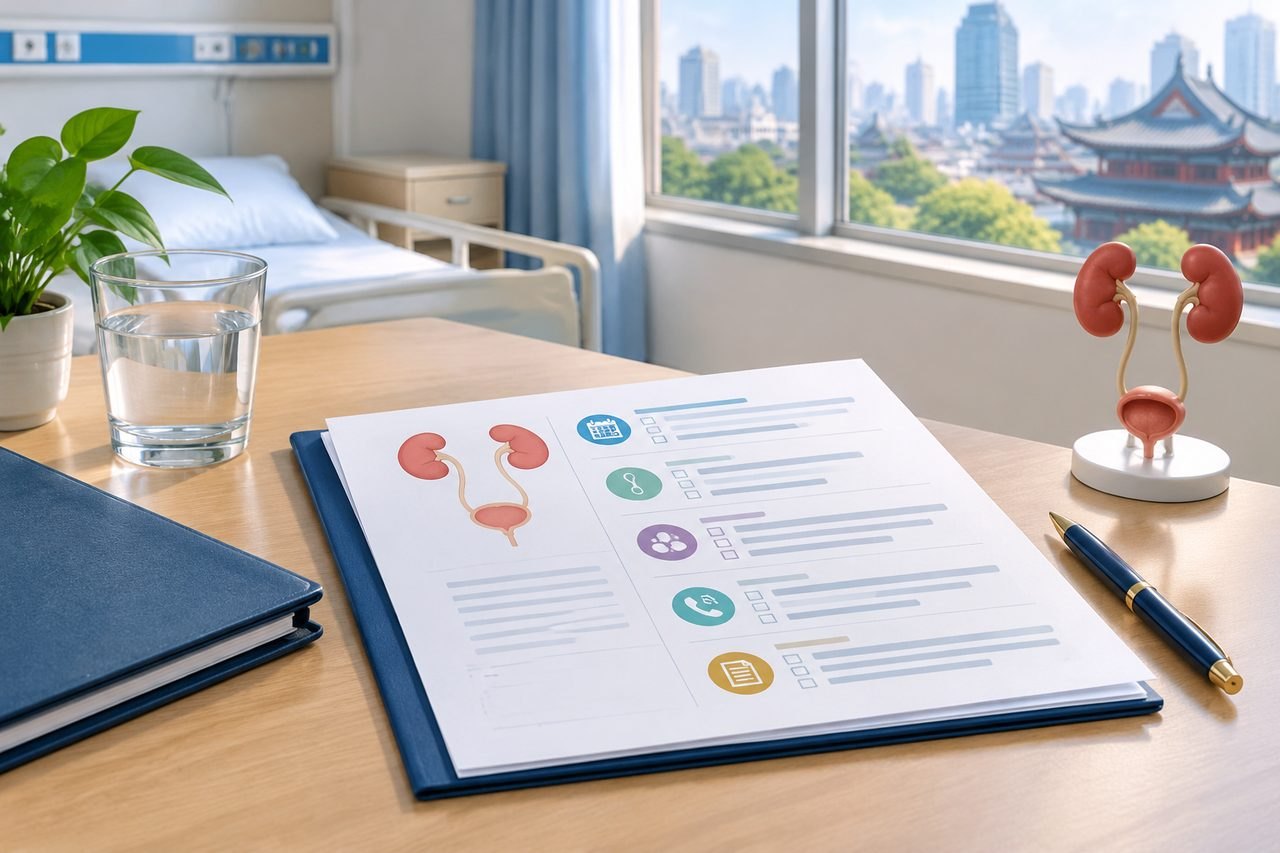
Why a written plan matters more than a verbal briefing
Ureteroscopy uses a telescope passed through the urinary tract to treat stones. The Newcastle Hospitals patient information explains that treatment may be staged and that a temporary ureteric stent may be left in place, requiring a later removal appointment. Those two facts alone mean the follow-up plan is not a formality. If treatment is staged, you need to know what remains and when the next stage would be considered. If a stent is present, you need to know who will remove it, where, and what you should do if you leave China before that happens.
A verbal briefing at discharge is easy to misremember, especially across a language barrier and after sedation or anaesthesia. A written plan gives your home urologist, family doctor or emergency department something concrete to work from. It also protects you from the common gap where the operating team assumes someone else is arranging the stent removal, and the receiving clinic assumes the operating team already did.
The plan does not need to be long. One page with clear headings is more useful than several pages of general advice. What matters is that it is specific to you, dated, and carries a named contact or department.
The questions that decide what the plan must contain
Before the plan is written, the clinical team needs to answer a short set of questions. These are not administrative details; each one changes what the follow-up plan should say.
Was the stone fully treated, or is further treatment planned? If treatment was staged, the plan should state what remains, what imaging or review would decide the next step, and whether that step is expected in China or could be done at home. Ask the team to write this in plain terms rather than a single phrase such as 'review as needed'.
Is a ureteric stent in place? If yes, the plan should record when it was inserted, when the team intends it to be removed, and how that removal appointment is arranged. Stent removal is a separate procedure with its own timing and arrangements, so it should not be left as an assumption.
What stone checks are planned afterwards? Follow-up after stone treatment may include imaging or metabolic assessment, but the exact tests and interval depend on your stone type, history and the team's judgement. Ask what this team proposes for you, and whether any of it can be done locally at home.
What symptoms or changes should prompt urgent contact? Ask the team to write down the warning signs they want you to act on, and whether you should contact them, a local emergency service, or both. This is a clinical instruction, so it must come from the treating team rather than from a coordination service.
What the written plan should actually say
A useful plan is specific enough that another clinician can act on it without calling the original hospital. Ask for the following items to appear in writing, in English or with a translation you can rely on.
The diagnosis and what was done: the stone location, the procedure performed, the date, and whether any stone remains. The stent status: whether a stent is present, its expected removal date or window, and who is responsible for arranging removal. The next clinical step: what review, imaging or test is planned, and the reason for it. The contact route: a named department, phone number or email that works from outside China, and the hours when it is answered. The records route: what documents you will receive, in what language, and how they will be sent to your home clinician.
Ask the team to distinguish clearly between instructions that are fixed and those that depend on how you recover. If a date is provisional, the plan should say so and state what would change it. A plan that presents a provisional date as certain creates a false sense of security when you book travel.
If the hospital provides its own discharge summary template, ask whether the stent and staged-treatment details can be added to it. A single document is easier to hand over than several separate notes.
- Diagnosis, stone location and date of the procedure
- Whether treatment was completed or staged, and what remains
- Whether a ureteric stent is in place and when removal is intended
- Who arranges stent removal and where it would take place
- Planned follow-up imaging, tests or clinic review, with the reason
- Warning symptoms and the exact contact route for each situation
- Which records you will receive and how they reach your home clinician
Stent removal and staged treatment: the two gaps to close
Most follow-up failures after ureteroscopy come from two places: a stent that nobody has clearly agreed to remove, and a second stage of treatment that was mentioned but never scheduled.
For the stent, ask directly: who will remove it, at which hospital, and how is that appointment booked? If the answer is that removal should happen at home, ask the team to state the acceptable timing window in writing and to provide the stent details your home urologist would need. Do not assume your home clinic will accept the removal without records; ask them in advance what they require.
For staged treatment, ask what the second stage is intended to achieve, what has to happen before it can be scheduled, and whether it could reasonably be done at home instead. If the team wants you to return to China, ask them to write down the clinical reason. That written reason helps your home clinician understand the plan and helps you decide whether the return trip is justified.
If you are unsure whether you can stay in China long enough for the planned follow-up, raise this before discharge rather than after. The team may be able to adjust the plan, or may advise a different arrangement. This is a clinical decision, and the treating team is the right place to make it.
Records, language and the handover to your home clinician
A follow-up plan is only useful if your home clinician can read it. Ask what language the discharge summary and imaging reports will be in, and whether an English version is available. If not, ask what translation arrangements the hospital can provide and whether the translation is done by the hospital or by a separate service.
Ask how the records will be given to you: printed, on a USB drive, by email, or through a patient portal. If imaging was performed, ask whether you will receive the images themselves or only the reports, because your home urologist may want to review the images. Ask whether the records can be sent directly to your home clinician, and what consent or request that requires.
Before you travel, contact your home urologist's office and ask what they need in order to take over follow-up. They may want the operative note, the stent details, the discharge summary and the imaging. Knowing this in advance lets you request the right documents while you are still at the hospital, rather than trying to obtain them from abroad later.
Keep your own copy of everything. Hospitals can be slow to release records after you have left, and a personal copy avoids delays if you need urgent local care.
Practical preparation and the next step
Before your appointment or admission, prepare a short list of the questions above and take it with you. If you use an interpreter, ask them to stay for the discharge discussion so the written plan and the verbal explanation match. Ask for the plan before you leave the ward, not after you have left the hospital.
If you are still planning care in China, the practical starting point is to confirm what the treating hospital can offer for your specific stone situation. The urology team decides whether ureteroscopy is suitable, whether treatment would be staged, and whether a stent is needed. A coordination service can help you request an appointment and prepare records, but it does not make those clinical decisions.
You can begin with a free initial enquiry by sending a brief summary of your diagnosis, the stone location if known, any previous treatment, and your main question. You do not need a complete medical archive at this stage, and you do not need to buy a proxy consultation to ask a question. If you want to understand the procedure itself before deciding, read the ureteroscopy and laser stone treatment reference, then bring your follow-up questions to the clinical team.
The single most useful action is to ask, before discharge, for a dated written plan that names the stent status, the next clinical step, the contact route and the records handover. If any of those four items is missing, ask for it to be added.
Sources & scope of this guide
References and official service information relevant to this guide.
This is general planning information and has not been individually reviewed by a doctor. Medical decisions and personal treatment advice come from your treating clinicians.