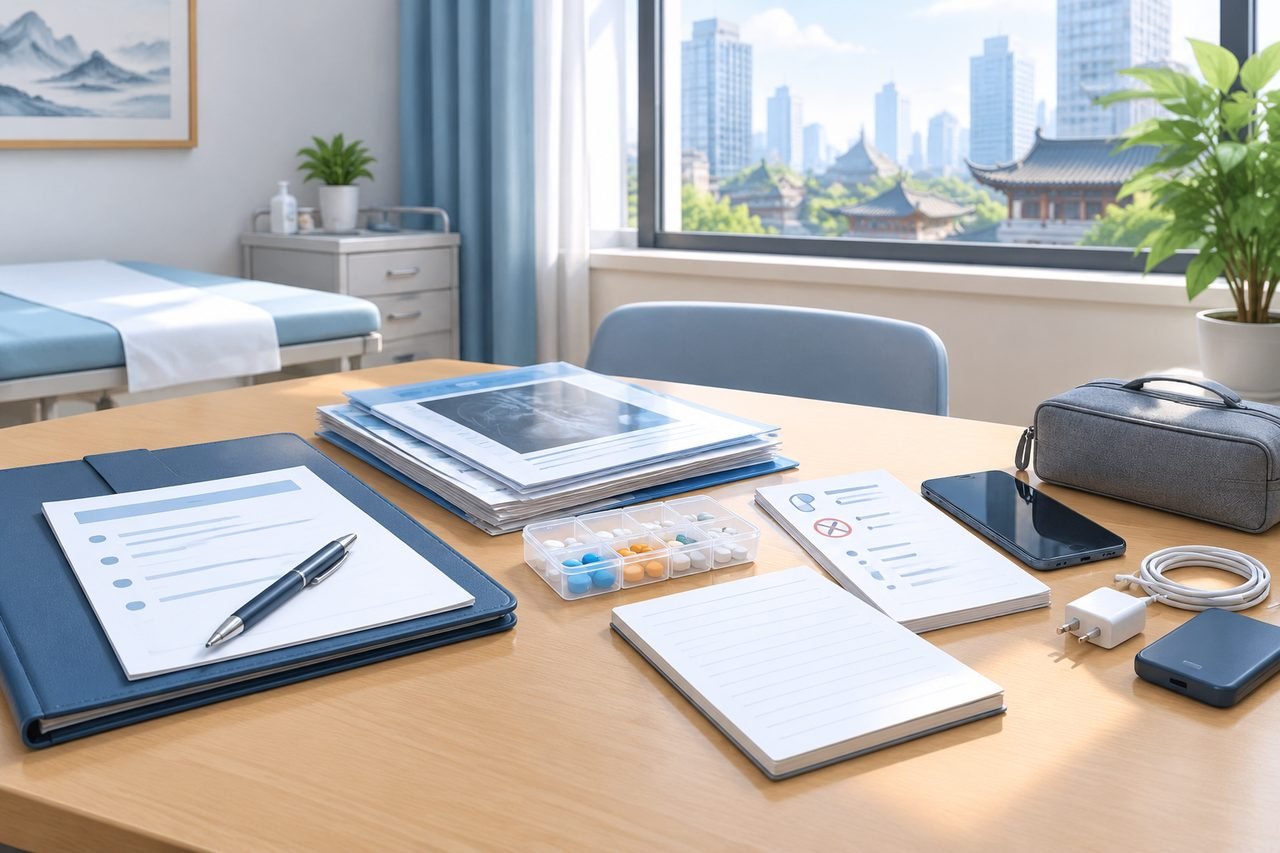
Start with a one-page summary, not your whole archive
The most useful item you can carry is a single page that a busy clinician can read in under two minutes. It should state your main concern in one or two sentences, when it started, what has already been tried, and what you want from this visit. If you have several separate problems, rank them so the specialist knows which one matters most to you.
This summary is not a substitute for your records. It is a map that helps the specialist decide which documents to open first. Without it, a first consultation can be spent reconstructing basic history instead of discussing the decision you travelled for.
Write it in plain English and, if you can, have a Chinese translation prepared. The hospital may provide interpretation, but a translated summary reduces the risk of a detail being lost. Keep dates in a consistent format and avoid abbreviations that only your home clinic uses.
Records that usually change the conversation
What counts as a key record depends on your specialty, but some categories are broadly useful. Imaging reports and the actual images, pathology reports, operation notes, discharge summaries, and recent laboratory results all help a specialist understand your situation. If a diagnosis was made elsewhere, the report that established it is more valuable than a later summary that only repeats the conclusion.
Bring the images themselves, not only the radiologist's report. Reports describe findings; the specialist may want to review the actual scan. Ask your home provider how to obtain a copy on disc or through a secure link, and check that the file opens before you travel.
For any procedure you have had, the operation note and the implant or device details matter. If you have a pacemaker, joint replacement, stent, or similar device, carry the card or documentation that identifies the model. This is not because every visit requires it, but because it answers questions that otherwise take time to resolve.
Medication list and allergy information
Carry a current medication list with generic names, doses, and how often you take each one. Include anything you take regularly, including supplements and traditional medicines, because interactions and side effects are part of the clinical picture. If you have stopped a medicine recently, note that and the reason. A specialist reading a list of ten items with doses can see the shape of your treatment at a glance; a bag of labelled boxes cannot be scanned in the same way.
The list should also record who prescribed each medicine and when it was last reviewed. That matters when a specialist is deciding whether a symptom is part of the original condition or a side effect of treatment. If two clinicians in different countries have prescribed for the same problem, say so, because duplicated therapy is a question the visiting clinician will want to resolve rather than assume.
Allergies and previous reactions deserve their own line. State what happened, not just the name of the drug. A specialist can act on "rash and swelling after penicillin" more reliably than on "allergic to antibiotics". Include the timing and whether the reaction was treated, since that changes how cautious the next prescription needs to be.
If you have had a reaction to contrast dye, latex, or an anaesthetic, put that on the same line. These are the details that alter what can be offered on the day, and they are easy to forget when you are concentrating on the main complaint. A short allergy block at the top of the page is more useful than a note buried in a discharge summary.
Do not change any medicine before the visit on the basis of this article. If you are unsure whether a medicine should be continued, that is a question for the treating clinician, and it may need to be answered before you travel. Bring enough of your regular medicines for the trip plus a margin, and keep them in original packaging with the prescription or a copy of it.
If you use a device such as an insulin pump, a continuous monitor, or an inhaler, note the model and the supplies you rely on. Ask the hospital in advance whether you should bring spares or whether they can be sourced locally. This is a logistics question with a clinical edge, and it is better answered before you fly than on the morning of the appointment.
A written medication list also helps at the pharmacy and at any unscheduled visit during your trip. Keep a copy in your folder and a photo on your phone. If a clinician asks what you take, you can hand over the same page every time instead of reconstructing it from memory in a second language.
Questions that decide the next step
A first visit is more productive when you arrive with specific questions. Ask what the specialist thinks the main problem is, what information is still missing, and what the next step would be. Ask whether any test or procedure is being recommended now, and what it is meant to show.
Ask about alternatives, including doing nothing or continuing current treatment. Ask what would change the plan, and what warning signs should prompt earlier contact. If a procedure is discussed, ask about the intended extent, the device or technique planned, and what follow-up is expected.
Write the answers down or ask permission to record the discussion. Memory of a consultation in a second language is unreliable, and a short written summary afterwards helps you explain the plan to family or your home clinician.
Practical items and digital access
Carry your passport and any hospital registration documents you have been given, plus a printed copy of your appointment confirmation. Keep a small folder with the one-page summary, medication list, and key reports so you can hand it over without searching.
Have your records available in more than one form. A USB drive or disc is useful, but some hospitals prefer a secure upload or a cloud link. Ask the hospital in advance which it accepts, because file-sharing arrangements differ between providers.
Bring a charger and, if you rely on your phone for records, a backup. If you use a translation app, test it before the visit. Interpretation can be arranged, but confirming the language and timing with the hospital is part of preparation, not an assumption.
What the hospital still has to confirm
No article can tell you exactly what a particular hospital will require. Document rules, language support, room arrangements, and appointment timing are provider-specific and should be confirmed directly. Ask the hospital or your coordination contact what to bring, what to send in advance, and whether originals are needed.
If you are using a coordination service, the free initial review checks your available diagnosis, records, and main question, and suggests a next step. It is not a diagnosis and does not confirm acceptance. A proxy consultation is optional and not a prerequisite for an appointment.
The hospital decides suitability and acceptance. A first visit is an assessment, not a guarantee of treatment. If your symptoms worsen before travel, seek local care rather than waiting for the appointment.
Sources & scope of this guide
References and official service information relevant to this guide.
This is general planning information and has not been individually reviewed by a doctor. Medical decisions and personal treatment advice come from your treating clinicians.