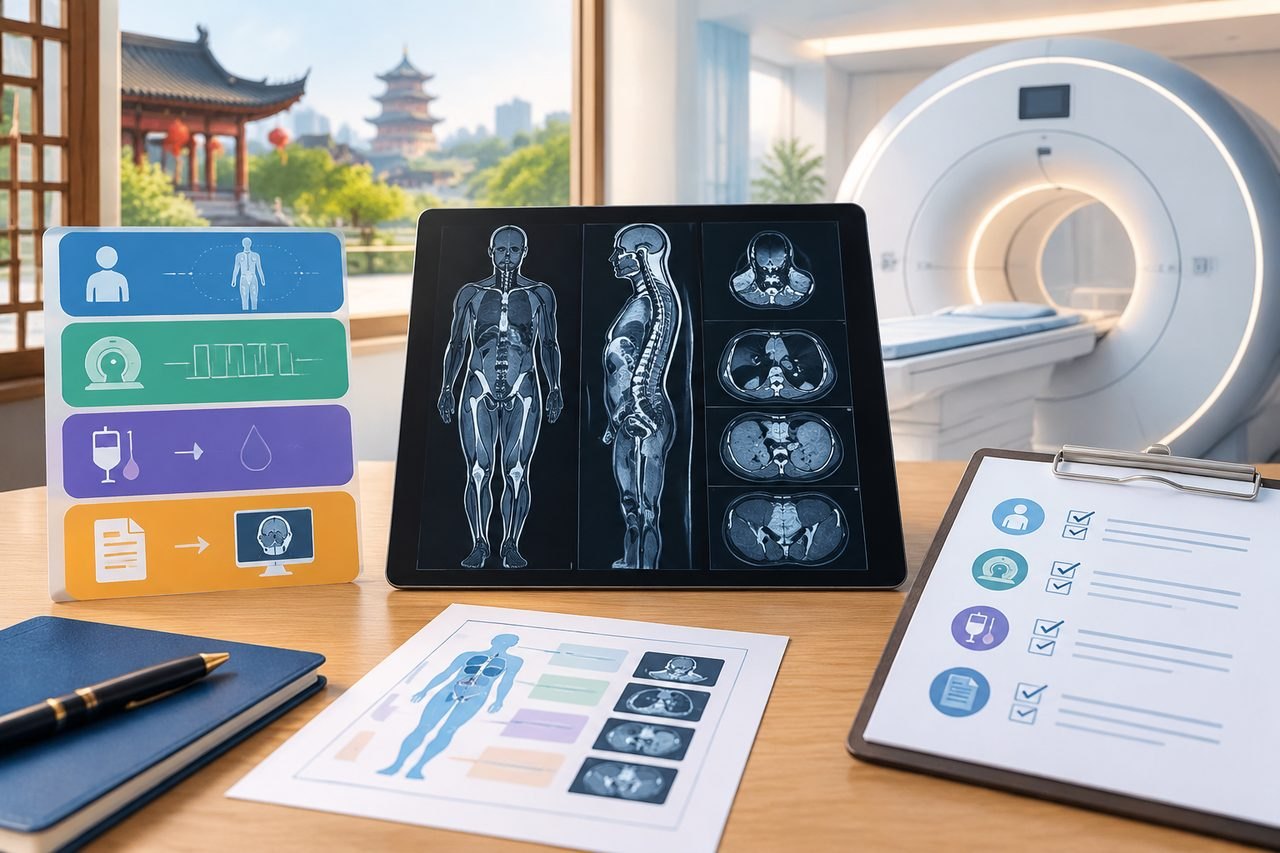
Why Protocol Details Decide Whether the Enquiry Is Useful
Whole-body MRI is not one standard examination. Different providers may use different scanners, coil setups, slice thicknesses, sequences and body coverage, and they may or may not use intravenous contrast. Two enquiries that both say whole-body MRI can therefore describe quite different examinations. If you send only the phrase whole-body MRI, the reply you receive may not match what you actually need.
This matters because the protocol should follow the clinical question. A person with no symptoms who is considering a preventive checkup has a different starting point from someone with an existing diagnosis who needs a follow-up comparison, and both differ from a patient with current symptoms that need diagnostic assessment. In the first situation, a clinician should advise whether any screening test is appropriate at all. In the second, the protocol usually needs to reproduce or build on earlier imaging so the two sets of images can be compared. In the third, the priority is assessment of the symptom, not a broad screening package.
For an overseas enquiry, the practical consequence is that you should not ask only for a price or an appointment date. Ask what the proposed protocol includes, what it is intended to answer, and which clinician will decide whether it is suitable for your situation. Those three answers determine whether the rest of the planning is worth doing.
Separate Three Situations Before You Compare Anything
The first situation is asymptomatic screening. Here there is no confirmed disease and no specific symptom driving the request. The decision about whether a whole-body MRI is appropriate, and which protocol would be used, belongs to a qualified clinician who can consider your history, prior results and the limitations of screening. A checkup provider can explain what its programme offers, but it should not present a scan as necessary for everyone.
The second situation is follow-up of a known condition. If you already have a diagnosis and previous imaging, the new protocol needs to be comparable with the old one. That means the receiving clinician should see the earlier report and, where possible, the earlier images. Ask whether the proposed protocol is designed for comparison with your existing studies, and what information the radiologist needs in order to report it in a useful way.
The third situation is symptoms. Current pain, unexplained weight loss, neurological changes or other new symptoms call for a specialist consultation rather than a screening purchase. A whole-body scan may or may not be part of that assessment, and the specialist should decide. If your symptoms are urgent or worsening, seek local medical care first rather than delaying assessment for an overseas enquiry.
Naming which of these three situations applies to you is the single most useful thing you can do in your first message. It lets the provider route your enquiry correctly instead of offering a generic package.
- Asymptomatic screening: no confirmed disease and no specific symptom; a clinician should advise whether any test is appropriate.
- Known-condition follow-up: existing diagnosis and prior imaging; comparability with earlier studies matters.
- Symptom assessment: current symptoms; a specialist consultation comes before any screening decision.
The Protocol Questions Worth Putting in Writing
When you contact a provider, ask for written confirmation of the protocol details rather than a verbal summary. Written answers are easier to compare and easier to check against your own clinician's advice. The questions below are administrative and technical; they do not require you to interpret images or make a diagnosis.
Ask what body regions the protocol covers and whether coverage is continuous or limited to selected areas. Ask which sequences are planned and whether intravenous contrast is included, optional or not planned. Ask whether the examination is intended as a screening study or as a diagnostic study for a specific question. Ask who will read the images, what the report will contain, and in what language it will be issued. Ask whether the images themselves, not only the report, can be provided to you afterwards.
Also ask what preparation is required, how long the appointment is expected to take, and whether any part of the examination may need to be repeated. These are practical points, but they affect whether the scan can be completed in one visit and whether the result will be usable by your own doctors.
If a provider cannot answer these questions before you commit, that is useful information. It may mean the enquiry needs to go to a different department or that more clinical context is required first.
What to Send, and What Not to Send, in the First Message
An initial enquiry does not require a complete medical archive. A short summary is enough to start: your main question, the reason for the request, any relevant diagnosis, and the country you are writing from. If you have a recent imaging report or a specialist letter, mentioning it is helpful, but you do not need to upload everything at the first contact.
After the first reply, the provider can tell you which records are actually needed for the next step. At that stage, relevant items may include previous imaging reports, the images themselves if comparison is planned, recent laboratory results, a list of current medications, and any specialist correspondence. Ask how records should be shared and whether translation is required.
Do not send passport numbers, payment card details or a full medical history through an initial web form. Those are not needed to answer a protocol question, and sharing them early creates avoidable risk. Keep the first message focused on the clinical question and the practical decision you are trying to make.
If you are unsure whether a document is relevant, describe it in one line and ask. That is faster than sending a large file set that the receiving clinician has to sort through.
How to Read the Reply You Receive
A useful reply will distinguish between what the provider can arrange and what a clinician must decide. It should tell you whether the proposed protocol matches your stated situation, what information is still missing, and what the next step would be. It should not promise that a scan will find or exclude any particular condition, and it should not present a package as suitable for everyone.
Be cautious if a reply confirms a scan before understanding your situation, or if it describes the protocol only in marketing terms without technical detail. Equally, be cautious if a provider offers a firm clinical conclusion based only on a records summary. A records-based opinion can help clarify options and identify what further assessment may be needed, but it does not replace examination and it does not establish final suitability or hospital acceptance.
If the reply is unclear, ask one follow-up question at a time. For example: which clinician will decide whether this protocol is appropriate for me, and what information do they still need? That single question often resolves more uncertainty than a long list of general queries.
Remember that the hospital, not the coordination service, decides whether a test or admission is suitable. Coordination can help you prepare and communicate, but it does not make clinical decisions.
Practical Planning and a Sensible Next Step
Once the protocol question is clear, the remaining planning is administrative. You may need to confirm appointment timing, the hospital or clinic route, language arrangements and how the report will be delivered. Ask each of these as a specific question rather than assuming a standard process. Public tertiary hospitals and private international hospitals are both possible routes, and their arrangements can differ.
If you are considering a routine preventive checkup rather than a diagnostic scan, the checkup planning page explains base packages and add-ons, and notes that a clinician should advise on the interval and suitable tests. A stand-alone diagnostic test normally needs a specialist's order, so ask the provider whether a whole-body MRI enquiry would be handled as a diagnostic test or as part of a checkup package.
A brief next step: send a short summary of your situation and your main question through the enquiry route, and ask the provider to confirm the protocol details in writing. An initial enquiry is free and does not require buying a proxy consultation. If your symptoms are urgent, seek local care first.
For checkup-related planning, you can review the health checkup packages page and use its enquiry anchor to ask about protocol details for your specific situation.
Sources & scope of this guide
References and official service information relevant to this guide.
This is general planning information and has not been individually reviewed by a doctor. Medical decisions and personal treatment advice come from your treating clinicians.