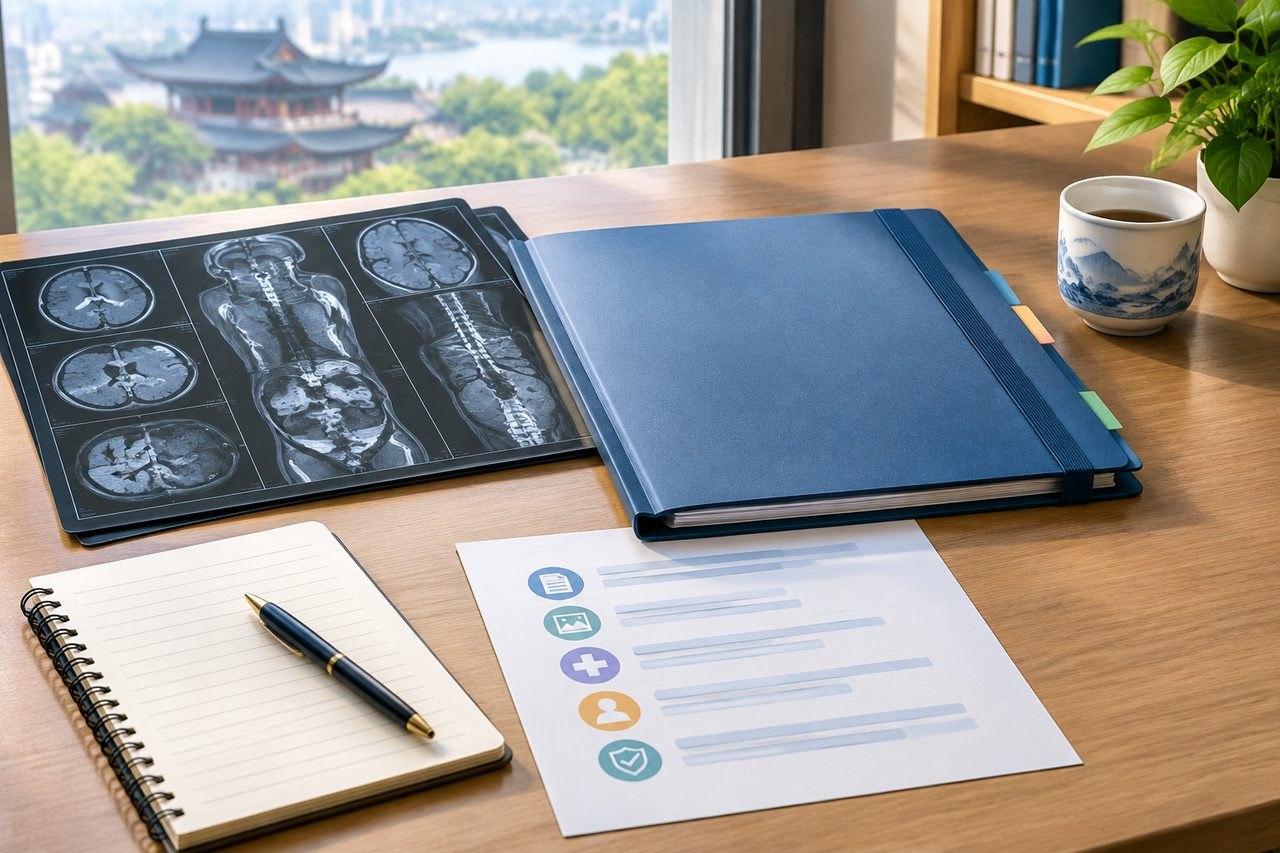
What a whole-body MRI enquiry produces, and what it does not
A whole-body MRI enquiry in China is usually a request for a scan and a report, not a diagnosis you can act on alone. The report describes what the radiologist saw. It may include a conclusion, a comparison with earlier imaging if you supplied it, and a recommendation such as further imaging, a specialist review or no specific action. It does not replace your home doctor's assessment of your symptoms, history and other tests.
That distinction matters for the handover. Your home doctor needs the images and the report, plus enough context to judge whether the findings are new, stable or unrelated to the reason you arranged the scan. If you send only a one-line summary, your doctor cannot confirm what was measured, which sequences were used or whether the comparison is valid. If you send only the images without the report, your doctor has to interpret raw data without the radiologist's reasoning.
So the first handover decision is scope. Ask the provider what the enquiry includes: the scan itself, a written report, access to the images, and any recommendation section. Ask whether the report will be in English, whether a translated summary is available, and whether the radiologist can be contacted for clarification. These are administrative questions, and the answers determine what you can actually pass to your home doctor.
Identify every document before you leave the provider
Identification is where a handover can break down. Two files named scan_report.pdf and images.zip tell your home doctor nothing. Before you leave, ask the provider to confirm the exact document names, the date of the scan, the patient identifiers used, and the name and role of the person who signed the report. Write these down in one place.
Ask specifically for the imaging format. Whole-body MRI images are normally stored as a DICOM dataset, which your home doctor or radiologist can open in standard viewing software. A PDF of selected images is useful for a quick look but is not the same as the full dataset. Ask whether you will receive a disc, a download link or both, and whether the link expires. If it expires, ask how your home doctor can request the images later.
Also ask for the written recommendation as a separate item. Some reports include a conclusion and a recommendation in the same document. Others issue a scan report and a separate clinical note. Knowing which you have prevents your home doctor from assuming a recommendation exists when it does not, or missing one that was issued separately.
A practical identification checklist you can confirm with the provider:
The scan date and the body areas covered.
The report date, author name and author role.
The image format and how long access lasts.
Whether a separate recommendation or follow-up note is issued.
Whether an English version or translation is available.
Write a cover note that tells your home doctor what you need
Your home doctor is busy, and a large file without a clear request is easy to set aside. Write a short cover note that states four things: why you arranged the scan, what you want your doctor to do, what you have already been told, and how to reach the provider if clarification is needed.
The reason matters because it frames the review. If you arranged the scan for a specific symptom, say so. If it was a general check, say that too. Your doctor can then judge whether the findings relate to your concern or are incidental.
The request should be concrete. For example: please review the attached report and images, tell me whether any finding needs follow-up, and advise whether I should repeat or extend any test. Avoid asking your doctor to confirm a diagnosis from the scan alone. Ask for a review and a plan.
The provider contact line should include the hospital or clinic name, the department, the report author if known, and the official contact route. Do not send your doctor a personal mobile number unless the provider has confirmed that clinical questions can be answered that way. A named department contact is more reliable and easier to document.
Keep the cover note to one page. Put the document list at the top so your doctor can see immediately what is attached and what is missing.
Agree who is responsible for the next step
Handover is not complete when the files arrive. It is complete when someone owns the next action. Before you leave China, ask the provider what happens if your home doctor has a question: who answers, through which channel, and within what arrangement. Ask whether the provider can issue a supplementary clarification letter if your home doctor requests one.
At home, confirm with your doctor's office that the package was received and logged. Ask whether the practice needs the images in a different format, whether a radiology review is required, and whether you should book a follow-up appointment to discuss the findings. Do not assume that sending the files starts a review. In many practices, the review happens at a scheduled appointment.
If your home doctor recommends a test or referral based on the scan, that recommendation belongs to your home clinician. The China provider's report is one input. If the two views differ, the useful step is a direct conversation between the clinicians, or a written clarification request, not a second scan arranged on your own.
Name one person on each side. On the China side, that may be the international department or the reporting radiologist's office. On the home side, it may be your general practitioner or the specialist who ordered the review. Write both names into your cover note so neither side has to guess.
Keep the handover auditable and repeatable
Medical records get lost, links expire and formats change. Build a simple archive that you can resend without reconstructing it. Keep one folder with the report, the images, the cover note and a short log of who received what and when.
The log does not need to be elaborate. A single page with dates, names and actions is enough. If your home doctor asks for the images again six months later, you can resend the same package and point to the original request. If the provider issues a clarification, add it to the same folder rather than starting a new one.
Ask the provider whether the report can be reissued or re-downloaded if your copy is lost. Ask whether there is an official records request route for your home doctor to use directly. These questions are administrative, and the answers determine how much you have to manage personally.
Do not edit the report or images. If you need a translation, ask the provider or a qualified translator to produce it and keep the original alongside. A translated summary without the source document is harder for your home doctor to rely on.
If you are planning a checkup in China and want the results to be usable at home, the handover should be designed before the scan, not after. The health checkup planning guide explains how to choose a base package and confirm what the report will include.
What to confirm in writing before you travel home
Before you leave the provider, ask for a written summary of what you will receive and when. This is not a clinical document. It is an administrative confirmation that lists the report, the images, the recommendation if issued, and the contact route for follow-up questions. If the provider cannot confirm a delivery date, ask what the expected process is and who to contact if it is delayed.
Ask whether the report will state the limitations of the scan. A whole-body MRI may not answer every question, and a report that notes what was not assessed helps your home doctor avoid over-reading the findings. If the report does not include this, ask your home doctor to request clarification rather than assume.
Confirm the language of the report and whether an English version is standard or must be requested. If a translation is needed, ask who produces it and whether it is included in the written scope. Do not assume that a report issued in China will automatically be in a language your home doctor reads.
Finally, ask what the provider needs from your home doctor, if anything. Some providers welcome a written question from the receiving clinician. Others prefer to issue a clarification letter. Knowing the preferred route prevents a chain of unanswered emails.
When you get home, send the package once, with the cover note, and confirm receipt. Then book the appointment where the findings will be discussed. The handover is complete when your home doctor has reviewed the material and told you the next step.
If you are still planning the enquiry, start with a short summary of your question and the records you already have. An initial enquiry is free and does not require buying a proxy consultation. The provider will tell you what information is needed and whether a whole-body MRI enquiry is a suitable route for your situation. The hospital decides suitability, and your home doctor remains the person who interprets the findings in the context of your care.
Sources & scope of this guide
References and official service information relevant to this guide.
This is general planning information and has not been individually reviewed by a doctor. Medical decisions and personal treatment advice come from your treating clinicians.