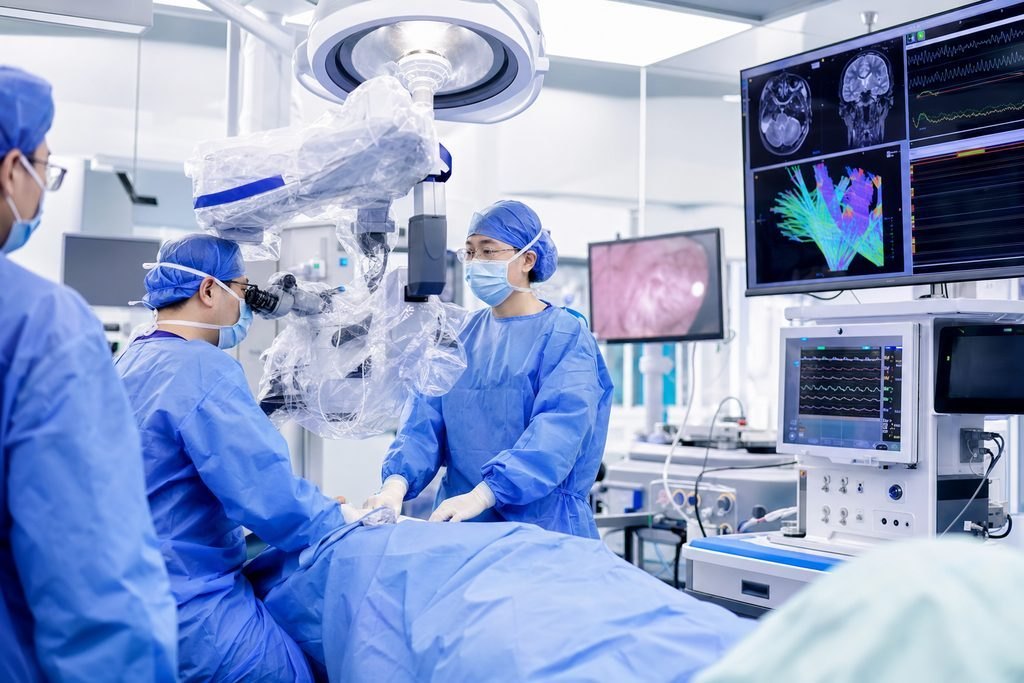
Why imaging and pathology are reviewed together, not separately
A glioma is not one disease. Assessment of an adult central nervous system tumour considers tumour type, site and grade together with the patient's own circumstances, and treatment decisions are individual. That single sentence explains why a surgeon in China cannot give you a meaningful plan from an MRI report alone, or from a pathology report alone.
Imaging describes anatomy. It shows the lesion's location, its size, which lobe or structure it involves, and how close it sits to areas that control speech, movement or vision. That spatial information shapes whether an operation is technically reasonable and what the surgical team would want to protect.
Pathology describes biology. A tissue sample, when one is available, tells the clinical team what kind of tumour this is and how aggressive it appears under the microscope. Type and grade influence what the team expects the tumour to do and what further treatment might be discussed after surgery.
The two are complementary. Imaging without pathology may leave the tumour type uncertain. Pathology without current imaging may leave the surgical team unable to judge what is safely reachable. When you approach a hospital in China, expect the clinical team to want both, plus your clinical history, before offering a view on suitability.
This is also why a records-based opinion is a review, not a final decision. A specialist can discuss what the records suggest and what is missing, but hospital acceptance and the operative plan belong to the treating team after they have assessed you.
What the imaging actually needs to show the surgical team
If you are preparing for a glioma surgery enquiry in China, the imaging question is not simply "do I have an MRI?" It is whether the images the hospital receives are the ones its clinicians can actually read and compare.
A receiving neurosurgical team will typically want to know what sequences were performed, whether contrast was used, and whether the study is recent enough to reflect your current situation. They will also want to see the images themselves, not only the radiologist's written report, because the operative decision depends on the anatomy visible on the scan.
Ask your current hospital what format the images are stored in and whether they can be shared digitally or on disc. Ask whether the report is in English or can be translated. These are practical questions, and the answers determine whether a remote review is possible at all.
It also helps to be clear about what has changed. If you have had more than one scan, the comparison between them may matter more than any single study. Note the dates and bring the earlier images too, not only the latest.
One caution: do not assume that a scan done elsewhere will automatically be accepted as sufficient. Whether additional imaging is needed is a clinical decision for the treating team, and you should ask them directly rather than trying to predict it.
- Which imaging sequences were performed, and was contrast used?
- Are the actual images available, not only the written report?
- What are the dates of each study, and is there an earlier scan for comparison?
- Is the radiology report available in English, or can a translation be arranged?
- Has the treating team said whether it needs additional imaging before deciding?
What pathology adds, and why a sample may not yet exist
Pathology and imaging are often discussed as if they arrive together. In practice, many patients enquiring about glioma surgery in China do not yet have a tissue diagnosis. That is normal, and it changes what a review can and cannot tell you.
If a biopsy or previous operation has already produced a tissue sample, the pathology report becomes central. It identifies the tumour type and grade, and it may include additional testing that the treating team considers relevant. Ask your current hospital for the full report, including any addendum or supplementary studies, not just a summary line.
If no sample exists, the clinical team may still be able to discuss the imaging and your history, but the tumour type and grade may remain uncertain. In that situation, a biopsy may be part of what the treating team proposes before any resection is planned. Whether a biopsy is needed, and when, is a clinical judgement for them.
There is a further practical point. Pathology slides and blocks are physical materials, and hospitals sometimes need the original slides rather than a photocopy of the report for a second review. If you are considering a pathology review in China, ask your current hospital what it can release and in what form.
Do not treat a pathology report from one hospital as automatically final for another. Whether the receiving team accepts it, or wants its own review, is something to confirm with them.
How imaging and pathology shape the surgical goal
The reason both matter is that they feed into the same decision: what is the operation trying to achieve?
For some tumours in some locations, the goal may be as complete a removal as is safe. For others, the goal may be a limited resection or a biopsy to obtain tissue while protecting function. The tumour's site on imaging and its type and grade on pathology both inform that judgement, along with your age, symptoms and general health.
This is why a general description of "glioma surgery" is not enough to plan your care. The same diagnosis can lead to different operations depending on where the tumour sits and what the tissue shows. A surgical team in China will want to make that assessment themselves rather than adopt a plan made elsewhere.
It also means that the question "am I suitable for surgery in China?" cannot be answered from a scan alone. The treating hospital decides suitability after reviewing the records and, in many cases, after seeing you. An initial enquiry does not establish that surgery will be offered.
If you have been told a specific operation is planned, ask what the goal of that operation is and what the alternatives were. That conversation will tell you more about your situation than any general description of the procedure.
What further treatment planning depends on after surgery
Glioma care rarely ends with the operation. Imaging and pathology also shape what is discussed afterwards, which is another reason the treating team wants complete records before forming a view.
The pathology result, including type and grade, is central to any discussion of additional treatment. The extent of surgery visible on post-operative imaging matters too. Together they inform whether further treatment is considered and what kind.
This is not a decision you can make in advance from a distance. It depends on findings that may only become clear after surgery, and on the treating team's assessment of your individual situation. Any plan discussed before surgery is provisional.
For an overseas patient, this has a practical consequence. If you are weighing travel to China for glioma surgery, ask the hospital what it can tell you before you arrive and what will only be decided afterwards. Ask who will discuss the pathology result with you, and in what language.
Do not assume that a plan described at the enquiry stage will be the plan delivered. The treating team's assessment, and the tissue findings, may change it.
Preparing your records and questions before you enquire
The most useful thing you can do before contacting a hospital or coordination service in China is to organise what you already have. You do not need a complete archive to start, but you do need to know what exists.
Begin with a short summary: your main question, your diagnosis if known, and the key dates. Then list the imaging studies you have, the pathology reports if any, and the treatments you have already received. Keep it factual and brief for the first contact.
When you are ready to share more, ask your current hospital for the actual images and the full pathology report, including any supplementary testing. Ask about translation if the documents are not in English. These requests take time, so starting them early is sensible.
Then prepare the questions that only the treating team can answer. What imaging do they need? Do they want the original pathology slides? Is a biopsy likely before any resection? What is the goal of surgery in your case? What will be decided only after the operation? Who will explain the results to you?
Write these down before your appointment. It is easy to lose track of them in a consultation, especially in a second language.
A brief next step: if you would like help understanding which records a Chinese neurosurgical team may ask for, you can send a short summary through the enquiry form or by email. An initial enquiry is free and does not commit you to treatment, travel or a proxy consultation. The hospital, not the coordination team, decides whether surgery is suitable for you.
- A one-paragraph summary of your situation and main question.
- A list of imaging studies with dates and whether images are available.
- Pathology reports, including any supplementary testing, if a sample exists.
- A note of treatments already received and current medications.
- Your written questions for the treating team.
Sources & scope of this guide
References and official service information relevant to this guide.
This is general planning information and has not been individually reviewed by a doctor. Medical decisions and personal treatment advice come from your treating clinicians.