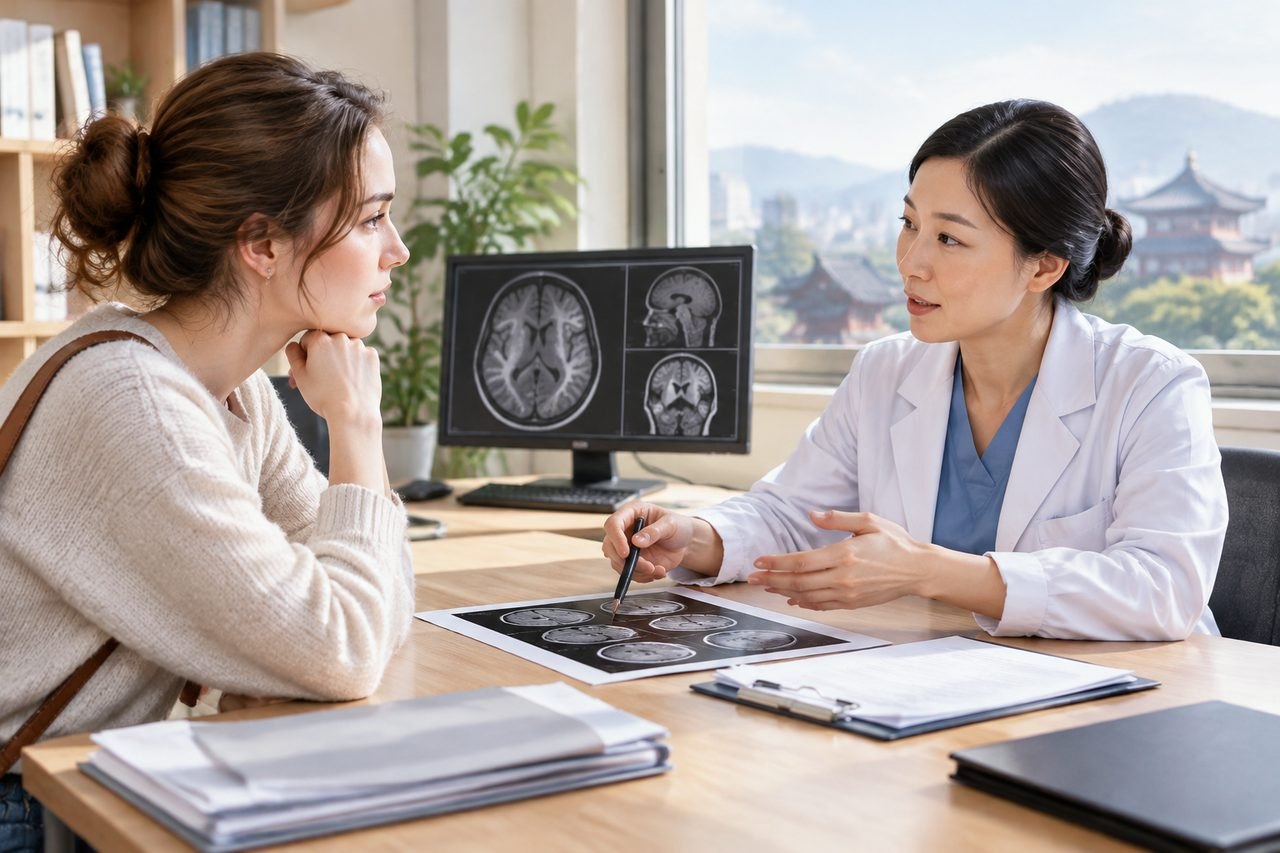
Why the observation-versus-treatment question cannot be answered from an article
A low-grade glioma is not one condition with one correct plan. Assessment of an adult central nervous system tumour considers the tumour type, its site and grade, together with the patient's own circumstances, and treatment decisions are individual. That is the framework a treating team uses. It is also why no article, including this one, can tell you whether you should be observed or treated.
The decision usually turns on details that only your own imaging, pathology and clinical history can supply. Two people with the same reported grade can be in very different situations because of where the tumour sits, what the molecular profile shows, whether there have been changes on serial scans, and what symptoms are present. A clinician who has not seen your files cannot responsibly lean either way.
This guide therefore does not recommend observation or treatment. It explains how to prepare for that conversation in China, what records make the discussion useful, and what to ask so the answer you receive is specific to you rather than general.
The records that make an observation-versus-treatment discussion possible
A useful consultation starts with a complete file, not a summary. The single most valuable item is your MRI series itself, not just the radiologist's report. Bring the actual images on disc or through a secure link, with the dates, so the team can compare one scan against the next. Reports describe what someone saw; the images let a new team form its own view of size, location and any change over time.
Pathology matters just as much. If a biopsy or resection has been done, the pathology report and, where available, the molecular or genomic results are central to how a low-grade glioma is understood and discussed. If no tissue diagnosis exists yet, say so clearly rather than leaving the team to assume one was done. The absence of a molecular diagnosis is itself a fact that shapes the conversation.
Alongside imaging and pathology, gather your clinical history in plain terms: when symptoms began, what they are, what has changed, and any seizures and their pattern. List current medicines with doses. Include relevant blood results, any genetic or hereditary information you have, and a short note of your main question in your own words. A one-page timeline of scans and procedures helps the team see the trajectory quickly.
Keep this as a checklist you can actually assemble before travel. The point is not to send everything immediately, but to know what you have and what is missing, so the first clinical conversation is about your case rather than about locating documents.
- MRI images with dates, not only the written reports
- Pathology report and any molecular or genomic results
- Operative notes if surgery or biopsy has already occurred
- Symptom history, including seizures and any change over time
- Current medicines with doses and relevant blood results
- A one-page timeline of scans, procedures and key dates
Molecular diagnosis: why it changes the questions you ask
For gliomas, the molecular profile has become part of how tumours are classified and discussed, and it can influence what a team considers relevant. You do not need to interpret these results yourself. You do need to know whether they exist, whether they are complete, and whether the receiving team considers them sufficient or wants the tissue reviewed again.
This is a common gap. A patient arrives with a pathology report from an earlier biopsy that predates current molecular testing, or with results that were never finalised. Rather than guessing, ask directly: does the team have everything it needs to characterise this tumour, or would additional review of the existing tissue be useful? That question is administrative and clinical at once, and it belongs to the treating pathologist and clinician, not to a coordination service.
If molecular testing has not been done, ask whether it is relevant in your case and what it would involve. Do not assume it is required for everyone, and do not assume it is unavailable. The honest position is that you do not yet know, and the team can tell you.
Serial MRI: what 'change' means and who decides
Observation, where it is chosen, depends on being able to compare scans over time. That makes the quality and comparability of your imaging important. Scans done at different hospitals with different protocols can be harder to compare than a consistent series, and a team may want to repeat imaging on its own equipment before drawing conclusions.
When you discuss your case, ask how the team reads change: what features they look at, and what would prompt them to reconsider a plan of observation. You are not asking for a prediction. You are asking what monitoring would involve, who reviews the scans, and how findings would be communicated to you. If you are based abroad, ask how follow-up imaging could be arranged and shared, and whether that is realistic for you.
Be cautious about drawing your own conclusions from a report that says 'stable' or 'slightly increased'. Those words carry different weight depending on the full picture, and only the treating team can interpret them in your case. Bring the images and let them do that.
Questions to put to the treating team in China
A focused question list keeps the consultation on your decision rather than on general information. Ask what the team understands your diagnosis to be, including grade and molecular features, and whether they agree with the earlier assessment or want to review the tissue. Ask what they would recommend and, importantly, why, so you hear the reasoning rather than only the conclusion.
If observation is discussed, ask what it would involve in practice: what monitoring, how often, and what would trigger a change in plan. If treatment is discussed, ask what the options are, what each is intended to achieve, and what the alternatives and trade-offs are. Ask what the team needs from you to move forward, and what remains uncertain.
You are entitled to ask about risks and about what is known regarding outcomes in situations like yours. A responsible clinician can discuss evidence-based risk and the limits of what is known without guaranteeing any individual result. Write your questions down and take notes or arrange interpretation so you leave with clear answers.
One practical point: ask who will make the final recommendation and who you would contact with later questions. Knowing the responsible clinician and the route for follow-up prevents your case from drifting between departments.
- What is my diagnosis, including grade and molecular features?
- Do you agree with the earlier assessment, or should the tissue be reviewed?
- What do you recommend, and what is the reasoning behind it?
- If observation: what monitoring, how often, and what would change the plan?
- If treatment: what options, what is each intended to achieve, and what are the trade-offs?
- What do you still need from me, and what remains uncertain?
- Who is responsible for my case, and how do I follow up?
Planning the China visit and the next step
Once you know what your records contain and what you want to ask, the practical arrangements become clearer. A neurosurgical or neuro-oncology consultation in China can be requested through a public tertiary hospital or a private international hospital, and the route affects language support, scheduling and cost. Ask what each route involves before deciding, and confirm what the hospital itself requires in terms of records and appointment registration.
Do not assume that a remote review settles your case. A records-based opinion can help you understand the options and prepare questions, but suitability, hospital acceptance and any treatment decision belong to the treating hospital and licensed clinicians. If your symptoms are worsening, or you have new or uncontrolled seizures or other urgent problems, seek local medical care first rather than waiting on an overseas enquiry.
If you would like help assembling your records, requesting a specialist appointment, or arranging interpretation for the consultation, ChinaSpecialistCare can assist with that coordination. An initial enquiry is free and asks only for a brief summary, not a complete medical archive; you can share records after first contact. You do not need to purchase a proxy consultation to make an enquiry, and coordination fees are separate from hospital medical fees.
The next step is simple: gather your MRI images, pathology and molecular results, and write your top three questions. Then make contact and let the clinical team tell you what applies to your tumour and your situation.
Sources & scope of this guide
References and official service information relevant to this guide.
This is general planning information and has not been individually reviewed by a doctor. Medical decisions and personal treatment advice come from your treating clinicians.