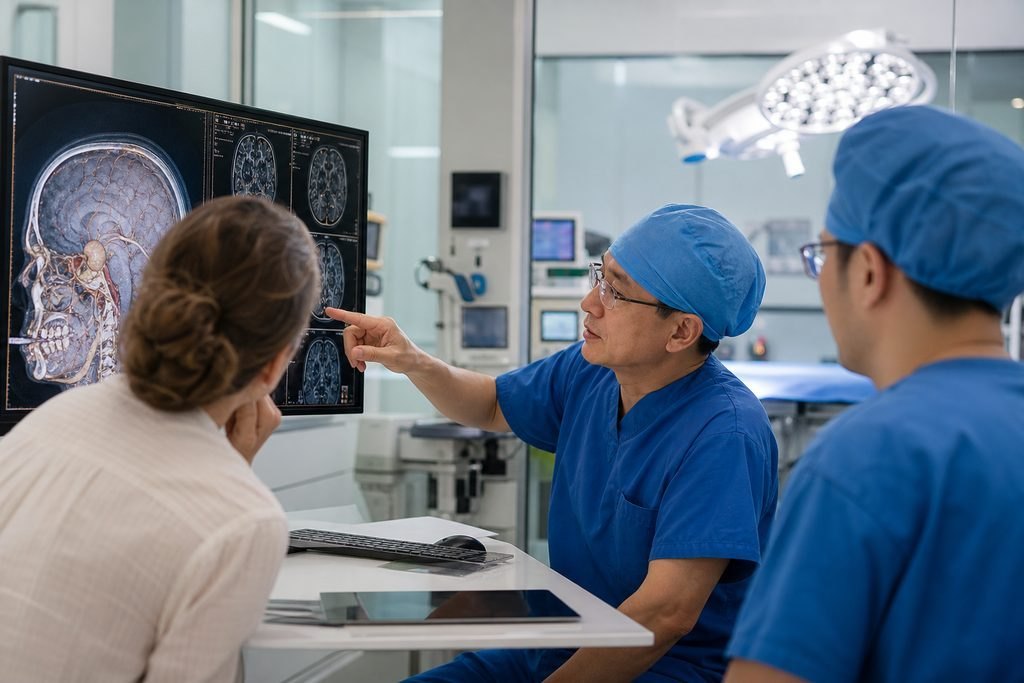
What a parallel review can and cannot change
The practical value of a second look at a low-grade glioma is not a new diagnosis. It is a check on the sequence: whether the molecular profile has been read the way another centre would read it, whether the serial MRI changes are being interpreted the same way, and whether the balance between observation and treatment still looks reasonable to a team that reviews this tumour type.
That is a records-based opinion. It cannot examine you, cannot run its own scan on the day, and cannot take over your care from a distance. It also cannot tell you that your current plan is wrong. What it can do is give you a written view on the same evidence your local team already has, which you then discuss with the clinicians who know you.
This distinction matters because patients sometimes treat a remote opinion as a decision. It is not. The treating hospital in your own country remains responsible for what happens next, and any change to observation intervals, imaging schedules or treatment should come from that team after they have seen the review.
The records that make a glioma review useful
A low-grade glioma review lives or dies on the file. A remote opinion tends to come back vague when the reviewer received a summary letter instead of the underlying material. Ask your local hospital what it can release, and in what format, before you approach anyone in China.
Imaging is the first pillar. You want the actual DICOM files from your MRI series, not photographs of a screen and not only the radiologist's report. A reviewer needs to compare the earliest available scan with the most recent one to judge change over time. If your hospital can put the series on discs or a secure transfer link, that is far more useful than a PDF.
Pathology is the second pillar. For a glioma, the tissue diagnosis and the molecular markers reported alongside it shape how any centre thinks about the case. Ask for the pathology report in full, including any molecular or genomic sections, and ask whether slides or blocks can be requested if a re-read is ever needed. You do not have to decide about a re-read now; you just need to know it is possible.
The third pillar is the clinical narrative: your symptoms and when they started, seizure history if relevant, current medicines with doses, the dates of every scan, and any surgery or biopsy already performed with its date and outcome. A short typed timeline you write yourself is often more useful to a reviewer than a thick folder of unrelated paperwork.
- MRI DICOM files covering the full series, earliest to most recent, with scan dates
- Full pathology report including molecular or genomic sections, plus whether slides or blocks are retrievable
- A one-page timeline: symptom onset, biopsy or surgery dates, treatment dates, scan dates
- Current medicines with doses and who prescribed them
- The specific question you want answered, written in one or two sentences
Observation versus treatment: what to ask, not what to assume
Many low-grade glioma patients are in a monitoring phase, and that is exactly when a parallel review feels most uncertain. Nothing is actively happening, so it is tempting to look for a centre that will act. Be careful here. A remote reviewer who has never examined you is in a poor position to recommend earlier intervention, and a reviewer who recommends waiting is not carrying the risk of waiting with you.
The better use of a review in this phase is to test the reasoning. Ask whether the imaging interval your local team has set is consistent with the behaviour seen on your serial scans. Ask what features on those scans would change the plan. Ask whether the molecular profile has any bearing on how closely you should be watched. These are questions a reviewer can answer from records, and the answers are useful to your local team even if they disagree.
Assessment of an adult central nervous system tumour considers tumour type, site and grade together with the patient's own circumstances, and treatment decisions are individual. That is the frame to bring to any review: not a protocol to be applied, but a judgement to be compared.
How to keep your local team in charge
The single most useful thing you can do before contacting anyone in China is tell your local clinician that you are seeking a records-based opinion. This is not a confrontation. Most treating teams are comfortable with a second read, and some will help you assemble the file faster than you could alone.
Be explicit about roles when you write to a Chinese service. State that your local team remains responsible for your care, that you are seeking a written opinion on the records, and that you will share the result with your local clinician before anything changes. That framing removes a frequent misunderstanding on both sides.
When the opinion arrives, take it to your local team rather than acting on it yourself. Ask them directly: does this change anything, and if not, why not? A disagreement between two centres is information, not a crisis. It usually means the case sits in a grey area, which is worth knowing.
If your local team is already planning a biopsy, surgery or radiotherapy, do not delay it to wait for an overseas reply. A review can be arranged around a scheduled procedure, and a preliminary reply that arrives after treatment has started is still useful for what comes next.
What a Chinese neurosurgery service can realistically offer
For an overseas patient, the realistic route is a records-based neurosurgical opinion, followed by an appointment request only if you and your local team decide that travelling makes sense. A glioma surgery service in China reviews imaging, pathology and clinical history, and can discuss whether the case is one they would manage differently and what they would need to see you in person.
What no service can promise in advance is acceptance, a specific surgeon, a specific date, or that treatment in China will be recommended at all. Those decisions belong to the hospital and its clinicians after they have seen your records. A review that concludes your current plan is appropriate is a legitimate and useful outcome, not a failed enquiry.
If you do decide to explore care in China further, the practical questions are about scope rather than price. Ask what the review includes, who reads the file, what format the written opinion takes, whether it will be in English, and what additional records would be needed before any in-person appointment could be considered. Get those answers in writing before you commit to anything.
ChinaSpecialistCare can help with a free initial case review, records handling, interpretation and specialist appointment requests for glioma cases. We do not diagnose, prescribe or decide suitability, and an enquiry does not require buying a proxy consultation. Hospital medical fees and our coordination fees are separate.
Next step
Start with your local team. Ask what imaging and pathology material they can release to you, and tell them you are seeking a records-based opinion from a Chinese neurosurgery service. Then send a short summary of the case and your specific question through the enquiry form, email or WhatsApp. An initial enquiry is free, and you can share fuller records after first contact. Do not pause observation, medication or a scheduled procedure while you wait for a reply.
Sources & scope of this guide
References and official service information relevant to this guide.
This is general planning information and has not been individually reviewed by a doctor. Medical decisions and personal treatment advice come from your treating clinicians.